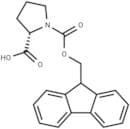
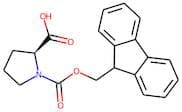
CAS 71989-31-6
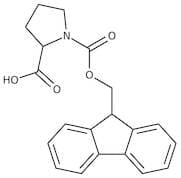
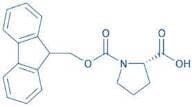
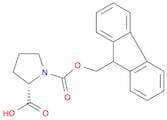
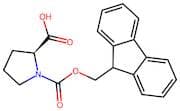
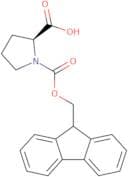
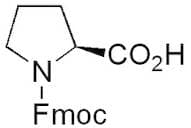
:Fmoc-Pro-OH
- (2S)-1-[(9H-Fluoren-9-ylmethoxy)carbonyl]pyrrolidine-2-carboxylic acid
- (2S)-1-[[(9H-Fluoren-9-yl)methoxy]carbonyl]pyrrolidine-2-carboxylic acid
- (S)-N-(9-Fluorenylmethoxycarbonyl)proline
- (S)-hidrogenopirrolidina-1,2-dicarboxilato de 1-(9H-fluoren-9-ilmetilo)
- (S)-hydrogenopyrrolidine-1,2-dicarboxylate de 1-(9H-fluorene-9-ylmethyle)
- 1,2-Pyrrolidinedicarboxylic acid, 1-(9H-fluoren-9-ylmethyl) ester, (S)-
- 1-(9H-fluoren-9-ylmethyl) hydrogen (S)-pyrrolidine-1,2-dicarboxylate
- 1-(9H-fluoren-9-ylmethyl)-(S)-hydrogenpyrrolidin-1,2-dicarboxylat
- Fluorenylmethoxycarbonylproline
- Fmoc-<span class="text-smallcaps">L</span>-Pro-OH
- Fmoc-<span class="text-smallcaps">L</span>-proline
- Fmoc-L-proline
- Fmoc-Pro-OH
- N-(9-Fluorenylmethoxycarbonyl)-<span class="text-smallcaps">L</span>-proline
- N-(9-Fluorenylmethoxycarbonyl)-L-proline
- N-(9-Fluorenylmethoxycarbonyl)proline
- N-FMOC-<span class="text-smallcaps">L</span>-proline
- N-FMOC-L-proline
- Nsc 334294
- See more synonyms
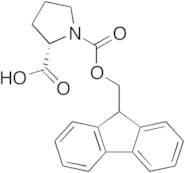
N-[(9H-Fluoren-9-ylmethoxy)carbonyl]-L-proline
CAS:Formula:C20H19NO4Purity:>98.0%(T)(HPLC)Color and Shape:White to Almost white powder to crystalMolecular weight:337.38N-Fmoc-L-proline, 98%
CAS:It is used as pharmaceutical intermediate. Fmoc method is used for the synthesis of the new polymeric support for the preparation of C-terminal peptide amides. This Thermo Scientific Chemicals brand product was originally part of the Alfa Aesar product portfolio. Some documentation and label informFormula:C20H19NO4Purity:98%Color and Shape:Crystals or powder or crystalline powder, White to pale creamMolecular weight:337.38Fmoc-Pro-OH
CAS:M03372 - Fmoc-Pro-OH
Formula:C20H19NO4Purity:98%Color and Shape:Solid, Crystalline or PowderMolecular weight:337.375Fmoc-Pro-OH
CAS:Bachem ID: 4003150.
Formula:C20H19NO4Purity:99.8%Color and Shape:WhiteMolecular weight:337.38Ref: IN-DA003QO0
5kgTo inquire5g21.00€10g25.00€25g25.00€50g37.00€100g53.00€250g93.00€500g141.00€1kg179.00€Fmoc-L-Proline, 10mM (in DMSO)
CAS:Fmoc-L-Proline, 10mM (in DMSO)Formula:C20H19NO4Purity:≥98%Molecular weight:337.37Fmoc-L-Proline
CAS:Fmoc-L-Proline (Fmoc-Pro-OH) is a proline derivative.Formula:C20H19NO4Purity:99.22%Color and Shape:SolidMolecular weight:337.37Fmoc-Pro-OH
CAS:Formula:C20H19NO4Purity:≥ 99.0%Color and Shape:White to off-white or pale yellow crystalline powderMolecular weight:337.38FMOC-Pro-OH
CAS:FMOC-Pro-OHFormula:C20H19NO4Purity:98%Color and Shape: white to off white powderMolecular weight:337.37g/molFmoc-Pro-OH
CAS:Fmoc-Pro-OH is a synthetic cyclic peptide with the amino acid sequence (Fmoc-Lys-Lys-Ala-Glu)n. Fmoc-Pro-OH binds to the androgen receptor and can be used as a research tool to identify other molecules that bind to the same receptor. It has been shown to inhibit the activity of ester hydrochloride, trifluoroacetic acid, and superparamagnetic iron in coordination complexes.Formula:C20H19NO4Purity:Min. 95 Area-%Color and Shape:White Off-White PowderMolecular weight:337.37 g/molFmoc-Pro-OH
CAS:Fmoc-Pro-OH is a peptide that contains the Fmoc protecting group. It is used in the synthesis of peptides and has been shown to be effective against microbial infections with marine sponges. The synthesis of this compound can be carried out on an on-line automated peptide synthesizer. The Fmoc protecting group is removed by treatment with trifluoroacetic acid (TFA) in dichloromethane, which leaves the side chain unprotected. This compound has a high binding affinity for the receptor site of fibrinogen and can potentially inhibit the growth of bacteria that cause bacterial infection, such as Staphylococcus aureus and Pseudomonas aeruginosa.
Fmoc-Pro-OH can also be used to synthesize other functional groups such as sulfamoyl groups or acetonitrile groups, depending on the desired outcome.Formula:C20H19NO4Purity:Min. 98 Area-%Molecular weight:337.38 g/molFMOC-L-Proline extrapure, 99%
CAS:Formula:C20H19NO4Purity:min. 99%Color and Shape:White to Off white, Crystalline powderMolecular weight:337.38L-Proline-N-Fmoc
CAS:Controlled ProductApplications L-Proline-N-Fmoc is N-Fmoc protected L-Proline (P755995) which is an amino acid and precursor (with vitamin C) for collagen, the building block of the structure of tendons, ligaments, arteries, veins and muscles. It is important in wound healing.
References Bondarenko, L.B., et al.: Int. J. Peptides., 2, 1687 (2012); Rimer, T., et al.: Biomacromolecules, 13, 2110 (2012);Formula:C20H19NO4Color and Shape:NeatMolecular weight:337.37L-Proline-d3-N-Fmoc
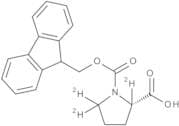
CAS:Controlled ProductApplications L-Proline-d3-N-Fmoc was used to prepare potent bombesin-like peptides for GRP-receptor targeting of tumors. It was also used to synthesize tetrapeptide aldehyde inhibitors of dengue virus NS3 protease.
References Nock, B., et al.: J. Med. Chem., 48, 100 (2005); Yin, Z., et al.: Bioorg. Med. Chem. Lett., 16, 40 (2006)Formula:C20D3H16NO4Color and Shape:NeatMolecular weight:340.39
![N-[(9H-Fluoren-9-ylmethoxy)carbonyl]-L-proline](/_next/image/?url=https%3A%2Fstatic.cymitquimica.com%2Fproducts%2F3B%2Fthumb%2FF0298.jpg&w=3840&q=75)