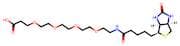
![4,7,10,13-Tetraoxa-16-azaheneicosanoicacid, 21-[(3aS,4S,6aR)-hexahydro-2-oxo-1H-thieno[3,4-d]imida…](/_next/image/?url=https%3A%2Fstatic.cymitquimica.com%2Fcas-image%2Fthumb-webp%2F307440-471013-tetraoxa-16-azaheneicosanoicacid-21-3as-4s-6ar-hexahydro-2-oxo-1h-thieno-34-d-imidazol-4-yl-17-oxo.webp&w=3840&q=75)
CAS 721431-18-1
:4,7,10,13-Tetraoxa-16-azaheneicosanoicacid, 21-[(3aS,4S,6aR)-hexahydro-2-oxo-1H-thieno[3,4-d]imidazol-4-yl]-17-oxo-
Description:
4,7,10,13-Tetraoxa-16-azaheneicosanoic acid, with the CAS number 721431-18-1, is a complex organic compound characterized by its unique structural features, including multiple oxygen and nitrogen atoms within its molecular framework. This compound contains a long carbon chain, which contributes to its hydrophobic properties, while the presence of tetraoxa and azaheneicosanoic acid functional groups imparts hydrophilicity and potential reactivity. The thieno[3,4-d]imidazole moiety suggests biological activity, possibly indicating its role in medicinal chemistry or as a pharmacophore. The stereochemistry, indicated by the specific configuration of the hexahydro-2-oxo group, may influence its biological interactions and efficacy. Overall, this compound's intricate structure suggests potential applications in drug development, particularly in targeting specific biological pathways or functions. Further studies would be necessary to elucidate its full chemical behavior, stability, and potential therapeutic uses.
Formula:C21H37N3O8S
Synonyms:- 15-[D(+)-Biotinylamino]-4,7,10,13-Tetraoxapentadecanoic Acid
Sort by
Purity (%)
0
100
|
0
|
50
|
90
|
95
|
100
Found 9 products.
Biotin-PEG4-propionic Acid
CAS:Formula:C21H37N3O8SPurity:>98.0%(T)Color and Shape:White to Light yellow powder to crystalMolecular weight:491.6015-[D-(+)-Biotinylamino]-4,7,10,13-tetraoxapentadecanoic acid
CAS:Formula:C21H37N3O8SPurity:97%Color and Shape:SolidMolecular weight:491.5988Ref: IN-DA005JT7
5gTo inquire10gTo inquire50gTo inquire25mg51.00€50mg63.00€100mg75.00€250mg111.00€1g245.00€Biotin-PEG4-acid
CAS:Biotin-PEG4-acid is a PEG-based linker for PROTACs which joins two essential ligands, crucial for forming PROTAC molecules.Formula:C21H37N3O8SColor and Shape:SolidMolecular weight:491.6Biotin-PEG4-propionic acid
CAS:Biotin-PEG4-propionic acid is a PEG compound with two different functional groups (also known as heterobifunctional). Unlike homobifunctional PEG compounds (same functional group on both ends), this type of compounds are more versatile as have two different anchor points. Biotin-PEG4-propionic acid is used as a linker and spacer to add a PEG moiety, via pegylation (a bioconjugation technique) to proteins, peptides, oligonucleotides, small molecules and nanoparticles.Formula:C21H37N3O8SPurity:Min. 95%Color and Shape:PowderMolecular weight:491.6 g/moldPEG®24-Biotin Acid
CAS:dPEG®24-Biotin Acid is a PEG compound with two different functional groups (also known as heterobifunctional). Unlike homobifunctional PEG compounds (same functional group on both ends), this type of compounds are more versatile as have two different anchor points. dPEG®24-Biotin Acid is used as a linker and spacer to add a PEG moiety, via pegylation (a bioconjugation technique) to proteins, peptides, oligonucleotides, small molecules and nanoparticles.Formula:C61H117N3O28SPurity:Min. 95%Molecular weight:1,325.6 g/moldPEG®4 Biotin Acid
CAS:dPEG®4 Biotin Acid is a PEG compound with two different functional groups (also known as heterobifunctional). Unlike homobifunctional PEG compounds (same functional group on both ends), this type of compounds are more versatile as have two different anchor points. dPEG®4 Biotin Acid is used as a linker and spacer to add a PEG moiety, via pegylation (a bioconjugation technique) to proteins, peptides, oligonucleotides, small molecules and nanoparticles.
Purity:Min. 95%Molecular weight:491.6 g/moldPEG®48-Biotin Acid
CAS:dPEG®48-Biotin Acid is a PEG compound with two different functional groups (also known as heterobifunctional). Unlike homobifunctional PEG compounds (same functional group on both ends), this type of compounds are more versatile as have two different anchor points. dPEG®48-Biotin Acid is used as a linker and spacer to add a PEG moiety, via pegylation (a bioconjugation technique) to proteins, peptides, oligonucleotides, small molecules and nanoparticles.Formula:C112H218N4O53SPurity:Min. 95%Molecular weight:2,500.99 g/mol
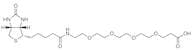

![15-[D-(+)-Biotinylamino]-4,7,10,13-tetraoxapentadecanoic acid](/_next/image/?url=https%3A%2Fstatic.cymitquimica.com%2Fproducts%2FIN%2Fthumb%2FDA005JT7.jpg&w=3840&q=75)