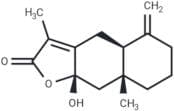
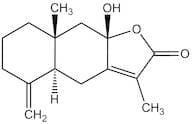
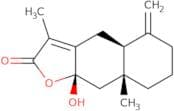
CAS 73030-71-4
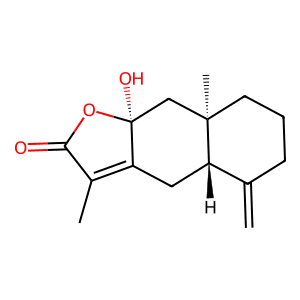
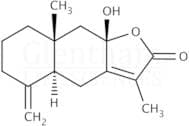
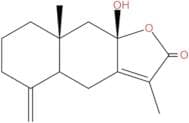
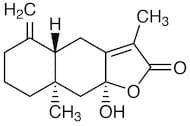
:Atractylenolide III
Description:
Atractylenolide III is a bioactive compound primarily derived from the roots of the traditional Chinese medicinal herb Atractylodes macrocephala. It belongs to the class of sesquiterpenes and is characterized by its unique chemical structure, which contributes to its various pharmacological properties. This compound is known for its potential anti-inflammatory, anti-cancer, and immunomodulatory effects, making it of interest in both traditional medicine and modern pharmacological research. Atractylenolide III exhibits a range of biological activities, including the ability to inhibit certain enzymes and modulate signaling pathways, which may contribute to its therapeutic effects. Additionally, it has been studied for its protective effects against oxidative stress and its role in enhancing immune responses. The compound is typically extracted and purified for research purposes, and its safety profile is generally considered favorable, although further studies are needed to fully understand its mechanisms of action and potential applications in clinical settings.
Formula:C15H20O3
InChI:InChI=1/C15H20O3/c1-9-5-4-6-14(3)8-15(17)12(7-11(9)14)10(2)13(16)18-15/h11,17H,1,4-8H2,2-3H3/t11-,14+,15-/m0/s1
InChI key:InChIKey=FBMORZZOJSDNRQ-GLQYFDAESA-N
SMILES:O[C@@]12C(C[C@@]3([C@@](C)(C1)CCCC3=C)[H])=C(C)C(=O)O2
Synonyms:- (4aS,8aR,9aS)-4a,5,6,7,8,8a,9,9a-Octahydro-9a-hydroxy-3,8a-dimethyl-5-methylenenaphtho[2,3-b]furan-2(4H)-one
- (4aS,8aR,9aS)-9a-hydroxy-3,8a-dimethyl-5-methylidene-4a,5,6,7,8,8a,9,9a-octahydronaphtho[2,3-b]furan-2(4H)-one
- 8β-Hydroxyasterolide
- Atractylenolide III
- Atractylenolide β
- Codonolactone
- Naphtho(2,3-b)furan-2(4H)-one, 4a,5,6,7,8,8a,9,9a-octahydro-9a-hydroxy-3,8a-dimethyl-5-methylene-, (4aS,8aR,9aS)-
- Naphtho[2,3-b]furan-2(4H)-one, 4a,5,6,7,8,8a,9,9a-octahydro-9a-hydroxy-3,8a-dimethyl-5-methylene-, [4aS-(4aα,8aβ,9aβ)]-
- Atractylenolide III, BR
- (4aS,8aR,9aS)-9a-Hydroxy-3,8a-dimethyl-5-methylidene-4,4a,6,7,8,9-hexahydrobenzo[f][1]benzoxol-2-one
- Atractylenolide beta
- 8-HYDROXYASTEROLIDE
- ICodonolactone
- Atracylenolide III
- ATRACTYLENOLIDE
- (4aS)-4a,5,6,7,8,8a,9,9a-Octahydro-9aβ-hydroxy-3,8aβ-dimethyl-5-methylenenaphtho[2,3-b]furan-2(4H)-one
- Atractylenolide III (ICodonolactone
- Atractylenolide III USP/EP/BP
- See more synonyms
Sort by
Purity (%)
0
100
|
0
|
50
|
90
|
95
|
100
Found 9 products.
Naphtho[2,3-b]furan-2(4H)-one,4a,5,6,7,8,8a,9,9a-octahydro-9a-hydroxy-3,8a-dimethyl-5-methylene-,(4aS,8aR,9aS)-
CAS:Formula:C15H20O3Purity:98%Color and Shape:SolidMolecular weight:248.3175Atractylenolide III
CAS:Atractylenolide III is the major bioactive component of Atractylodes lancea, it inhibits histamine release, suppresses activation of p38 mitogen-activated protein kinase, C-Jun-N-terminal protein kinase, and nuclear factor-κB in stimulated HMC-1 cells, and suppresses the activation of caspase-1 and the expression of receptor interacting protein-2, suggests that atractylenolide III may control immunological reactions by regulating the cellular functions of IL-6 in mast cells.Formula:C15H20O3Purity:95%~99%Color and Shape:White cryst.Molecular weight:248.322Atractylenolide III
CAS:Formula:C15H20O3Purity:>98.0%(T)(HPLC)Color and Shape:White to Light yellow powder to crystalMolecular weight:248.32Atractylenolide III
CAS:Atractylenolide III could treat cognitive issues and lung cancer by modulating apoptosis factors.Formula:C15H20O3Purity:99.53% - 99.82%Color and Shape:SolidMolecular weight:248.32Ref: TM-T3902
2mg37.00€5mg52.00€1mL*10mM (DMSO)58.00€10mg82.00€25mg120.00€50mg170.00€100mg255.00€200mg378.00€Atractylenolide iii
CAS:LactoneFormula:C15H20O3Purity:≥ 98.0 % (HPLC)Color and Shape:PowderMolecular weight:248.32AtractylenolideIII
CAS:Atractylenolide III is a sesquiterpene lactone, which is derived from the rhizomes of Atractylodes macrocephala, a plant commonly used in traditional Chinese medicine. With its origin in botanical sources, the compound is notable for its diverse biological activities and mechanisms of action. Atractylenolide III exerts its effects primarily through the modulation of various signaling pathways, including anti-inflammatory, anti-cancer, and immunomodulatory pathways. It inhibits the production of pro-inflammatory cytokines and regulates the expression of key signaling proteins, thus impacting cellular processes such as proliferation, apoptosis, and differentiation. The compound shows promise in the treatment of conditions like cancer, inflammation, and immune disorders. Researchers continue to explore its potential benefits, seeking to elucidate the molecular mechanisms underlying its therapeutic effects and to optimize its application in various biomedical fields.Purity:Min. 95%
![Naphtho[2,3-b]furan-2(4H)-one,4a,5,6,7,8,8a,9,9a-octahydro-9a-hydroxy-3,8a-dimethyl-5-methylene-,(…](/_next/image/?url=https%3A%2Fstatic.cymitquimica.com%2Fproducts%2FIN%2Fthumb%2FDA00ICC9.jpg&w=3840&q=75)