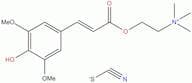
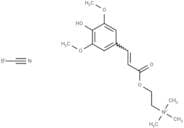
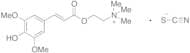
CAS 7431-77-8
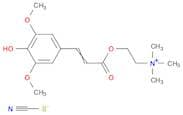
:Sinapinethiocyanate
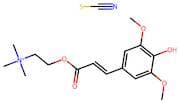
- Sinapine thiocyanate
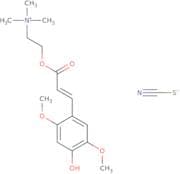
2-((3-(4-Hydroxy-2,5-Dimethoxyphenyl)Acryloyl)Oxy)-N,N,N-Trimethylethanaminium Thiocyanate
CAS:2-((3-(4-Hydroxy-2,5-Dimethoxyphenyl)Acryloyl)Oxy)-N,N,N-Trimethylethanaminium ThiocyanatePurity:98+%Molecular weight:368.45g/molSinapine thiocyanate
CAS:Sinapine thiocyanate has antioxidant activities and is hepatoprotective in a dose-dependent manner, implies that Brassica rapa seeds could be developed as a functional food for hepatoprotection.Formula:C16H24NO5Purity:95%~99%Molecular weight:310.369Sinapine thiocyanate
CAS:Sinapine Thiocyanate, is a derivative of Sinapine (S486605), an alkaloidal amine found in black mustard seeds.Formula:C16H24NO5·CNSPurity:99.79% - ≥95%Color and Shape:SolidMolecular weight:368.45Sinapine Thiocyanate
CAS:Stability Hygroscopic
Applications Sinapine Thiocyanate, is a derivative of Sinapine (S486605), an alkaloidal amine found in black mustard seeds. It is the choline ester of Sinapic Acid (S486800).It is also a phenolic-chloine conjugates, acting as anti-oxidants and acetylcholinesterase inhibitors, that can be used for the treatment of Alzheimer’s disease (AD).
References Tzagoloff, A., et al.: plant Physiology, 38, 202 (1963); Karvela, E., et al.: Food Chem., 110, 263 (2008),Formula:C16H24NO5·CNSColor and Shape:Off White SolidMolecular weight:368.452-((3-(4-Hydroxy-2,5-dimethoxyphenyl)acryloyl)oxy)-N,N,N-trimethylethanaminium thiocyanate
CAS:Formula:C17H24N2O5SPurity:≥98%Molecular weight:368.45Sinapine thiocyanate
CAS:Sinapine thiocyanate is an alkaloid derivative, which is a naturally occurring compound primarily found in the seeds of cruciferous plants. It functions as an ester formed between sinapic acid and choline, which plays a role in plant metabolism. The compound is a modification of sinapine, linked with thiocyanate ions, conferring distinct biochemical properties.
Formula:C16H24NO5·CNSPurity:Min. 95%Color and Shape:Off-White PowderMolecular weight:368.45 g/molRef: 3D-FS73993
Discontinued product