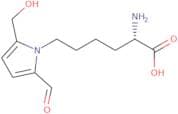
![6-[2-formyl-5-(hydroxymethyl)-1H-pyrrol-1-yl]-L-norleucine](/_next/image/?url=https%3A%2Fstatic.cymitquimica.com%2Fcas-image%2Fthumb-webp%2F392776-pyrraline.webp&w=3840&q=75)
CAS 74509-14-1
:6-[2-formyl-5-(hydroxymethyl)-1H-pyrrol-1-yl]-L-norleucine
Description:
6-[2-formyl-5-(hydroxymethyl)-1H-pyrrol-1-yl]-L-norleucine, with the CAS number 74509-14-1, is a chemical compound that features a pyrrole ring substituted with a formyl group and a hydroxymethyl group, along with an amino acid structure derived from L-norleucine. This compound is characterized by its unique structural components, which include a five-membered nitrogen-containing heterocycle (the pyrrole) and an amino acid backbone. The presence of the formyl group suggests potential reactivity in condensation reactions, while the hydroxymethyl group may contribute to its solubility and interaction with biological systems. The L-norleucine moiety indicates that this compound is an amino acid derivative, which may influence its biological activity and potential applications in pharmaceuticals or biochemistry. Overall, the combination of these functional groups suggests that this compound could exhibit interesting properties, including potential roles in biochemical pathways or as a building block in synthetic chemistry.
Formula:C12H18N2O4
InChI:InChI=1/C12H18N2O4/c13-11(12(17)18)3-1-2-6-14-9(7-15)4-5-10(14)8-16/h4-5,7,11,16H,1-3,6,8,13H2,(H,17,18)/t11-/m0/s1
InChI key:InChIKey=VTYFITADLSVOAS-NSHDSACASA-N
SMILES:C(CCC[C@@H](C(O)=O)N)N1C(CO)=CC=C1C=O
Synonyms:- Pyrraline
- 1H-Pyrrole-1-hexanoic acid, α-amino-2-formyl-5-(hydroxymethyl)-, (αS)-
- ε-Pyrrolyllysine
- 1H-Pyrrole-1-hexanoic acid, α-amino-2-formyl-5-(hydroxymethyl)-, (S)-
- (αS)-α-Amino-2-formyl-5-(hydroxymethyl)-1H-pyrrole-1-hexanoic acid
- 1-(L-norleucin-6-yl)pyrraline
- ε-Pyrrole-lysine
- (S)-2-Amino-6-(2-formyl-5-(hydroxymethyl)-1H-pyrrol-1-yl)hexanoic acid
- 2-formyl-5-(hydroxymethyl)pyrrole-1-norleucine
- epsilon-pyrrole-lysine
- 1H-Pyrrole-1-hexanoicacid, a-aMino-2-forMyl-5-(hydroxyMethyl)-,(aS)-
- (2S)-2-aMino-6-(2-forMyl-5-hydroxyMethyl-pyrrol-1-yl)-hexanoic acid
- See more synonyms
Sort by
Purity (%)
0
100
|
0
|
50
|
90
|
95
|
100
Found 3 products.
Pyrraline
CAS:Controlled ProductStability Hygroscopic
Applications Pyrraline, an advanced Maillard product, was used to evaluate heat damage from the manufacturing and storage of enteral formulas and model systems. A significant increase in Pyrraline content was observed after the heat treatment of common whey proteins.
References Nakayama, T., et al.: Agr. Biol. Chem., 44, 1201 (1980), Morales, F., et al.: J. Food Sci., 64, 855 (1999),Formula:C12H22N2O4Color and Shape:NeatMolecular weight:258.31Pyrraline
CAS:Pyrraline is a natural compound that was first isolated from the roots of the plant Pyracantha coccinea in 1932. It has been found to be effective against diabetic nephropathy, and has been shown to inhibit the polymerase chain reaction (PCR) in human serum. Pyrraline has also been shown to be effective against diabetic neuropathy, which is caused by an accumulation of advanced glycation end products (AGEs) in cells. Pyrraline inhibits AGEs formation by binding to cell nuclei and preventing DNA synthesis. This drug also binds to the ryanodine receptor on the calcium channel, which leads to increased uptake of calcium ions into cells. In addition, pyrraline inhibits collagenase activity and can act as a model system for studying protein synthesis pathways.Formula:C12H18N2O4Purity:Min. 95%Color and Shape:Off-White To Light Brown To Brown SolidMolecular weight:254.28 g/mol