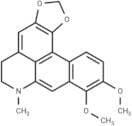
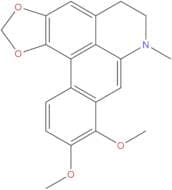
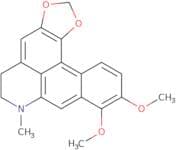
![9,10-dimethoxy-7-methyl-6,7-dihydro-5H-[1,3]benzodioxolo[6,5,4-de]benzo[g]quinoline](/_next/image/?url=https%3A%2Fstatic.cymitquimica.com%2Fcas-image%2Fthumb-webp%2F320398-910-dimethoxy-7-methyl-67-dihydro-5h-13-benzodioxolo-654-de-benzo-g-quinoline.webp&w=3840&q=75)
CAS 77784-22-6
:9,10-dimethoxy-7-methyl-6,7-dihydro-5H-[1,3]benzodioxolo[6,5,4-de]benzo[g]quinoline
Description:
9,10-Dimethoxy-7-methyl-6,7-dihydro-5H-[1,3]benzodioxolo[6,5,4-de]benzo[g]quinoline is a complex organic compound characterized by its unique polycyclic structure, which includes both benzodioxole and quinoline moieties. This compound features two methoxy groups (-OCH3) and a methyl group (-CH3) that contribute to its chemical properties and potential biological activity. The presence of multiple aromatic rings suggests that it may exhibit significant stability and lipophilicity, which can influence its solubility and interaction with biological systems. The compound's structure may also suggest potential applications in medicinal chemistry, particularly in the development of pharmaceuticals, due to the presence of functional groups that can participate in various chemical reactions. Additionally, the compound's CAS number, 77784-22-6, allows for its identification in chemical databases, facilitating research and development efforts. Overall, the characteristics of this compound make it a subject of interest in both synthetic and medicinal chemistry.
Formula:C20H19NO4
InChI:InChI=1/C20H19NO4/c1-21-7-6-11-8-16-20(25-10-24-16)18-12-4-5-15(22-2)19(23-3)13(12)9-14(21)17(11)18/h4-5,8-9H,6-7,10H2,1-3H3
SMILES:CN1CCc2cc3c(c4c5ccc(c(c5cc1c24)OC)OC)OCO3
Synonyms:- Dehydrocrebanine
Sort by
Purity (%)
0
100
|
0
|
50
|
90
|
95
|
100
Found 4 products.
Dehydrocrebanine
CAS:Dehydrocrebanine: IC50 2.14 ug/mL against HL-60 leukemia cells; IC50 70 ng/mL for malaria.Formula:C20H19NO4Purity:98%Color and Shape:SolidMolecular weight:337.37Dehydrocrebanine
CAS:Formula:C20H19NO4Purity:95%~99%Color and Shape:Yellow powderMolecular weight:337.375Dehydrocrebanine
CAS:Dehydrocrebanine is an alkaloid, which is a naturally occurring chemical compound. It is derived primarily from certain plant species known for their rich alkaloid content, such as those in the Menispermaceae family. The compound exhibits a unique mode of action by interacting with specific receptors and ion channels in biological systems, potentially modulating various physiological processes.Formula:C20H19NO4Purity:Min. 95%Molecular weight:337.4 g/mol