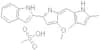
CAS 803712-79-0
:Obatoclax mesilate
Description:
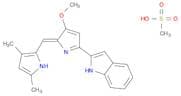
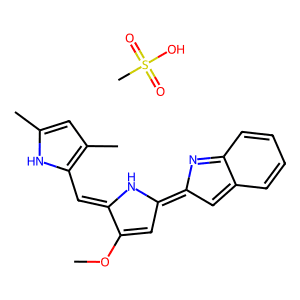
Obatoclax mesilate is a small molecule inhibitor primarily known for its role in cancer therapy, particularly in targeting various types of tumors. It functions as a pan-Bcl-2 inhibitor, disrupting the function of Bcl-2 family proteins that are crucial for regulating apoptosis, thereby promoting cancer cell death. The compound is characterized by its ability to induce apoptosis in cancer cells that are resistant to conventional therapies. Obatoclax mesilate is typically administered in a clinical setting and has been investigated in various clinical trials for its efficacy against hematological malignancies and solid tumors. Its chemical structure includes a complex arrangement of rings and functional groups that contribute to its biological activity. The mesilate salt form enhances its solubility and stability, making it more suitable for pharmaceutical applications. As with many investigational drugs, the safety profile and potential side effects are continuously evaluated during clinical trials to determine its therapeutic viability.
Formula:C21H23N3O4S
InChI:InChI=1/C20H19N3O.CH4O3S/c1-12-8-13(2)21-16(12)10-19-20(24-3)11-18(23-19)17-9-14-6-4-5-7-15(14)22-17;1-5(2,3)4/h4-11,21-22H,1-3H3;1H3,(H,2,3,4)/b19-10-;
SMILES:Cc1cc(C)[nH]c1/C=C\1/C(=CC(=N1)c1cc2ccccc2[nH]1)OC.CS(=O)(=O)O
Synonyms:- 2-[2-[(3,5-Dimethyl-1H-pyrrol-2-yl)methylene]-3-methoxy-2H-pyrrol-5-yl]-1H-indole methanesulfonate
Sort by
Purity (%)
0
100
|
0
|
50
|
90
|
95
|
100
Found 4 products.
Obatoclax Mesylate
CAS:Obatoclax Mesylate (GX15-070) is a Bcl-2 antagonist (Ki: 0.22 μM) and can induce apoptosis with up-regulation of Bim, induced cytochrome c release, andFormula:C20H19N3O·CH4O3SPurity:99.58% - 99.88%Color and Shape:SolidMolecular weight:413.49Obatoclax mesylate
CAS:Obatoclax mesylate is a synthetic small molecule, which is derived from chemical synthesis with a primary mode of action as a pan-BCL-2 inhibitor. This compound antagonizes multiple anti-apoptotic proteins within the BCL-2 family, ultimately promoting apoptosis in malignant cells. Its ability to inhibit these proteins disrupts the survival mechanisms that cancer cells exploit, potentially restoring apoptotic pathways that are often dysregulated in cancerous tissues.
Formula:C20H19N3O·CH4O3SPurity:Min. 95%Color and Shape:Black SolidMolecular weight:413.49 g/mol