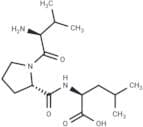
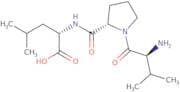
CAS 90614-49-6
:L-Valyl-L-prolyl-L-leucine
- 468: PN: WO2005081628 SEQID: 470 claimed protein
- <span class="text-smallcaps">L</smallcap>-Leucine, <smallcap>L</smallcap>-valyl-<smallcap>L</span>-prolyl-
- <span class="text-smallcaps">L</smallcap>-Leucine, N-(1-<smallcap>L</smallcap>-valyl-<smallcap>L</span>-prolyl)-
- <span class="text-smallcaps">L</smallcap>-Valyl-<smallcap>L</smallcap>-prolyl-<smallcap>L</span>-leucine
- H-Val-Pro-Leu-OH
- L-valyl-L-prolyl-L-leucine
- Valylprolylleucine
- Diprotin B
- L-Leucine, L-valyl-L-prolyl-
- L-Leucine, N-(1-L-valyl-L-prolyl)-
- (-)-L-Val-L-Pro-L-Leu-OH
- L-VALYL-L-PROLYL LEUCINE
- VAL-PRO-LEU
- n-(1-l-valyl-l-prolyl)-l-leucin
- Val-Pro-Leu-OH
- 2-[[1-(2-amino-3-methylbutanoyl)pyrrolidine-2-carbonyl]amino]-4-methylpentanoic acid
- See more synonyms
L-Leucine, L-valyl-L-prolyl-
CAS:Formula:C16H29N3O4Purity:98%Color and Shape:SolidMolecular weight:327.4192Diprotin B
CAS:Diprotin B is a colony-stimulating factor protein that has inhibitory properties in the colon. It has been shown to be effective in reducing symptoms of bowel disease and inflammatory bowel disease, as well as reducing the recurrence of colon cancer. Diprotin B inhibits the release of inflammatory cytokines such as tumor necrosis factor-α (TNF-α) and interleukin-6 (IL-6). The inhibition of these proinflammatory cytokines may contribute to the anti-inflammatory effects observed with Diprotin B treatment. Diprotin B also prevents cytosolic calcium accumulation, which can lead to cell lysis. This process is mediated by antimicrobial peptides called defensins that are expressed in Paneth cells found in the small intestine and colon. Defensins have also been shown to induce cell lysis through their ability to bind to bacterial membranes.
Formula:C16H29N3O4Purity:Min. 95%Molecular weight:327.43 g/molDiprotin B
CAS:Diprotin B is a dipeptidyl peptidase IV inhibitor.Formula:C16H29N3O4Purity:98%Color and Shape:White Lyophilized PowderMolecular weight:327.42Diprotin B
CAS:Diprotin B is a peptide that is the most potent inhibitor of serine proteases identified to date. It has been shown to inhibit both chymotrypsin and trypsin, with an IC50 value of 0.5 nM for chymotrypsin and 2 nM for trypsin. Diprotin B is able to inhibit the enzymatic activity by protonation at the catalytic residue, S2, in the active site of serine proteases. The efficiency of this inhibition can be increased by altering pH or adding proton donors such as HCl or NaOH. This peptide also hydrolyzes at a slower rate than the substrate (chymotrypsin). Diprotin B has a molecular weight of 906 Da and contains two amino acids: valine (Val) and leucine (Leu). It contains no functional groups that would be expected to affect its inhibitory properties.
Formula:C16H29N3O4Purity:Min. 95%Molecular weight:327.42 g/mol