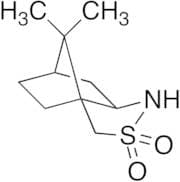
CAS 94594-90-8
:(2R)-Bornane-10,2-sultam
Description:
(2R)-Bornane-10,2-sultam, with the CAS number 94594-90-8, is a cyclic sulfonamide compound characterized by its unique bicyclic structure derived from bornane. This compound features a sulfonamide functional group, which contributes to its chemical reactivity and potential applications in various fields, including medicinal chemistry. The presence of the sultam ring indicates that it possesses both nitrogen and sulfur atoms within its structure, which can influence its solubility and interaction with biological systems. Typically, sultams exhibit interesting properties such as stability under certain conditions and the ability to participate in various chemical reactions, including nucleophilic substitutions. The stereochemistry denoted by (2R) indicates a specific spatial arrangement of atoms, which can affect the compound's biological activity and interactions. Overall, (2R)-Bornane-10,2-sultam is of interest for its potential applications in drug development and as a synthetic intermediate in organic chemistry.
Formula:C10H17NO2S
InChI:InChI=1/C10H17NO2S/c1-9(2)7-3-4-10(9)6-14(12,13)11-8(10)5-7/h7-8,11H,3-6H2,1-2H3/t7-,8-,10+/m0/s1
Synonyms:- [3aS-(3aalpha,6alpha,7abeta)]-Hexahydro-8,8-dimethyl-3H-3a,6-methano-2,1-benzisothiazole 2,2-dioxide
- (1S)-(-)-2,10,Camphor sultam
- 8,8-Dimethyloctahydro-4,7-Methano-2,1-Benzothiazole 2,2-Dioxide
- (7aR)-8,8-dimethylhexahydro-3a,6-methano-2,1-benzothiazole 2,2-dioxide
- (3aS,6R,7aR)-8,8-dimethylhexahydro-3a,6-methano-2,1-benzothiazole 2,2-dioxide
- (6R)-8,8-dimethylhexahydro-3a,6-methano-2,1-benzisothiazole 2,2-dioxide
- (3aS,6S,7aS)-8,8-dimethylhexahydro-3a,6-methano-2,1-benzisothiazole 2,2-dioxide
- (-)-Camphorsultam
- (1S)-(-)-2,10-Camphorsultam
- (1S)-(-)-2,11-Camphorsultam
Sort by
Purity (%)
0
100
|
0
|
50
|
90
|
95
|
100
Found 8 products.
(-)-10,2-Camphorsultam
CAS:Formula:C10H17NO2SPurity:>98.0%(GC)Color and Shape:White to Almost white powder to crystalMolecular weight:215.31(1S,2R)-(-)-10,2-Camphorsultam, 99%
CAS:(1S,2R)-(-)-10,2-Camphorsultam is used in the asymmetric synthesis of (S)- and (R)-N-Fmoc-S-trityl--methylcysteine. It is used as proton source in the synthesis of chiral ,-substituted -butyrolactones. It is also employed as a chiral probe for the optical resolution by HPLC and X-ray crystallographiFormula:C10H17NO2SPurity:99%Color and Shape:Crystals or powder or crystalline powder, White to pale creamMolecular weight:215.31(3aS,6R,7aR)-8,8-Dimethylhexahydro-1H-3a,6-methanobenzo[c]isothiazole 2,2-dioxide
CAS:Formula:C10H17NO2SPurity:98%Color and Shape:SolidMolecular weight:215.3125(1S,5R)-10,10-Dimethyl-3-Thia-4-Azatricyclo[5.2.1.0(1,5)]Decane 3,3-Dioxide
CAS:(1S,5R)-10,10-Dimethyl-3-Thia-4-Azatricyclo[5.2.1.0(1,5)]Decane 3,3-DioxidePurity:97%Molecular weight:215.31g/mol(1S)-(-)-2,10-Camphorsultam
CAS:Formula:C10H17NO2SPurity:98%Color and Shape:CrystallineMolecular weight:215.31(1S)-Camphorsultam
CAS:Controlled ProductApplications (1S)-Camphorsultam is used as a chiral auxiliary to control the stereochemistry in order to obtain the desired stereoselective product. It’s also a reagent used to make Camphorsultam conjugates, and used as a catalyst with the help of a lewis acid in organic reactions such as the Diels-Alder reaction, and the Grignard reaction.
References Springthorpe, B., et al.: Bioorg. Med. Chem. Lett., 17, 6013 (2007); Inoue, M., et al.: Nat. Chem., 2, 280 (2010); Chapuis, C., et al.: Pol. J. Chem., 68, 2323-31 (1994); Merhcan, F.L., et al.: Tetrahedron: Asymmetry, 7, 667-70 (1996);Formula:C10H17NO2SColor and Shape:NeatMolecular weight:215.13
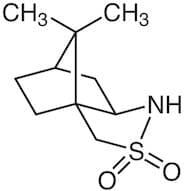



![(3aS,6R,7aR)-8,8-Dimethylhexahydro-1H-3a,6-methanobenzo[c]isothiazole 2,2-dioxide](/_next/image/?url=https%3A%2Fstatic.cymitquimica.com%2Fproducts%2FIN%2Fthumb%2FDA003BJT.jpg&w=3840&q=75)

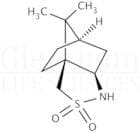

![(1S,5R)-10,10-Dimethyl-3-Thia-4-Azatricyclo[5.2.1.0(1,5)]Decane 3,3-Dioxide](/_next/image/?url=https%3A%2Fstatic.cymitquimica.com%2Fproducts%2F54%2Fthumb%2FOR1007931.jpg&w=3840&q=75)