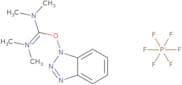
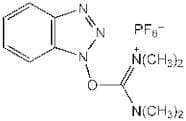
![1-[Bis(dimethylamino)methylene]-1H-benzotriazolium hexafluorophosphate(1-) 3-oxide](/_next/image/?url=https%3A%2Fstatic.cymitquimica.com%2Fcas-image%2Fthumb-webp%2F343069-1-bis-dimethylamino-methylene-1h-benzotriazolium-hexafluorophosphate-1-3-oxide.webp&w=3840&q=75)
CAS 94790-37-1
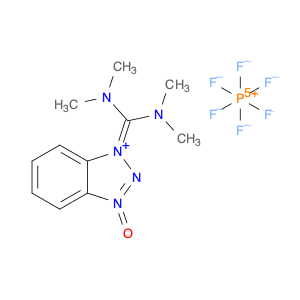
:1-[Bis(dimethylamino)methylene]-1H-benzotriazolium hexafluorophosphate(1-) 3-oxide
Description:
1-[Bis(dimethylamino)methylene]-1H-benzotriazolium hexafluorophosphate(1-) 3-oxide, commonly referred to by its CAS number 94790-37-1, is a chemical compound that features a benzotriazole moiety, which is known for its applications in various fields, including organic synthesis and materials science. This compound is characterized by its unique structure that includes a bis(dimethylamino)methylene group, contributing to its reactivity and potential as a nucleophilic agent. The presence of the hexafluorophosphate anion indicates strong ionic interactions, which can enhance solubility in polar solvents. Additionally, the 3-oxide functional group may impart specific electronic properties, making it useful in photochemical applications. The compound is typically handled with care due to its potential toxicity and reactivity, and it is often used in controlled laboratory settings. Its applications may extend to areas such as catalysis, dye synthesis, and as a reagent in organic transformations, showcasing its versatility in chemical research and development.
Formula:C11H16N5O·F6P
InChI:InChI=1S/C11H16N5O.F6P/c1-13(2)11(14(3)4)15-9-7-5-6-8-10(9)16(17)12-15;1-7(2,3,4,5)6/h5-8H,1-4H3;/q+1;-1
InChI key:InChIKey=BSKUEERROYGAFF-UHFFFAOYSA-N
SMILES:C(N(C)C)(N(C)C)=[N+]1C=2C(N(=O)=N1)=CC=CC2.[P+5]([F-])([F-])([F-])([F-])([F-])[F-]
Synonyms:- 1-[Bis(dimethylamino)methylene]-1H-benzotriazolium hexafluorophosphate(1-) 3-oxide
- 1H-Benzotriazolium, 1-[bis(dimethylamino)methylene]-, 3-oxide, hexafluorophosphate(1-) (1:1)
- 1H-Benzotriazolium, 1-[bis(dimethylamino)methylene]-, hexafluorophosphate(1-), 3-oxide
- 2-(1H-Benzotriazole-1-Yl)-1,1,3,3-Tetramethyluronium Hexafluorophosphate
- Hbtu
- N-Hbtu
- N-[(1H-benzotriazol-1-yloxy)(dimethylamino)methylidene]-N-methylmethanaminium hexafluorophosphate
- O-(Benzotriazol-1-yl)-N,N,N',N'-tetramethyluronium Hexafluorophosphate
- O-Benzotriazole-N,N,N',N'-tetramethyl-uronium-hexafluoro-phosphate
- O-Benzotriazole-N,N,N',N'-tetramethyl-uronium-hexafluorophosphate
Sort by
Purity (%)
0
100
|
0
|
50
|
90
|
95
|
100
Found 11 products.
HBTU [Coupling Reagent for Peptide]
CAS:Formula:C11H16F6N5OPPurity:>98.0%(HPLC)Color and Shape:White to Almost white powder to crystalMolecular weight:379.25O-(1H-Benzotriazol-1-yl)-N,N,N',N'-tetramethyluronium hexafluorophosphate, 98%
CAS:O-(1H-Benzotriazol-1-yl)-N,N,N',N'-tetramethyluronium hexafluorophosphate is used as a coupling reagent for solid-phase peptide synthesis. It has been shown to effectively suppress racemization. This Thermo Scientific Chemicals brand product was originally part of the Alfa Aesar product portfolio. SFormula:C11H16N5OPurity:98%Color and Shape:Crystalline powder, White to pale creamMolecular weight:234.281-(Bis(dimethylamino)methylene)-1H-benzo[d][1,2,3]triazole-1-ium 3-oxide hexafluorophosphate(V), 98%
CAS:Formula:C11H16F6N5OPColor and Shape:White - Almost white crystal - PowdeMolecular weight:379.24O-Benzotriazol-1-yl-N,N,N',N'-tetramethyluronium hexafluorophosphate
CAS:Formula:C11H16F6N5OPPurity:98%Color and Shape:SolidMolecular weight:379.2418Ref: IN-DA0035F7
10kgTo inquire10g20.00€5g21.00€25g24.00€50g25.00€100g28.00€250g50.00€500g73.00€1kg114.00€5kg360.00€25kg1,736.00€50kg3,236.00€100kg5,772.00€O-(Benzotriazol-1-yl)-N,N,N',N'-tetramethyluronium hexafluorophosphate
CAS:O-(Benzotriazol-1-yl)-N,N,N',N'-tetramethyluronium hexafluorophosphateFormula:C11H16N5O·PF6Purity:≥95%Color and Shape:White Solid-CrystalsMolecular weight:379.24181HBTU
CAS:Formula:C11H16F6N5OPPurity:≥ 99.0%Color and Shape:White to almost white powder or crystalsMolecular weight:379.25O-(Benzotriazol-1-yl)-N,N,N’,N’-tetramethyluronium hexafluorophosphate
CAS:Formula:C11H16F6N5OPPurity:99.0%Color and Shape:Solid, Powder or Crystalline Powder or SolidMolecular weight:379.247HBTU Reagent
CAS:HBTU is a reagent that is used in the synthesis of peptides. It has been shown to have inhibitory properties and stable complexes with ester linkages. HBTU has been shown to have a negative effect on congestive heart disease, which may be due to its ability to bind to receptors and mimic the effects of peptide hormones. This compound is also used as a model system for mitochondrial membrane potential. HBTU binds covalently to the peptide hormone receptor, which slows down the rate of degradation and increases its resistance to proteases. HBTU can also be used as an immunosuppressant drug in animal models of autoimmune diseases by inhibiting T-cell proliferation and cytokine production.
Formula:C11H16N5OPF6Purity:Min. 95%Molecular weight:379.25 g/molHBTU
CAS:HBTU is a common reagent used for peptide coupling, which can be employed for amide and ester formation. It is stable, highly reactive, suitable for solid phase and in-solution synthesis. The major advantages of HBTU are high yields, fast reaction times, easy reaction conditions, racemisation control and ease of purification from the water-soluble by-products. HBTU contains both the carbodiimide function and the benzotriazole one, activating the carboxylic acid and forming HOBt in situ. Although HBTU was originally catalogued as uronium salt, X-ray diffraction showed evidence for it to be an aminium salt instead.Formula:C11H16F6N5OPPurity:Min. 99 Area-%Color and Shape:White PowderMolecular weight:379.24 g/molHBTU
CAS:HBTU is a common reagent used for peptide coupling, which can be employed for amide and ester formation. It is stable, highly reactive, suitable for solid phase and in-solution synthesis. The major advantages of HBTU are high yields, fast reaction times, easy reaction conditions, racemisation control and ease of purification from the water-soluble by-products. HBTU contains both the carbodiimide function and the benzotriazole one, activating the carboxylic acid and forming HOBt in situ. Although HBTU was originally catalogued as uronium salt, X-ray diffraction showed evidence for it to be an aminium salt instead.Formula:C11H16F6N5OPPurity:Min. 99 Area-%Molecular weight:379.24 g/molHBTU extrapure, 98%
CAS:Formula:C11H16F6N5OPPurity:min. 98 %Color and Shape:White, Crystalline powderMolecular weight:379.25
![HBTU [Coupling Reagent for Peptide]](/_next/image/?url=https%3A%2Fstatic.cymitquimica.com%2Fproducts%2F3B%2Fthumb%2FB1657.jpg&w=3840&q=75)