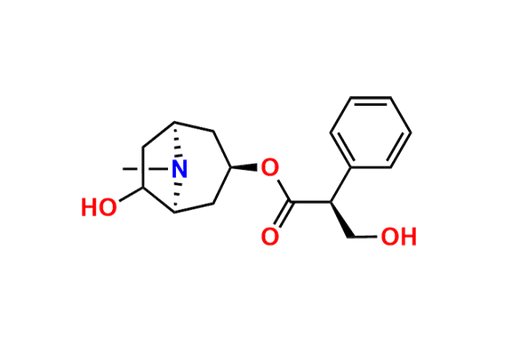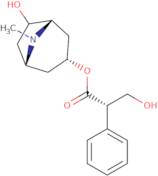
CAS 949092-65-3
:Formula:C17H23NO4
InChI:InChI=1S/C17H23NO4/c1-18-12-7-13(9-15(18)16(20)8-12)22-17(21)14(10-19)11-5-3-2-4-6-11/h2-6,12-16,19-20H,7-10H2,1H3/t12-,13-,14-,15+,16?/m1/s1
InChI key:WTQYWNWRJNXDEG-YFVFXCHESA-N
SMILES:CN1[C@@H]2C[C@H](C[C@H]1C(C2)O)OC(=O)[C@H](CO)C3=CC=CC=C3
Filter by
Purity percentage
0
100
|
0
|
50
|
90
|
95
|
100
Found 4 products.
- Lower prices
- Higher prices
- Lower purities
- Higher purities
- Faster estimated delivery
(1S,3R,5S)-6-Hydroxy-8-methyl-8-azabicyclo[3.2.1]oct-3-yl (αS)-α-(hydroxymethyl)benzeneacetate
CAS:(1S,3R,5S)-6-Hydroxy-8-methyl-8-azabicyclo[3.2.1]oct-3-yl (αS)-α-(hydroxymethyl)benzeneacetateFormula:C17H23NO4Purity:98%Molecular weight:305.37Atropine EP Impurity E (Mixture of Diastereomers) (7-Hydroxyhyoscyamine)
CAS:Formula:C17H23NO4Molecular weight:305.387-Hydroxyhyoscyamine
CAS:7-Hydroxyhyoscyamine is an antibacterial agent that is used in the treatment of bacterial infections. It has been shown to inhibit the growth of a number of bacteria including Staphylococcus aureus, Streptococcus pyogenes, and Escherichia coli. 7-Hydroxyhyoscyamine has been shown to be more potent than 6-hydroxyhyoscyamine (6-OH Hya) for inhibiting protein synthesis in the bacteria. The compound does not have any psychoactive effects, unlike atropine sulfate, which is also an alkaloid found in plants from the Solanaceae family. 7-Hydroxyhyoscyamine can be synthesized by reacting atropine with nitrous acid or hydrochloric acid. This synthetic process leads to n-oxides as impurities, which can be removed by using a reversed phase high performance liquid chromatography (RP HPLC). Validation of thisFormula:C17H23NO4Purity:Min. 95%Color and Shape:PowderMolecular weight:305.4 g/molRef: 3D-IH171348
Discontinued product