


CAS 952652-79-8
:Sort by
Purity (%)
0
100
|
0
|
50
|
90
|
95
|
100
Found 10 products.
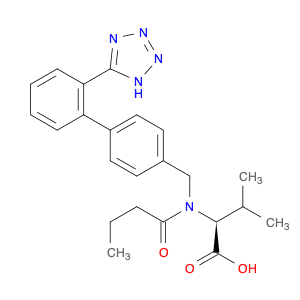
Valsartan Related Compound B (N-butyryl-N-{[2'-(1H-tetrazole-5-yl)-biphenyl-4-yl]methyl}-L-valine)
CAS:Heterocyclic compounds with nitrogen hetero-atom(s) only, aromatic or modified aromatic, nesoiFormula:C23H27N5O3Color and Shape:White PowderMolecular weight:421.21139(S)-2-(N-((2'-(1H-tetrazol-5-yl)-[1,1'-biphenyl]-4-yl)methyl)butyramido)-3-methylbutanoic acid
CAS:(S)-2-(N-((2'-(1H-tetrazol-5-yl)-[1,1'-biphenyl]-4-yl)methyl)butyramido)-3-methylbutanoic acidFormula:C23H27N5O3Purity:98%Molecular weight:421.49Valsartan EP Impurity C (Valsartan USP Related Compound B)
CAS:Formula:C23H27N5O3Color and Shape:Off-White SolidMolecular weight:421.50(2S)-2-[Butanoyl[[2'-(1H-tetrazol-5-yl)biphenyl-4-yl]methyl]amino]-3-methylbutanoic Acid
CAS:Color and Shape:NeatValsartan n-Propyl Impurity
CAS:Controlled ProductImpurity Valsartan Related Compound B
Applications Valsartan n-Propyl is an impurity in the synthesis of Valsartan (V095750). Valsartan USP Related Compound B.
References Hillaert, S., et al.: J. Pharm. Biomed. Anal., 31, 329 (2003), Carlucci, G., et al.: Anal. Lett., 33, 2491 (2000), Cagigal, E., et al.: Talanta, 54, 1121 (2001),Formula:C23H27N5O3Color and Shape:NeatMolecular weight:421.49(S)-N-Butyryl-N-[[2'-(1H-tetrazol-5-yl)biphenyl-4-yl]methyl]valine
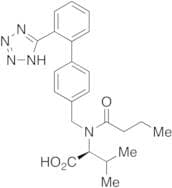
CAS:(S)-2-(N-((2'-(1H-Tetrazol-5-yl)-[1,1'-biphenyl]-4-yl)methyl)butyramido)-3-methylbutanoic acidFormula:C23H27N5O3Purity:98%Molecular weight:421.49N-(1-Oxobutyl)-N-[[2'-(2H-tetrazol-5-yl)[1,1'-biphenyl]-4-yl]methyl]-L-valine
CAS:N-(1-Oxobutyl)-N-[[2'-(2H-tetrazol-5-yl)[1,1'-biphenyl]-4-yl]methyl]-L-valine (GW1929) is a potent vasodilator that is used for the treatment of hypertension. It is synthesized by condensation of sodium hydroxide with 2-(4′-chlorophenyl)piperazine followed by methyl esterification and chloride acylation. The synthesis of GW1929 has been accomplished in two steps: carbonate cyclization and valsartan hydrolysis. In the first step, the carboxylic acid group of GW1929 was converted to its corresponding chloride compound which was then reacted with methyl bromide to yield the desired product. The second step involved hydrolysis of GW1929 with potassium carbonate, after which it was oxidized with azide to form an ester. SodiumFormula:C23H27N5O3Purity:Min. 95%Color and Shape:White PowderMolecular weight:421.49 g/mol




![(2S)-2-[Butanoyl[[2'-(1H-tetrazol-5-yl)biphenyl-4-yl]methyl]amino]-3-methylbutanoic Acid](/_next/image/?url=https%3A%2Fstatic.cymitquimica.com%2Fproducts%2F86%2Fthumb%2FMM0487.04-0025.jpg&w=3840&q=75)




![N-(1-Oxobutyl)-N-[[2'-(2H-tetrazol-5-yl)[1,1'-biphenyl]-4-yl]methyl]-L-valine](/_next/image/?url=https%3A%2Fstatic.cymitquimica.com%2Fproducts%2F3D%2Fthumb%2FIO28664.jpg&w=3840&q=75)
