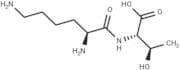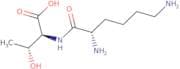
CAS 97791-84-9
:L-Threonine, L-lysyl-
Description:
L-Threonine, L-lysyl- is a dipeptide composed of the amino acids L-threonine and L-lysine. It is characterized by its structure, which includes the amino group, carboxyl group, and side chains of both constituent amino acids. This compound is typically soluble in water due to the presence of polar functional groups, which facilitate hydrogen bonding. L-Threonine is an essential amino acid, meaning it must be obtained through diet, while L-lysine is also essential and plays a crucial role in protein synthesis, hormone production, and calcium absorption. The dipeptide form may exhibit unique biological activities, including potential roles in metabolism and cellular functions. Additionally, it may be involved in various biochemical pathways, contributing to the synthesis of proteins and other biomolecules. The CAS number 97791-84-9 uniquely identifies this compound in chemical databases, aiding in its study and application in fields such as biochemistry, nutrition, and pharmaceuticals.
Formula:C10H21N3O4
Sort by
Purity (%)
0
100
|
0
|
50
|
90
|
95
|
100
Found 3 products.
Lysyl threonine
CAS:Lysyl threonine is a dipeptide composed of lysine and threonine. It is an incomplete breakdown product of protein digestion or protein catabolism.Formula:C10H21N3O4Color and Shape:SolidMolecular weight:247.29H-Lys-Thr-OH trifluroacetate
CAS:Please enquire for more information about H-Lys-Thr-OH trifluroacetate including the price, delivery time and more detailed product information at the technical inquiry form on this pageFormula:C10H21N3O4•(C2HF3O2)xPurity:Min. 95%H-Lys-Thr-OH hydrochloride salt
CAS:H-Lys-Thr-OH hydrochloride salt is a synthetic amino acid that has been used in the synthesis of a cyclic peptide. The synthesis was achieved by metathesis reactions, which involved the reaction of an acid chloride with a chiral amine to form an ester. H-Lys-Thr-OH hydrochloride salt has been shown to have high binding constants to its targets and can be used as a selective reagent for the synthesis of virus proteins. It is also able to bind to carboxylate groups, which are common in wild type viruses and gene products. This reagent also has cleavage products, which can be used for efficient method for synthesizing cyclic peptides.
Formula:C10H21N3O4Purity:Min. 95%Molecular weight:247.29 g/mol