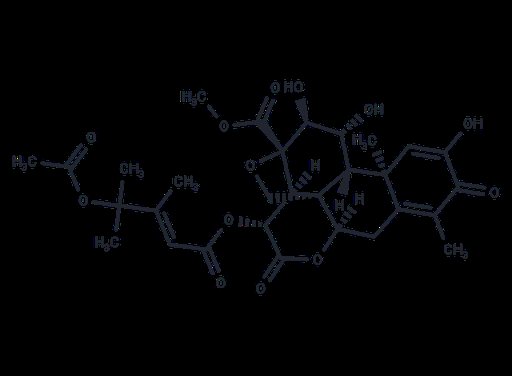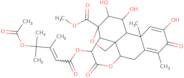
CAS 99132-99-7
:Formula:C30H36O13
InChI:InChI=1S/C30H36O13/c1-12(27(4,5)43-14(3)31)8-18(33)42-21-23-29-11-40-30(23,26(38)39-7)24(36)20(35)22(29)28(6)10-16(32)19(34)13(2)15(28)9-17(29)41-25(21)37/h8,10,17,20-24,32,35-36H,9,11H2,1-7H3/b12-8+/t17-,20-,21-,22-,23-,24+,28+,29-,30+/m1/s1
InChI key:MJOFLSVJDZIFKV-UUTDASJCSA-N
SMILES:CC1=C2C[C@@H]3[C@@]45CO[C@@]([C@@H]4[C@H](C(=O)O3)OC(=O)/C=C(\C)/C(C)(C)OC(=O)C)([C@H]([C@@H]([C@@H]5[C@]2(C=C(C1=O)O)C)O)O)C(=O)OC
Filter by
Purity percentage
0
100
|
0
|
50
|
90
|
95
|
100
Found 2 products.
- Lower prices
- Higher prices
- Lower purities
- Higher purities
- Faster estimated delivery
Dehydrobruceantinol
CAS:Dehydrobruceantinol shows bitter taste and has antileukemic activity.Formula:C30H36O13Purity:98%Color and Shape:SolidMolecular weight:604.605Dehydrobruceantinol
CAS:Dehydrobruceantinol is a bioactive sesquiterpene lactone, which is isolated from the plant Brucea javanica. This plant is native to Southeast Asia and has been traditionally used in herbal medicine. Dehydrobruceantinol exerts its effects through the inhibition of specific enzymatic pathways and disruption of cellular proliferation mechanisms. It has been identified as an effective antimalarial agent due to its ability to target the Plasmodium falciparum parasite, disrupting its life cycle and preventing replication.Formula:C30H36O13Purity:Min. 95%Molecular weight:604.6 g/mol