Fluorogenic Substrates
In this category, you will find a comprehensive selection of fluorogenic substrates designed for enzymatic catalysis. These substrates are used with various types of enzymes and are capable of producing color and fluorescence upon reaction. Fluorogenic substrates are essential tools in biochemical and molecular biology research, enabling the detection and quantification of enzyme activity with high sensitivity and specificity. They are widely used in assays for studying enzyme kinetics, screening for enzyme inhibitors, and monitoring cellular processes. At CymitQuimica, we provide high-quality fluorogenic substrates to support your research, ensuring reliable and accurate results in your enzymatic assays.
Found 297 products of "Fluorogenic Substrates"
Sort by
Purity (%)
0
100
|
0
|
50
|
90
|
95
|
100
D-Alanine 7-amido-4-methylcoumarin free base
CAS:<p>D-Alanine 7-amido-4-methylcoumarin free base is a chromogenic substrate that is used in diagnostic testing. It is used to identify the presence of beta-lactamase, which catalyzes the hydrolysis of penicillin and cephalosporin antibiotics, by turning the substrate into a bright blue color. D-Alanine 7-amido-4-methylcoumarin free base can also be used as a fluorescent substrate for bioluminescence or chemiluminescence reactions. This product is high quality and has CAS number 201847-51-0.</p>Formula:C13H14N2O3Purity:Min. 95%Molecular weight:246.26 g/mol4-(Trifluoromethyl)umbelliferyl-b-D-cellotetraoside
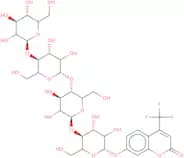
CAS:<p>4-(Trifluoromethyl)umbelliferyl-b-D-cellotetraoside is a chemiluminescent substrate that can be used in the detection of peroxidase, horseradish peroxidase, and other enzymes. It is a fluorescent product that emits light upon reaction with hydrogen peroxide. This product has been tested for purity and quality and has shown to have no detectable levels of heavy metals or other contaminants. 4-(Trifluoromethyl)umbelliferyl-b-D-cellotetraoside is not cytotoxic and can be used for the detection of enzyme activity in living cells. 4-(Trifluoromethyl)umbelliferyl-b-D-cellotetraoside is also known as TMBECFDA, which stands for Trifluoromethyl)umbelliferone (Cellobiose) (Biot</p>Purity:Min. 95%Molecular weight:878.7 g/mol4-Methylumbelliferyl phosphate, free acid
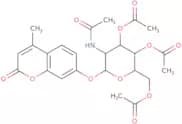
CAS:<p>A sensitive fluorogenic substrate for fluorometric and UV-spectrophotometric assays of phosphatases. It is used for the detection of C. perfringens because acid phosphatase is a highly specific indicator for C. perfringens.</p>Formula:C10H9O6PMolecular weight:256.15 g/mol4-Methylumbelliferyl 2-acetamido-3,4,6-tri-O-acetyl-2-deoxy-b-D-glucopyranoside
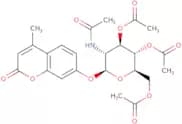
CAS:<p>4-Methylumbelliferyl 2-acetamido-3,4,6-tri-O-acetyl-2-deoxy--bDglucopyranoside is a compound that has been shown to interact with glutamicum and casein kinase. It is also a test compound for corynebacterium glutamicum and interacts with it by functional theory. The compound has been shown to inhibit inflammatory diseases and may be used as a potential treatment for these diseases.</p>Purity:Min. 95%Molecular weight:505.47 g/mol(4-Nitrophenyl)methyl-b-D-glucopyranoside
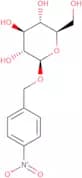
CAS:<p>This product is a fluorogenic substrate that is used in the detection of enzymes in biological systems. It is also used as a ligand to study enzyme activity and can be used to quantify enzyme activity. This product is made from high-purity, high-quality reagents and is often used as an enzyme substrate in diagnostic kits for food testing, environmental testing, and detection of bacteria with the help of chemiluminescence. The CAS number for this product is 700368-52-1. This product can be used for fluorescence staining and bioluminescence.</p>Purity:Min. 95%Molecular weight:315.28 g/mol6,8-Difluoro-4-methylumbelliferyl b-D-cellotetraoside
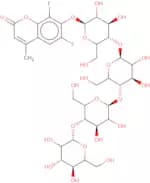
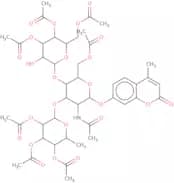
<p>6,8-Difluoro-4-methylumbelliferyl b-D-cellotetraoside is a chemiluminescent substrate for the detection of esterases. It is also used as an enzyme substrate in diagnostic applications and as a fluorogenic substrate in food testing. 6,8-Difluoro-4-methylumbelliferyl b-D-cellotetraoside has been shown to be an excellent ligand for use in immunoassays and can be conjugated to antibodies or antigens. 6,8-Difluoro-4-methylumbelliferyl b-D-cellotetraoside is chemically stable and has high purity and high quality.</p>Purity:Min. 95%Molecular weight:860.71 g/mol4-Methylumbelliferyl 2-acetamido-3-O-(2,3,4-tri-O-acetyl-a-L-fucopyranosyl)-4-O-(2,3,4,6-tetra-O-acetyl-b-D-galactopyranosyl)-6-O-ac etyl-2-deoxy-b-D-glucopyranoside
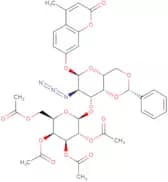
<p>4-Methylumbelliferyl 2-acetamido-3-O-(2,3,4-tri-O-acetyl-a-L-fucopyranosyl)-4-O-(2,3,4,6 -tetra-O-acetylbDgalactopyranosyl)-6-O-acetyldEoxybDglucopyranoside is a chemiluminescent substrate that has been used in the detection of beta galactosidase activity. It is a ligand for beta galactosidases and can be used for the study of enzyme kinetics. This compound also exhibits high purity and is available in CAS number: 916071. 4MUFAGAALF is suitable for use in culture media and environmental testing as well as diagnostics (e.g., bioluminescence), staining (fluorogenic substrate), and chromogenic substrates</p>Purity:Min. 95%Molecular weight:1,023.94 g/mol4-Methylumbelliferyl 2-azido-2-deoxy-3-O-(tetra-O-acetyl-b-D-galactopyranosyl)-4,6-O-benzylidene-a-D-galactopyranoside
CAS:<p>4-Methylumbelliferyl 2-azido-2-deoxy-3-O-(tetra-O-acetyl-b-D-galactopyranosyl)-4,6-O-benzylidene a D galactopyranoside is a chemiluminescent substrate for detecting ligands. It has been used to detect the presence of bacteria, fungi, and parasites in food samples and as an indicator for enzymatic activity. This product is an excellent fluorescent substrate for the detection of nucleic acids such as DNA. This product is a conjugate with high purity, which makes it suitable for use in various types of applications.</p>Formula:C37H39N3O16Purity:Min. 95%Molecular weight:781.72 g/mol4-Methylumbelliferyl 2-acetamido-3,4,6-tri-O-acetyl-2-deoxy-a-D-glucopyranoside
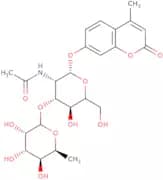
CAS:<p>4-Methylumbelliferyl 2-acetamido-3,4,6-tri-O-acetyl-2-deoxy-a-D-glucopyranoside is a chromogenic substrate for enzymes that catalyze the hydrolysis of glycosidic bonds. It can be used in diagnostic tests to identify antibodies against certain bacteria and fungi. The fluorogenic form of 4-methylumbelliferyl 2-acetamido-3,4,6-triO acetyl -2 deoxy a D glucopyranoside can be used as a chemiluminescent substrate for detecting bacterial activity. 4 methylumbelliferyl 2 acetamido 3,4,6 triO acetyl -2 deoxy a D glucopyranoside is also useful in bioluminescent assays to detect ATP production in bacteria and other microorganisms. CAS No: 1174287–76–3</p>Purity:Min. 95%Molecular weight:505.48 g/mol4-Methylumbelliferyl 2-acetamido-2-deoxy-3-O-(a-L-fucopyranosyl)-b-D-glucopyranoside
CAS:<p>4-Methylumbelliferyl 2-acetamido-2-deoxy-3-O-(alpha-L-fucopyranosyl)-beta-D-glucopyranoside is a fluorogenic substrate for alpha-L-fucosidase. After enzymatic cleaveage, free 4-methylumbelliferone (also known as hymecromone) is released, exhibiting blue fluorescence upon excitation with UV light. The strongest fluorescence of 4-methylumbelliferone requires deprotonation of the hydroxyl group (thus requires alkaline pH), with a maximal fluorescence intensity obtained with excitation at 350 to 370 nm and emission at 440 to 470 nm. The use of 4-methylumbelliferyl 2-acetamido-2-deoxy-3-O-(alpha-L-fucopyranosyl)-beta-D-glucopyranosideas a substrate for measuring the alpha-L-fucosidase activity is used for fucosidosis diagnosis (deficiency of the enzyme alpha-L-fucosidase) and lysosomal storage disorder screening.</p>Formula:C24H31NO12Purity:Min. 95 Area-%Color and Shape:White PowderMolecular weight:525.5 g/mol6-Chloro-4-trifluoromethylumbelliferyl b-D-galactopyranoside
<p>6-Chloro-4-trifluoromethylumbelliferyl b-D-galactopyranoside is a chromogenic substrate that can be used in enzyme assays to measure the activity of beta-glucuronidase. This compound is sold as a conjugate with an enzyme, which will not interfere with the assay. The compound has been tested to have high purity and quality.</p>Purity:Min. 95%Resorufin maltotriose
<p>Resorufin maltotriose is an alpha-amylase substrate that releases the dye resorufin with red emission (lmax=585 nm) after enzyme reaction.</p>Formula:C30H47NO18Purity:Min. 95%Molecular weight:709.69 g/molCaspase substrate
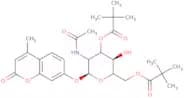
CAS:<p>Caspase substrates are a class of pharmacological agents that regulate apoptosis. Caspases are proteases that cleave specific proteins in the cell, leading to apoptosis. Pro-apoptotic proteins activate caspases, while anti-apoptotic proteins inhibit them. Caspase substrates can be either pro-caspase or anti-caspase, depending on the desired effect. They may also be used to regulate caspases without affecting their activity. The caspase substrate is cleaved by caspases and releases a polypeptide fragment that triggers apoptosis in some cells, but not others. For example, the Hl-60 cell line is resistant to the pro-apoptotic effects of the substrate because it contains an anti-apoptotic protein called Bcl-2. In contrast, myocardial cells contain pro-apoptotic proteins and are sensitive to the pro-apoptotic effects of the substrate. In</p>Purity:Min. 95%Molecular weight:821.75 g/mol4-Methylumbelliferyl 2-acetamido-2-deoxy-3,6-di-O-pivaloyl-b-D-galactopyranoside
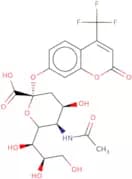
CAS:<p>4-Methylumbelliferyl 2-acetamido-2-deoxy-3,6-di-O-pivaloyl-b-D-galactopyranoside is a chemiluminescent substrate that reacts with an enzyme to produce light. It is used in the detection of ATPase activity and in the diagnosis of diseases. This product has been tested for quality and environmental safety, and it does not contain any hazardous substances. It is highly pure and can be used for testing food, diagnosing diseases, or staining cells.</p>Purity:Min. 95%Molecular weight:547.59 g/mol4-Trifluoromethylumbelliferyl a-D-N-acetylneuraminic acid
CAS:<p>4-Trifluoromethylumbelliferyl a-D-N-acetylneuraminic acid is a fluorescent chemiluminescent substrate that is used in the detection of beta-galactosidase activity. Beta-galactosidase catalyzes the hydrolysis of 4-trifluoromethylumbelliferyl a-D-N-acetylneuraminic acid to form 4-trifluoromethylumbelliferone and D-galactose, which emits light at approximately 480 nm. This reaction can be detected by fluorescence spectrophotometry using a fluorometer or photometer. 4TFUNA is not toxic, does not inhibit enzymes, and has been tested for toxicity and mutagenicity using bacteria and mammalian cells.</p>Purity:Min. 95%Molecular weight:521.39 g/mol6,8-Difluoro-4-methylumbelliferyl b-D-cellotrioside
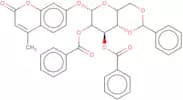
<p>6,8-Difluoro-4-methylumbelliferyl b-D-cellotrioside is a ligand that binds to active sites of enzymes such as beta-glucuronidase and beta-glucosidase. It is used in diagnostics for the detection of bacteria in culture media and food testing where it can be used as a chromogenic or fluorogenic substrate. 6,8-Difluoro-4-methylumbelliferyl b-D-cellotrioside is also used to detect the presence of bacteria and fungi in environmental samples. It has a high purity and conjugate with other molecules for use in fluorescence microscopy.</p>Purity:Min. 95%Color and Shape:White to off-white powder.Molecular weight:698.57 g/mol4-Methylumbelliferyl 2,3-di-O-benzoyl-4,6-O-benzylidene-b-D-galactopyranoside
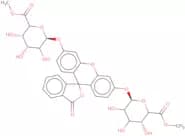
<p>4-Methylumbelliferyl 2,3-di-O-benzoyl-4,6-O-benzylidene-b-D-galactopyranoside is a fluorogenic substrate that is used in the detection of β-galactosidase activity. This product is a white to off white powder that has a purity of 99.2%. It has been given CAS number 53654–95–1 and it can be found in the Diagnostics section of Acros Organics.</p>Purity:Min. 95%Molecular weight:634.63 g/molFluorescein di-b-D-glucuronide dimethyl ester
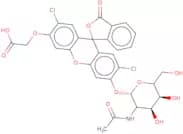
<p>Fluorogenic substrate for beta-glucuronidase</p>Purity:Min. 95%Color and Shape:PowderMolecular weight:712.61 g/mol6'-(O-(Carboxymethyl))-2',7'-dichlorofluoroscein 3'-(O-(N-acetyl-b-D-glucosamide))
<p>6'-(O-(Carboxymethyl))-2',7'-dichlorofluoroscein 3'-(O-(N-acetyl-b-D-glucosamide)) is a chemiluminescent substrate that can be used in the detection of ligands. This product has a CAS number of 44636-76-8 and is available at a purity level of 98%. It has been tested for bacterial contamination, as well as for adverse effects on culture media and environmental testing. 6'-(O-(Carboxymethyl))-2',7'-dichlorofluoroscein 3'-(O-(N-acetyl-b-D-glucosamide)) is an enzymatic substrate that can be used in diagnostic applications such as the detection of fluorescence, staining, and bioluminescence. It has also been shown to be useful in food testing.</p>Purity:Min. 95%Molecular weight:662.44 g/mol6-Chloro-4-methylumbelliferyl b-D glucuronide
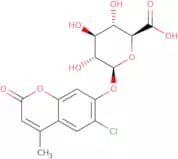
CAS:<p>6-Chloro-4-methylumbelliferyl b-D glucuronide is a fluorogenic substrate for beta-glucuronidase that exhibits longer absorption/emission maxima (~385/500 nm) than typical 4MU-derived substrates.</p>Formula:C16H15ClO9Purity:Min. 97 Area-%Color and Shape:White PowderMolecular weight:386.74 g/mol