Autophagy
Autophagy inhibitors target the cellular process of autophagy, which involves the degradation and recycling of cellular components through lysosomes. Autophagy is a critical mechanism for maintaining cellular homeostasis, but its dysregulation is implicated in various diseases, including cancer, neurodegeneration, and infections. Inhibitors of autophagy can block this process, making them valuable tools for studying the role of autophagy in disease and developing therapeutic strategies. At CymitQuimica, we offer autophagy inhibitors to support your research in cell biology, oncology, and neurodegenerative diseases.
Found 1486 products of "Autophagy"
Sort by
Purity (%)
0
100
|
0
|
50
|
90
|
95
|
100
LRRK2-IN-4
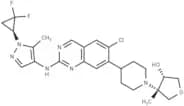
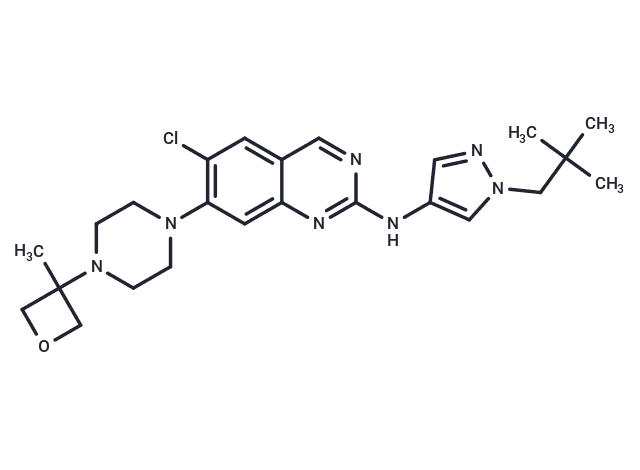
CAS:LRRK2-IN-4: Potent, selective LRRK2 inhibitor, oral, BBB-penetrating, IC50=2.6 nM, potential for Parkinson's.Formula:C25H29ClF2N6O2Color and Shape:SolidMolecular weight:518.99CXCR2 antagonist 5
<p>CXCR2 antagonist 5 (compound 25) binds strongly (IC50=0.013μM) and mobilizes calcium (IC50=0.1μM).</p>Formula:C15H14F2N4O2SColor and Shape:SolidMolecular weight:352.36SORT1-IN-2
CAS:SORT1-IN-2 (compound 6) is an inhibitor of SORT1.Formula:C21H29N3O4Color and Shape:SolidMolecular weight:387.47CXCR2 antagonist 6
CXCR2 antagonist 6: strong CXCR2 affinity (IC50=0.044 μM), hinders calcium mobilization (IC50=0.66 μM).Formula:C17H16F2N4OSColor and Shape:SolidMolecular weight:362.4Autophagy-IN-7
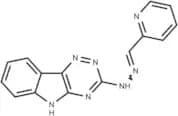
CAS:<p>Autophagy-IN-7 is an autophagy inhibitor for use in studying solid tumours.</p>Formula:C15H11N7Purity:98.47%Color and Shape:SolidMolecular weight:289.29LRRK2-IN-14
CAS:LRRK2-IN-14 (Compound 8), an orally active inhibitor of LRRK2, exhibits an IC 50 of 6.3 nM against LRRK2(G2019S) cell activity and demonstrates inhibitory effects on hERG with an IC 50 of 22 μM. Additionally, LRRK2-IN-14 is permeable to the blood-brain barrier [1].Formula:C17H18F3N5O2Color and Shape:SolidMolecular weight:381.35SLW131
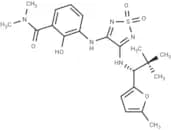
CAS:SLW131 (Compound 10) is a CCR7 antagonist with strong affinity, showing a Ki of 9.85 nM. It inhibits CCL19-induced Go protein activation with an IC50 of 29.4 μM and β-arrestin2 recruitment with an IC50 of 6.0 μM. SLW131 also suppresses CCL19-induced morphological changes in primary BMDC cells and CCR7-mediated migration of mouse CD4+ T cells.Formula:C21H27N5O5SColor and Shape:SolidMolecular weight:461.535(R)-SCH 546738
CAS:(R)-SCH 546738, the R-isomer of SCH 546738, is a non-competitive, orally active antagonist targeting the CXCR3 receptor, exhibiting a K_i of 0.4 nM for the human CXCR3 receptor.Formula:C23H31Cl2N7OColor and Shape:SolidMolecular weight:492.45Acetylpepstatin
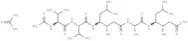
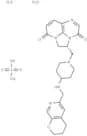
CAS:Acetylpepstatin is an inhibitor of HIV-1 protease, HIV-2 protease, aspartyl protease.Formula:C33H61N5O11Purity:98%Color and Shape:SolidMolecular weight:703.875DC-LC3in-D5
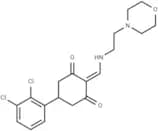
CAS:DC-LC3in-D5 is a potent and selective covalent inhibitor of LC3A/B that disrupts autophagy by covalently binding to Lys49 on LC3B.Formula:C19H22Cl2N2O3Purity:99.79%Color and Shape:SolidMolecular weight:397.3Z-FY-CHO
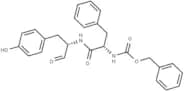
CAS:Pyridoxal (Pyridoxaldehyde), a component of vitamin B6, is an aldehyde obtained by oxidizing pyridoxine and is widely found in plants and animals.Formula:C26H26N2O5Purity:95.88%Color and Shape:SolidMolecular weight:446.5LRRK2-IN-20
CAS:LRRK2-IN-20 (EX. 4.64) is a selective inhibitor of LRRK2 with a potency of pIC50 at 0.7921 nM. This compound is applicable in research studies focused on Parkinson's Disease (PD).Formula:C24H32ClN7OColor and Shape:SolidMolecular weight:470.014-FPBUA
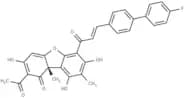
CAS:4-FPBUA, a semi-synthetic analog of lichen acid, enhances the functionality of cell-based blood-brain barriers (BBB) and increases the transport of β-amyloid (Aβ) in monolayer cells. Additionally, it acts as an inhibitor of mTOR, enhancing cellular autophagy (Autophagy) which can reverse BBB disruption in vivo, making it relevant for research in Alzheimer's disease.Formula:C31H23FO7Color and Shape:SolidMolecular weight:526.51LRRK2-IN-13
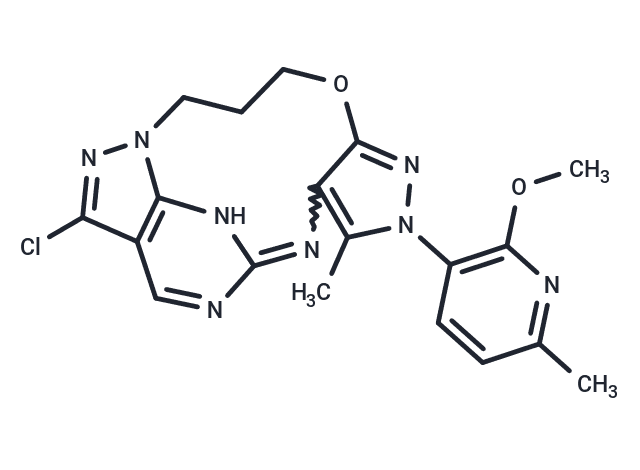
CAS:LRRK2-IN-13 (Compound 13), with an IC50 value of 0.57 nM, serves as an inhibitor of LRRK2 and exhibits properties that allow it to penetrate the brain [1].Formula:C19H19ClN8O2Color and Shape:SolidMolecular weight:426.86(R,R)-LRRK2-IN-7
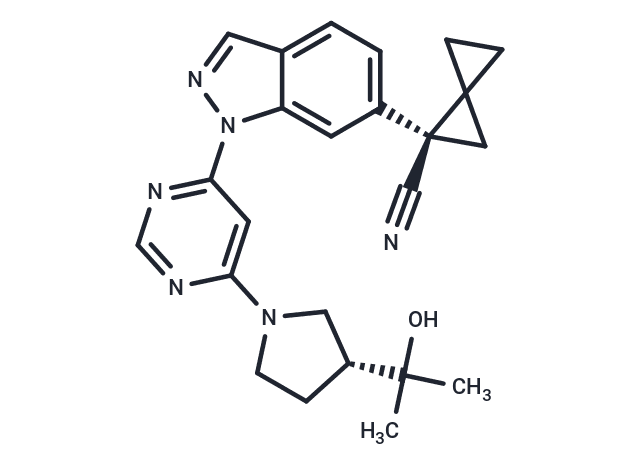
CAS:(R,R)-LRRK2-IN-7 is an isomer of LRRK2-IN-7, a potent and selective LRRK2 kinase inhibitor with CNS penetrance. It exhibits an IC50 of 0.9 nM and demonstrates over 1000-fold selectivity compared to other kinases, ion channels, and CYP enzymes.Formula:C24H26N6OMolecular weight:414.50DCC-3116
CAS:DCC-3116 is an orally active, selective and potent ULK1/2 inhibitor with anticancer activity.DCC-3116 inhibits autophagy and can be used in cancer research.Formula:C26H36F3N7O2Purity:98.55%Color and Shape:SoildMolecular weight:535.61Gepotidacin mesylate dihydrate
CAS:Gepotidacin mesylate dihydrate (GSK2140944 mesylate dihydrate) is an antibiotic and an inhibitor of bacterial type II topoisomerase.Formula:C25H36N6O8SPurity:99.85%Color and Shape:SolidMolecular weight:580.65Dusquetide
CAS:Dusquetide is a first-in-class innate defense regulator. Dusquetide displays activity in both reducing inflammation and increasing the clearance of bacterial infection.Formula:C25H47N9O5Purity:98%Color and Shape:SolidMolecular weight:553.709Dihydrocelastrol
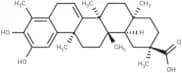
CAS:Dihydrocelastrol is synthesized by hydrogenation of celastrol, a treterpene isolated from Chinese medicinal plant Tripterygium regelii. Dihydrocelastrol could inhibit cell proliferation and promote apoptosis through caspase-dependent way in vitro. DHCE coFormula:C29H40O4Color and Shape:SolidMolecular weight:452.63VUF11207 trifluoroacetate salt
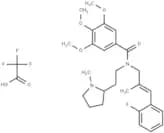
CAS:VUF11207 trifluoroacetate salt is a useful organic compound for research related to life sciences. The catalog number is T66657 and the CAS number is 1378524-41-4.Formula:C29H36F4N2O6Color and Shape:SolidMolecular weight:584.609