


Deuterated Compounds
Deuterated compounds are organic molecules in which one or more hydrogen atoms are replaced with deuterium, a stable isotope of hydrogen. These compounds are essential in various scientific fields, including NMR spectroscopy, mass spectrometry, and kinetic isotope studies. Deuterated compounds improve signal clarity and accuracy in analyses by reducing background noise and providing unique insights into reaction mechanisms and molecular structures. At CymitQuimica, you will find a wide range of deuterated compounds specifically designed to support your research in analytical chemistry and molecular studies.
Found 4238 products of "Deuterated Compounds"
Sort by
Purity (%)
0
100
|
0
|
50
|
90
|
95
|
100
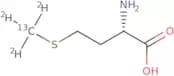
L-Methionine-methyl-13C,methyl-D3
CAS:Controlled ProductPlease enquire for more information about L-Methionine-methyl-13C,methyl-D3 including the price, delivery time and more detailed product information at the technical inquiry form on this pageFormula:C5H8D3NO2SPurity:Min. 95%Molecular weight:152.23 g/molAniline D5
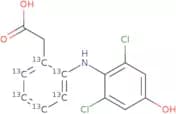
CAS:Controlled ProductAniline D5 is a metabolic probe used to study the activation of carcinogens. Aniline D5 inhibits the growth of cancer cells by binding to amines, which are present in epidermal growth factor and other growth factors. When an anhydrous sodium hydrogen bond forms between the amines and the aniline, it causes a frequency shift in the aromatic ring that leads to a change in its physical properties. This change can be detected using high-resolution NMR spectroscopy. The sensitivity of this technique has been improved by adding activated charcoal as a matrix effect.Formula:C6H2D5NPurity:Min. 95%Molecular weight:98.15 g/mol4’-Hydroxy diclofenac-13C6
CAS:Please enquire for more information about 4’-Hydroxy diclofenac-13C6 including the price, delivery time and more detailed product information at the technical inquiry form on this pageFormula:C6C8H11Cl2NO3Purity:Min. 95%Color and Shape:PowderMolecular weight:318.15 g/molHalobetasol Propionate-d5
CAS:Controlled ProductHalobetasol propionate-d5 is a steroid that is used to treat asthma. It is available as an inhalant, which is delivered directly into the lungs. When used in conjunction with another medication, such as salmeterol, it can help to reduce symptoms of asthma. Halobetasol propionate-d5 has been shown to be a potent anti-inflammatory agent that suppresses the inflammation of the airways and prevents asthma symptom. The drug does not have any negative side effects on lung function or respiratory muscles.Formula:C25H26D5F3O5SPurity:Min. 95%Molecular weight:505.6 g/molFmoc-[15N]Leu-OH
CAS:Fmoc-[15N]Leu-OH is a research chemical that has various applications in the field of biosynthesis and antibody production. It is commonly used in peptide synthesis and as a building block for the preparation of peptides and proteins. Fmoc-[15N]Leu-OH is known for its high purity and quality, making it an ideal choice for researchers and scientists working in the field of molecular biology. This compound can be easily dissolved in ethanol or other organic solvents, allowing for convenient use in laboratory experiments. With its unique characteristics and wide range of applications, Fmoc-[15N]Leu-OH is a valuable tool for those involved in biochemical research.Formula:C21H23NO4Purity:Min. 95%Molecular weight:354.41 g/mol([ring-D5]Phe8)-Angiotensin II acetate salt
CAS:Please enquire for more information about ([ring-D5]Phe8)-Angiotensin II acetate salt including the price, delivery time and more detailed product information at the technical inquiry form on this page
Formula:C50H66D5N13O12Purity:Min. 95%Molecular weight:1,051.21 g/mol([13C6]Leu6)-Endothelin-1 (human, bovine, dog, mouse, porcine, rat) acetate salt
Please enquire for more information about ([13C6]Leu6)-Endothelin-1 (human, bovine, dog, mouse, porcine, rat) acetate salt including the price, delivery time and more detailed product information at the technical inquiry form on this page
Purity:Min. 95%Fmoc-[15N]Val-OH
CAS:Fmoc-[15N]Val-OH is an epidermal growth factor receptor (EGFR) ligand that can be used to identify phosphorylation sites on EGFR. Fmoc-[15N]Val-OH binds to the tyrosine kinase domain of the EGFR and is phosphorylated by the intracellular protein tyrosine kinases, which leads to receptor activation. This compound has been shown to have a high affinity for human epidermoid carcinoma cells and can be used in cancer research as a potent and selective ligand. Fmoc-[15N]Val-OH is also known as a growth factor and has been shown to stimulate a number of cellular responses such as cell proliferation, migration, differentiation, and adhesion.Purity:Min. 95%Protein Kinase P34 (cd2) Substrate trifluoroacetate salt
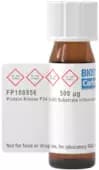
CAS:H-ADAQHATPPKKKRKVEDPKDF-OH peptide, which can act as a substrate of Protein Kinase P34 (cd2). The peptide is supplied as a trifluoroacetate salt.Formula:C106H172N32O32Purity:Min. 95%Molecular weight:2,406.7 g/mol([13C6]Leu15)-pTH (1-34) (human) trifluoroacetate salt
Please enquire for more information about ([13C6]Leu15)-pTH (1-34) (human) trifluoroacetate salt including the price, delivery time and more detailed product information at the technical inquiry form on this pagePurity:Min. 95%Fmoc-[D4]Ala-OH
CAS:Controlled ProductPlease enquire for more information about Fmoc-[D4]Ala-OH including the price, delivery time and more detailed product information at the technical inquiry form on this pageFormula:C18H13D4NO4Purity:Min. 95%Color and Shape:PowderMolecular weight:315.35 g/molFmoc-[ring-D5]Phe-OH
CAS:Controlled ProductPlease enquire for more information about Fmoc-[ring-D5]Phe-OH including the price, delivery time and more detailed product information at the technical inquiry form on this pageFormula:C24H16D5NO4Purity:Min. 95%Molecular weight:392.46 g/mol(Des-Gly10,D-Leu6,[13C6]Leu7,Pro-NHEt 9)-LHRH trifluoroacetate salt
Please enquire for more information about (Des-Gly10,D-Leu6,[13C6]Leu7,Pro-NHEt 9)-LHRH trifluoroacetate salt including the price, delivery time and more detailed product information at the technical inquiry form on this pagePurity:Min. 95%([D2]Gly4)-Cholecystokinin Octapeptide (sulfated) ammonium salt
Please enquire for more information about ([D2]Gly4)-Cholecystokinin Octapeptide (sulfated) ammonium salt including the price, delivery time and more detailed product information at the technical inquiry form on this pageFormula:C49H60D2N10O16S3Purity:Min. 95%Molecular weight:1,145.28 g/mol([13C6]Leu5)-Ghrelin (human) trifluoroacetate salt
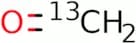
CAS:Please enquire for more information about ([13C6]Leu5)-Ghrelin (human) trifluoroacetate salt including the price, delivery time and more detailed product information at the technical inquiry form on this pagePurity:Min. 95%Formaldehyde-13C solution
CAS:20% by weight in water. 98 atom % 13CFormula:H13CHOPurity:Min. 95%Molecular weight:42.12 g/mol([13C6]Leu10)-CRF (human, rat) trifluoroacetate salt
Please enquire for more information about ([13C6]Leu10)-CRF (human, rat) trifluoroacetate salt including the price, delivery time and more detailed product information at the technical inquiry form on this pagePurity:Min. 95%(Cys(Bzl)84)-CD4 (81-92)
CAS:The CD4 molecule is a major component of the human immune system. It interacts with other cells, such as T-cells, and plays an important role in the immune response. The CD4 molecule is a glycoprotein that consists of two subunits, (Cys(Bzl)84)-CD4 and (81-92) H-Thr-Tyr-Ile-Cys(Bzl)-Glu-Val-Glu-Asp-Gln-Lys-Glu-. The sequence of this molecule is important for its function, as it has been shown to be essential for binding to HIV particles. This protein may also play a role in regulating the growth of T cells. It was found that the amino acid sequence of CD4 is not conserved among different species. The amino acid sequence specificity in the CD4 molecule is due to the cysteine residues. These residues are able to form disulfide bridges with other cysteFormula:C69H102N14O26SPurity:Min. 95%Molecular weight:1,575.69 g/mol([ring-D5]Phe3)-Octreotide acetate salt
CAS:Controlled ProductPlease enquire for more information about ([ring-D5]Phe3)-Octreotide acetate salt including the price, delivery time and more detailed product information at the technical inquiry form on this pageFormula:C49H61D5N10O10S2Purity:Min. 95%Molecular weight:1,024.27 g/molCD36 (93-110)-Cys
CAS:Please enquire for more information about CD36 (93-110)-Cys including the price, delivery time and more detailed product information at the technical inquiry form on this pageFormula:C96H151N29O33SPurity:Min. 95%Molecular weight:2,271.47 g/mol



![Fmoc-[15N]Leu-OH](/_next/image/?url=https%3A%2Fstatic.cymitquimica.com%2Fproducts%2F3D%2Fthumb-webp%2FFF111321.webp&w=3840&q=75)
![([ring-D5]Phe8)-Angiotensin II acetate salt](/_next/image/?url=https%3A%2Fstatic.cymitquimica.com%2Fproducts%2F3D%2Fthumb-webp%2FFR110025.webp&w=3840&q=75)
![([13C6]Leu6)-Endothelin-1 (human, bovine, dog, mouse, porcine, rat) acetate salt](/_next/image/?url=https%3A%2Fstatic.cymitquimica.com%2Fproducts%2F3D%2Fthumb-webp%2FFL110023.webp&w=3840&q=75)
![Fmoc-[15N]Val-OH](/_next/image/?url=https%3A%2Fstatic.cymitquimica.com%2Fproducts%2F3D%2Fthumb-webp%2FFF111322.webp&w=3840&q=75)
![([13C6]Leu15)-pTH (1-34) (human) trifluoroacetate salt](/_next/image/?url=https%3A%2Fstatic.cymitquimica.com%2Fproducts%2F3D%2Fthumb-webp%2FFL110012.webp&w=3840&q=75)
![Fmoc-[D4]Ala-OH](/_next/image/?url=https%3A%2Fstatic.cymitquimica.com%2Fproducts%2F3D%2Fthumb-webp%2FFF111394.webp&w=3840&q=75)
![Fmoc-[ring-D5]Phe-OH](/_next/image/?url=https%3A%2Fstatic.cymitquimica.com%2Fproducts%2F3D%2Fthumb-webp%2FFF111391.webp&w=3840&q=75)
![(Des-Gly10,D-Leu6,[13C6]Leu7,Pro-NHEt 9)-LHRH trifluoroacetate salt](/_next/image/?url=https%3A%2Fstatic.cymitquimica.com%2Fproducts%2F3D%2Fthumb-webp%2FFD109775.webp&w=3840&q=75)
![([D2]Gly4)-Cholecystokinin Octapeptide (sulfated) ammonium salt](/_next/image/?url=https%3A%2Fstatic.cymitquimica.com%2Fproducts%2F3D%2Fthumb-webp%2FFG110020.webp&w=3840&q=75)
![([13C6]Leu5)-Ghrelin (human) trifluoroacetate salt](/_next/image/?url=https%3A%2Fstatic.cymitquimica.com%2Fproducts%2F3D%2Fthumb-webp%2FFL110022.webp&w=3840&q=75)
![([13C6]Leu10)-CRF (human, rat) trifluoroacetate salt](/_next/image/?url=https%3A%2Fstatic.cymitquimica.com%2Fproducts%2F3D%2Fthumb-webp%2FFL110016.webp&w=3840&q=75)

![([ring-D5]Phe3)-Octreotide acetate salt](/_next/image/?url=https%3A%2Fstatic.cymitquimica.com%2Fproducts%2F3D%2Fthumb-webp%2FFR110015.webp&w=3840&q=75)
