Organic Halides
Subcategories of "Organic Halides"
Found 20442 products of "Organic Halides"
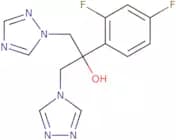
2-(2,4-Difluorophenyl)-1-(1H-1,2,4-triazol-1-yl)-3-(4H-1,2,4-triazol-4-yl)propan-2-ol
CAS:Please enquire for more information about 2-(2,4-Difluorophenyl)-1-(1H-1,2,4-triazol-1-yl)-3-(4H-1,2,4-triazol-4-yl)propan-2-ol including the price, delivery time and more detailed product information at the technical inquiry form on this page
Formula:C13H12F2N6OPurity:Min. 95%Molecular weight:306.27 g/mol4-Amino-3,5,6-trichloropyridine-2-carboxylic acid
CAS:4-Amino-3,5,6-trichloropyridine-2-carboxylic acid (4ATC) is a herbicide that inhibits the activity of pyridoxal phosphate (PLP)-dependent enzymes. 4ATC has been shown to be more toxic to plants than temozolomide and is used in vitro to study the effects of herbicides on cells. It inhibits cell growth and induces apoptosis in human cancer cells. In addition, 4ATC has been shown to inhibit the enzyme activities of group P2 proteins and nucleic acid synthesis. 4ATC also inhibits protein synthesis by inhibiting RNA synthesis in eukaryotic cells. 4ATC is not active against bacteria or fungi.Formula:C6H3Cl3N2O2Purity:Min. 95%Color and Shape:White To Tan SolidMolecular weight:241.46 g/mol7-(2-Chloroethyl)theophylline
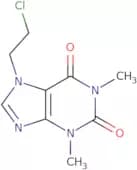
CAS:Controlled Product7-(2-Chloroethyl)theophylline is a drug that is used as a stimulant, depressant, and in some cases to treat asthma. It is an analog of theophylline (a methylxanthine), but with a chlorine atom attached to the 2-position. 7-(2-Chloroethyl)theophylline binds to adenosine receptors, which are found in the central nervous system and play an important role in regulating sleep and wakefulness. Chronic treatment with this drug leads to changes in the distribution of adenosine receptors in the brain. This leads to increased levels of adenosinergic neurotransmitters such as dopamine and serotonin, which may result in beneficial effects on mood disorders such as depression or anxiety. The more potent stimulant properties of 7-(2-Chloroethyl)theophylline are due to its ability to bind to other receptor sites, such as those for dopamine and norepinephrine.
Formula:C9H11ClN4O2Purity:Min. 95%Molecular weight:242.66 g/mol1-Chloro-3-iodobenzene
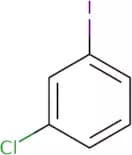
CAS:1-Chloro-3-iodobenzene is a chemical compound that is used in the synthesis of ceramics. It is a colorless solid with a melting point of 337℃ and has a molecular weight of 160.161 g/mol. 1-Chloro-3-iodobenzene can be synthesized by reacting zinc powder with ethylmagnesium chloride in the presence of an aluminium catalyst. This reaction produces 1-chloro-3-iodobenzene, which can then be reacted with carbonyl chloride to produce aminocarbonylation products. The chemical compound was first synthesized by Grignard reagents, which are organometallic compounds containing a carbon atom bonded to a magnesium ion. Kinetic studies have shown that 1-chloro-3-iodobenzene reacts with hydroxide ions to form fluorescent products, although it is not reactive towards water or ammonia.Formula:C6H4ClIPurity:Min. 95%Molecular weight:238.45 g/mol(Des-Gly10,D-Ser(tBu)6,Pro-NHNH29)-LHRH trifluoroacetate salt
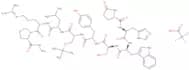
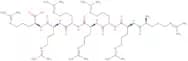
CAS:Please enquire for more information about (Des-Gly10,D-Ser(tBu)6,Pro-NHNH29)-LHRH trifluoroacetate salt including the price, delivery time and more detailed product information at the technical inquiry form on this pageFormula:C58H83N17O13Purity:Min. 95%Molecular weight:1,226.39 g/molH-Arg-Arg-Arg-Arg-Arg-Arg-Arg-OH trifluoroacetate salt
CAS:The Arg-Arg-Arg-Arg-Arg-Arg-Arg-Arg-OH trifluoroacetate salt is a biologically active form of arginine. It has been shown to inhibit the activity of both NS3 protease and NS4A protease from the hepatitis C virus (HCV). It also inhibits tumor cell growth in vitro, which may be due to its ability to upregulate epidermal growth factor receptor (EGFR) expression on tumor cells. The Arg-Arg-Arg-Arg-Arg-Arg-Arghydrogen trifluoroacetate salt is an inhibitor of estrogen receptor modulators that are used as therapeutic agents for breast cancer.Formula:C42H86N28O8Purity:Min. 95%Molecular weight:1,111.32 g/mol(D-Phe6,Leu-NHEt 13,des-Met14)-Bombesin (6-14) trifluoroacetate salt
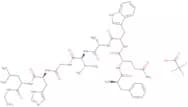
CAS:Bombesin is a peptide hormone that is secreted by the intestines and the pancreas. Bombesin stimulates the adrenal glands to release adrenaline, which in turn stimulates the bladder to contract. Bombesin has been shown to increase bladder efficiency significantly when given intravenously to patients with chronic urinary retention. This drug also has significant effects on pain syndrome, as it can facilitate or inhibit pain depending on its concentration. Bombesin's mechanism of action is still unclear, but it may work by antagonizing other neurotransmitters like noradrenaline or adrenaline.Formula:C49H69N13O9Purity:Min. 95%Molecular weight:984.15 g/molBiotinyl-pTH (1-34) (human) trifluoroacetate salt
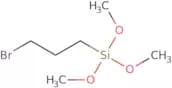
CAS:Please enquire for more information about Biotinyl-pTH (1-34) (human) trifluoroacetate salt including the price, delivery time and more detailed product information at the technical inquiry form on this pageFormula:C191H305N57O53S3Purity:Min. 95%Molecular weight:4,344.02 g/mol(3-Bromopropyl)trimethoxysilane
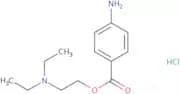
CAS:3-Bromopropyltrimethoxysilane is a divalent hydrocarbon that has been used as a model compound for the study of detection methods. It has been shown to have biocompatible properties and can be used as an immobilization template molecule. 3-Bromopropyltrimethoxysilane also reacts with pyridinium ions to form complexes that are highly stable. The stability of these complexes can be attributed to the functional groups on the pyridine ring, which are more susceptible to hydrolysis than those on the silica surface. 3-Bromopropyltrimethoxysilane is a substrate for nitrate reductase enzymes, resulting in inhibition of growth at concentrations low enough not to cause cytotoxicity.Formula:C6H15BrO3SiPurity:Min. 95%Molecular weight:243.17 g/molProcaine hydrochloride
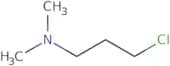
CAS:Controlled ProductSodium channel blockerFormula:C13H21ClN2O2Color and Shape:PowderMolecular weight:272.77 g/mol3-Chloro-N,N-dimethylpropan-1-amine
CAS:3-Chloro-N,N-dimethylpropan-1-amine (3CMP) is a chemical that belongs to the group of organic solvents. It is soluble in water and has a low toxicity for mammals. 3CMP has been shown to have antimicrobial properties against typhimurium and other bacteria. 3CMP binds to the hydroxyl group of biomembranes and interferes with bacterial replication by inhibiting RNA synthesis. The mechanism of this inhibition may be due to the chloride ions that are released from the membrane or may be due to an increase in cell size, which can lead to hypertrophy. 3CMP binds to the chloride ion on bacterial membranes, which inhibits the synthesis of RNA by blocking its ability to bind with the ribosome. This leads to cell death by inhibiting protein synthesis and cell division.Formula:C5H12ClNPurity:Min. 95%Molecular weight:121.61 g/mol5-(H-Gly-Pro-Gly-Pro-amido)-9-[di-(3-sulfonylpropyl)amino]-benzo[a]phenoxazonium perchlorate
CAS:Please enquire for more information about 5-(H-Gly-Pro-Gly-Pro-amido)-9-[di-(3-sulfonylpropyl)amino]-benzo[a]phenoxazonium perchlorate including the price, delivery time and more detailed product information at the technical inquiry form on this pageFormula:C36H42N7O11S2Purity:Min. 95%Molecular weight:812.89 g/mol(D-Pro7)-Angiotensin I/II (1-7) trifluoroacetate salt
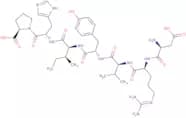
CAS:Please enquire for more information about (D-Pro7)-Angiotensin I/II (1-7) trifluoroacetate salt including the price, delivery time and more detailed product information at the technical inquiry form on this pageFormula:C41H62N12O11Purity:Min. 95%Molecular weight:899.01 g/molFibrinopeptide B (human) trifluoroacetate salt
CAS:Fibrinopeptide B is a fibrinogen-derived peptide that has shown to inhibit the growth of HL-60 cells. It may be active as a receptor antagonist for thrombin and caproic acid. Fibrinopeptide B also inhibits angiogenesis by inhibiting the binding of acidic, basic proteins to the vascular endothelium in atherosclerotic lesions. The biological sample can be obtained from human serum or plasma.Formula:C66H93N19O25Purity:Min. 95%Molecular weight:1,552.56 g/molMyelin Basic Protein (85-99) Peptide Antagonist trifluoroacetate salt
CAS:Please enquire for more information about Myelin Basic Protein (85-99) Peptide Antagonist trifluoroacetate salt including the price, delivery time and more detailed product information at the technical inquiry form on this pageFormula:C70H114N18O21Purity:Min. 95%Molecular weight:1,543.76 g/molNeuropeptide S (1-10) (human) trifluoroacetate salt
CAS:Please enquire for more information about Neuropeptide S (1-10) (human) trifluoroacetate salt including the price, delivery time and more detailed product information at the technical inquiry form on this pageFormula:C42H68N14O14SPurity:Min. 95%Molecular weight:1,025.14 g/molVIP (6-28) (human, mouse, rat) trifluoroacetate salt
CAS:VIP (6-28) (human, mouse, rat) trifluoroacetate salt H-Phe-Thr-Asp-Asn-Tyr-Thr-Arg-Leu-Arg-Lys-Gln-Met-Ala-Val-Lys -Lys-Tyr-Leu is a prophylactic agent that is used to prevent the development of intestinal peptide induced myocardial fibrosis. It has been shown to reduce the incidence and severity of cardiovascular diseases. VIP (6/28) has a vasoactive effect on the intestines and may also have an effect on the cardiovascular system.
Formula:C126H207N37O34SPurity:Min. 95%Molecular weight:2,816.29 g/mol4-bromo-5-chloro-2-fluorobenzoic Acid
CAS:Please enquire for more information about 4-bromo-5-chloro-2-fluorobenzoic Acid including the price, delivery time and more detailed product information at the technical inquiry form on this pageFormula:C7H3BrClFO2Purity:Min. 95%Molecular weight:253.45 g/molTetrabutylammonium fluoride trihydrate
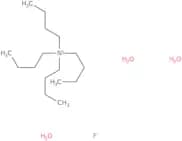
CAS:Tetrabutylammonium fluoride trihydrate is an aromatic hydrocarbon with a hydroxyl group. It is soluble in water and has a strong inhibitory effect on chain reactions. Tetrabutylammonium fluoride trihydrate can be used to inhibit the oxidation of quinoline derivatives that are used as drugs or pesticides. It also has an inhibitory effect on thermodynamic data such as the heat of vaporization, heat capacity, and entropy. The addition of trifluoroacetic acid to an organic solution containing hydrogen bonding interactions increases the solubility of tetrabutylammonium fluoride trihydrate in the organic solutions.Formula:C16H36FN•(H2O)3Purity:Min. 95%Color and Shape:PowderMolecular weight:315.51 g/molBiotinyl-BNP-32 (human) trifluoroacetate salt
CAS:Please enquire for more information about Biotinyl-BNP-32 (human) trifluoroacetate salt including the price, delivery time and more detailed product information at the technical inquiry form on this pageFormula:C153H258N52O44S5Purity:Min. 95%Molecular weight:3,690.34 g/mol


![5-(H-Gly-Pro-Gly-Pro-amido)-9-[di-(3-sulfonylpropyl)amino]-benzo[a]phenoxazonium perchlorate](/_next/image/?url=https%3A%2Fstatic.cymitquimica.com%2Fproducts%2F3D%2Fthumb-webp%2FFG110995.webp&w=3840&q=75)