Organic Halides
Subcategories of "Organic Halides"
Found 20442 products of "Organic Halides"
1-(4-(2-Nitro-4-(trifluoromethyl)phenoxy)phenyl)ethan-1-one
CAS:Please enquire for more information about 1-(4-(2-Nitro-4-(trifluoromethyl)phenoxy)phenyl)ethan-1-one including the price, delivery time and more detailed product information at the technical inquiry form on this page
Purity:Min. 95%Ref: 3D-FN168961
Discontinued product2-(4,6-dimethylpyrimidin-2-ylthio)-N-(4-iodophenyl)acetamide
CAS:Please enquire for more information about 2-(4,6-dimethylpyrimidin-2-ylthio)-N-(4-iodophenyl)acetamide including the price, delivery time and more detailed product information at the technical inquiry form on this page
Purity:Min. 95%Ref: 3D-FD170036
Discontinued product(4-(3-Nitrophenyl)(2,5-thiazolyl))(4-(trifluoromethoxy)phenyl)amine
CAS:Please enquire for more information about (4-(3-Nitrophenyl)(2,5-thiazolyl))(4-(trifluoromethoxy)phenyl)amine including the price, delivery time and more detailed product information at the technical inquiry form on this page
Formula:C16H10F3N3O3SPurity:Min. 95%Color and Shape:PowderMolecular weight:381.33 g/molRef: 3D-FN169531
Discontinued productN-(3,4-Difluorophenyl)-2-chloropropanamide
CAS:Please enquire for more information about N-(3,4-Difluorophenyl)-2-chloropropanamide including the price, delivery time and more detailed product information at the technical inquiry form on this pagePurity:Min. 95%Ref: 3D-FD169941
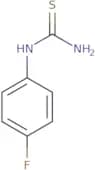
Discontinued productN-(4-Fluorophenyl)thiourea
CAS:N-(4-Fluorophenyl)thiourea (FPTU) is a molecule that belongs to the class of thioureas. It has been shown to have a constant dihedral angle and is membrane transportable, which may be due to its ability to bind receptor proteins. FPTU has also been shown to inhibit chloride ion transport through the intestinal wall. In addition, it has been shown to have anti-inflammatory properties in animal models, which may be due to its ability to inhibit γ-aminobutyric acid (GABA) synthesis.
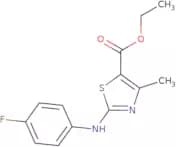
Formula:C7H7FN2SPurity:Min. 95%Molecular weight:170.21 g/molethyl 3-((4-fluorophenyl)amino)-5-methyl-2,4-thiazolecarboxylate
CAS:Please enquire for more information about ethyl 3-((4-fluorophenyl)amino)-5-methyl-2,4-thiazolecarboxylate including the price, delivery time and more detailed product information at the technical inquiry form on this page
Purity:Min. 95%Ref: 3D-FE169431
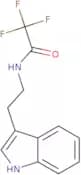
Discontinued product2,2,2-trifluoro-N-(2-indol-3-ylethyl)ethanamide
CAS:2,2,2-Trifluoro-N-(2-indol-3-ylethyl)ethanamide is a synthetic indole that can be used as an intermediate for the synthesis of carbamates.
Formula:C12H11F3N2OPurity:Min. 95%Color and Shape:PowderMolecular weight:256.22 g/molRef: 3D-FT169022
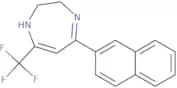
Discontinued product7-(2-Naphthyl)-5-(trifluoromethyl)-1H,2H,3H-1,4-diazepine
CAS:Please enquire for more information about 7-(2-Naphthyl)-5-(trifluoromethyl)-1H,2H,3H-1,4-diazepine including the price, delivery time and more detailed product information at the technical inquiry form on this pageFormula:C16H13F3N2Purity:Min. 95%Color and Shape:PowderMolecular weight:290.28 g/molRef: 3D-FN168955
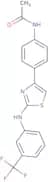
Discontinued productN-(4-(4-((3-(Trifluoromethyl)phenyl)amino)-3,5-thiazolyl)phenyl)ethanamide
CAS:Please enquire for more information about N-(4-(4-((3-(Trifluoromethyl)phenyl)amino)-3,5-thiazolyl)phenyl)ethanamide including the price, delivery time and more detailed product information at the technical inquiry form on this pageFormula:C18H14F3N3OSPurity:Min. 95%Color and Shape:PowderMolecular weight:377.38 g/molRef: 3D-FT169693
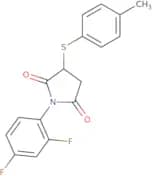
Discontinued product1-(2,4-difluorophenyl)-3-(4-methylphenylthio)pyrrolidine-2,5-dione
CAS:Please enquire for more information about 1-(2,4-difluorophenyl)-3-(4-methylphenylthio)pyrrolidine-2,5-dione including the price, delivery time and more detailed product information at the technical inquiry form on this page
Purity:Min. 95%Ref: 3D-FD170017
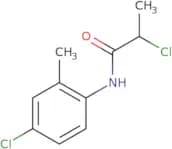
Discontinued productN-(4-Chloro-2-methylphenyl)-2-chloropropanamide
CAS:Please enquire for more information about N-(4-Chloro-2-methylphenyl)-2-chloropropanamide including the price, delivery time and more detailed product information at the technical inquiry form on this page
Purity:Min. 95%Ref: 3D-FC169985
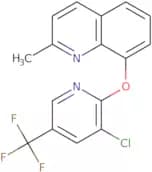
Discontinued product3-Chloro-2-(2-methyl(8-quinolyloxy))-5-(trifluoromethyl)pyridine
CAS:Please enquire for more information about 3-Chloro-2-(2-methyl(8-quinolyloxy))-5-(trifluoromethyl)pyridine including the price, delivery time and more detailed product information at the technical inquiry form on this page
Formula:C16H10ClF3N2OPurity:Min. 95%Color and Shape:PowderMolecular weight:338.71 g/molRef: 3D-FC169546
Discontinued product2-chloro-n-[3-(trifluoromethyl)phenyl]acetamide
CAS:Please enquire for more information about 2-chloro-n-[3-(trifluoromethyl)phenyl]acetamide including the price, delivery time and more detailed product information at the technical inquiry form on this page
Formula:C9H7ClF3NOPurity:Min. 95%Molecular weight:237.61 g/molRef: 3D-FC59251
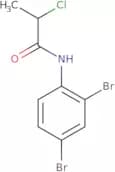
Discontinued productN-(2,4-Dibromophenyl)-2-chloropropanamide
CAS:Please enquire for more information about N-(2,4-Dibromophenyl)-2-chloropropanamide including the price, delivery time and more detailed product information at the technical inquiry form on this page
Purity:Min. 95%Ref: 3D-FD169162
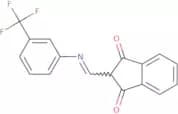
Discontinued product2-(2-Aza-2-(3-(trifluoromethyl)phenyl)vinyl)indane-1,3-dione
CAS:Please enquire for more information about 2-(2-Aza-2-(3-(trifluoromethyl)phenyl)vinyl)indane-1,3-dione including the price, delivery time and more detailed product information at the technical inquiry form on this page
Formula:C17H10F3NO2Purity:Min. 95%Color and Shape:PowderMolecular weight:317.26 g/molRef: 3D-FA169658
Discontinued product2-Chloro(3-pyridyl) 4-(5-chloro-2-methylphenyl)piperazinyl ketone
CAS:Please enquire for more information about 2-Chloro(3-pyridyl) 4-(5-chloro-2-methylphenyl)piperazinyl ketone including the price, delivery time and more detailed product information at the technical inquiry form on this page
Formula:C17H17Cl2N3OPurity:Min. 95%Color and Shape:PowderMolecular weight:350.24 g/molRef: 3D-FC170002
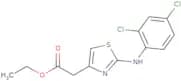
Discontinued productEthyl 2-(4-(2,4-dichlorophenylamino)-3,5-thiazolyl)acetate
CAS:Please enquire for more information about Ethyl 2-(4-(2,4-dichlorophenylamino)-3,5-thiazolyl)acetate including the price, delivery time and more detailed product information at the technical inquiry form on this page
Purity:Min. 95%Ref: 3D-FE169285
Discontinued product2-Chloro-N-[2-(trifluoromethyl)phenyl]propanamide
CAS:Please enquire for more information about 2-Chloro-N-[2-(trifluoromethyl)phenyl]propanamide including the price, delivery time and more detailed product information at the technical inquiry form on this pageFormula:C10H9ClF3NOPurity:Min. 95%Molecular weight:251.63 g/molRef: 3D-FC127364
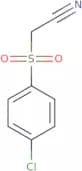
Discontinued product2-(4-Chlorobenzenesulphonyl)acetonitrile
CAS:2-(4-Chlorobenzenesulphonyl)acetonitrile is a reactive chemical that is synthesized from chloroform and acetonitrile. It can be used to synthesize various medicines such as analgesics, muscle relaxants, and x-ray contrast agents. 2-(4-Chlorobenzenesulphonyl)acetonitrile has minimal effects on the human body and is not known to cause any major health problems. It is metabolized in the liver by oxidation of the methyl group to form 4-chlorobenzene sulfonic acid, which is excreted through urine. The chlorine atom in this molecule has a trigonal bipyramidal geometry with a bond length of 1.82 Å, which can be seen in x-ray crystallography studies.
Formula:C8H6ClNO2SPurity:Min. 95%Color and Shape:PowderMolecular weight:215.66 g/molRef: 3D-FC36027
Discontinued productEthyl 3-((2,4-dichlorophenyl)amino)-5-methyl-2,4-thiazolecarboxylate
CAS:Please enquire for more information about Ethyl 3-((2,4-dichlorophenyl)amino)-5-methyl-2,4-thiazolecarboxylate including the price, delivery time and more detailed product information at the technical inquiry form on this pagePurity:Min. 95%Ref: 3D-FE169178
Discontinued product2-Chloro-6-fluorocinnamic acid
CAS:Please enquire for more information about 2-Chloro-6-fluorocinnamic acid including the price, delivery time and more detailed product information at the technical inquiry form on this page
Formula:C9H6ClFO2Purity:Min. 95%Color and Shape:PowderMolecular weight:200.59 g/molRef: 3D-FC79506
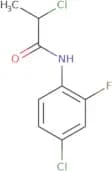
Discontinued productN-(4-Chloro-2-fluorophenyl)-2-chloropropanamide
CAS:Please enquire for more information about N-(4-Chloro-2-fluorophenyl)-2-chloropropanamide including the price, delivery time and more detailed product information at the technical inquiry form on this page
Purity:Min. 95%Ref: 3D-FC169939
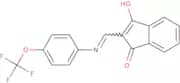
Discontinued product2-(((4-(Trifluoromethoxy)phenyl)amino)methylene)indane-1,3-dione
CAS:Please enquire for more information about 2-(((4-(Trifluoromethoxy)phenyl)amino)methylene)indane-1,3-dione including the price, delivery time and more detailed product information at the technical inquiry form on this page
Formula:C17H10F3NO3Purity:Min. 95%Color and Shape:PowderMolecular weight:333.26 g/molRef: 3D-FT169657
Discontinued productN-(4-Hydroxyphenyl)-2-chloropropanamide
Please enquire for more information about N-(4-Hydroxyphenyl)-2-chloropropanamide including the price, delivery time and more detailed product information at the technical inquiry form on this page
Purity:Min. 95%Ref: 3D-FH169975
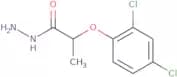
Discontinued product2-(2,4-Dichlorophenoxy)propanohydrazide
CAS:Please enquire for more information about 2-(2,4-Dichlorophenoxy)propanohydrazide including the price, delivery time and more detailed product information at the technical inquiry form on this page
Formula:C9H10Cl2N2O2Purity:Min. 95%Color and Shape:PowderMolecular weight:249.09 g/molRef: 3D-FD114225
Discontinued product2-{[3-chloro-5-(trifluoromethyl)-2-pyridinyl]sulfanyl}acetohydrazide
CAS:Please enquire for more information about 2-{[3-chloro-5-(trifluoromethyl)-2-pyridinyl]sulfanyl}acetohydrazide including the price, delivery time and more detailed product information at the technical inquiry form on this pagePurity:Min. 95%Ref: 3D-FC170011
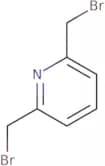
Discontinued product2,6-Bis(bromomethyl)pyridine
CAS:2,6-Bis(bromomethyl)pyridine (BMP) is a pyridine derivative that is used as a catalyst in organic synthesis. It has been shown to be an effective catalyst for the conversion of picolinic acid to xanthopterin in the presence of sodium. The reactivity of BMP can be attributed to its functionalities and the metal ion that it contains. The reaction mechanism has been studied by computer modelling and molecular modelling techniques. The catalytic rate is determined by intramolecular hydrogen transfer.
Formula:C7H7Br2NPurity:Min. 95%Molecular weight:264.95 g/molRef: 3D-FB74901
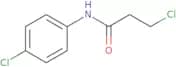
Discontinued product3-Chloro-N-(4-chlorophenyl)propanamide
CAS:Please enquire for more information about 3-Chloro-N-(4-chlorophenyl)propanamide including the price, delivery time and more detailed product information at the technical inquiry form on this page
Formula:C9H9Cl2NOPurity:Min. 95%Color and Shape:PowderMolecular weight:218.08 g/molRef: 3D-FC125304
Discontinued product2-chloro-N-(4-(trifluoromethylthio)phenyl)ethanamide
CAS:Please enquire for more information about 2-chloro-N-(4-(trifluoromethylthio)phenyl)ethanamide including the price, delivery time and more detailed product information at the technical inquiry form on this pageFormula:C9H7ClF3NOSPurity:Min. 95%Color and Shape:PowderMolecular weight:269.67 g/molRef: 3D-FC169732
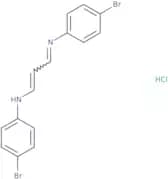
Discontinued product(3-(4-Bromophenylamino)prop-2-enylidene)4-bromophenylamine hydrochloride
CAS:Please enquire for more information about (3-(4-Bromophenylamino)prop-2-enylidene)4-bromophenylamine hydrochloride including the price, delivery time and more detailed product information at the technical inquiry form on this page
Formula:C15H12Br2N2•HClPurity:Min. 95%Color and Shape:PowderMolecular weight:416.54 g/molRef: 3D-FB169478
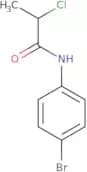
Discontinued productN-(4-Bromophenyl)-2-chloropropanamide
CAS:Please enquire for more information about N-(4-Bromophenyl)-2-chloropropanamide including the price, delivery time and more detailed product information at the technical inquiry form on this page
Formula:C9H9BrClNOPurity:Min. 95%Color and Shape:PowderMolecular weight:262.53 g/molRef: 3D-FB113989
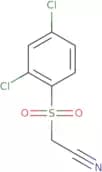
Discontinued product2,4-Dichlorobenzenesulphonylacetonitrile
CAS:Please enquire for more information about 2,4-Dichlorobenzenesulphonylacetonitrile including the price, delivery time and more detailed product information at the technical inquiry form on this page
Purity:Min. 95%Ref: 3D-FD168895
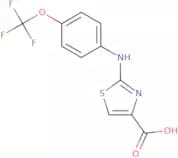
Discontinued product2-((4-(Trifluoromethoxy)phenyl)amino)-1,3-thiazole-4-carboxylic acid
CAS:Please enquire for more information about 2-((4-(Trifluoromethoxy)phenyl)amino)-1,3-thiazole-4-carboxylic acid including the price, delivery time and more detailed product information at the technical inquiry form on this page
Formula:C11H7F3N2O3SPurity:Min. 95%Color and Shape:PowderMolecular weight:304.25 g/molRef: 3D-FT169365
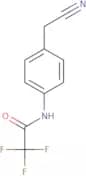
Discontinued productN-(4-(nitrilomethyl)phenyl)-2,2,2-trifluoroethanamide
CAS:Please enquire for more information about N-(4-(nitrilomethyl)phenyl)-2,2,2-trifluoroethanamide including the price, delivery time and more detailed product information at the technical inquiry form on this page
Formula:C10H7F3N2OPurity:Min. 95%Color and Shape:PowderMolecular weight:228.17 g/molRef: 3D-FN169117
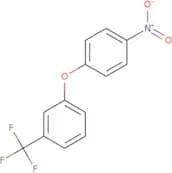
Discontinued product1-Nitro-4-(3-(trifluoromethyl)phenoxy)benzene
CAS:Please enquire for more information about 1-Nitro-4-(3-(trifluoromethyl)phenoxy)benzene including the price, delivery time and more detailed product information at the technical inquiry form on this page
Purity:Min. 95%Ref: 3D-FN168960
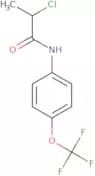
Discontinued product2-chloro-N-(4-(trifluoromethoxy)phenyl)propanamide
CAS:Please enquire for more information about 2-chloro-N-(4-(trifluoromethoxy)phenyl)propanamide including the price, delivery time and more detailed product information at the technical inquiry form on this page
Purity:Min. 95%Ref: 3D-FC169134
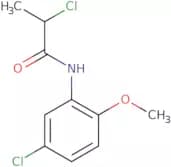
Discontinued product2-Chloro-N-(5-chloro-2-methoxyphenyl)propanamide
CAS:Please enquire for more information about 2-Chloro-N-(5-chloro-2-methoxyphenyl)propanamide including the price, delivery time and more detailed product information at the technical inquiry form on this pageFormula:C10H11Cl2NO2Purity:Min. 95%Molecular weight:248.11 g/molRef: 3D-FC114021
Discontinued product3-(4-Benzyloxy-3-methoxyphenyl)-4-(4-chlorophenyl)-1,2,4-triazoline-5-thione
CAS:Please enquire for more information about 3-(4-Benzyloxy-3-methoxyphenyl)-4-(4-chlorophenyl)-1,2,4-triazoline-5-thione including the price, delivery time and more detailed product information at the technical inquiry form on this pagePurity:Min. 95%Ref: 3D-FB169299
Discontinued productEthyl 3-(2-chloropropanoylamino)benzoate
Please enquire for more information about Ethyl 3-(2-chloropropanoylamino)benzoate including the price, delivery time and more detailed product information at the technical inquiry form on this page
Purity:Min. 95%Ref: 3D-FE169161
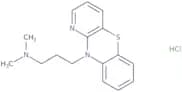
Discontinued productProthipendyl hydrochloride
CAS:Controlled ProductProthipendyl hydrochloride is a low-potency, non-selective 5-HT receptor antagonist. It is used in the treatment of depression and anxiety disorders. Prothipendyl hydrochloride has been shown to be effective in treating Parkinson's disease and other movement disorders by blocking the action of dopamine on 5-HT receptors. Prothipendyl hydrochloride also has been shown to have cardiac effects. It binds to cardiac tissue with high affinity, which may be due to its ability to bind nitrogen atoms. Prothipendyl hydrochloride is not active against human liver cells, which may be due to its specificity for cb2 receptors that are found only in the central nervous system.
Formula:C16H20ClN3SPurity:Min. 95%Molecular weight:321.87 g/molRef: 3D-FP27245
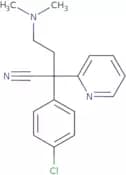
Discontinued productChlorphenamine EP Impurity D maleate salt
CAS:Chlorpheniramine nitrile is the nitrile derivative of chlorpheniramine. The decyanation reaction was carried out with potassium hydroxide and chlorpheniramine, then the resulting potassium nitriles were hydrolyzed using acid to yield the desired product. Chlorpheniramine nitrile has a potent anti-histaminic effect that is used for the treatment of allergies or anaphylaxis.
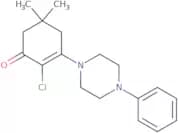
Formula:C17H18ClN3Purity:Min. 95%Molecular weight:299.8 g/mol2-Chloro-5,5-dimethyl-3-(4-phenylpiperazinyl)cyclohex-2-en-1-one
CAS:Please enquire for more information about 2-Chloro-5,5-dimethyl-3-(4-phenylpiperazinyl)cyclohex-2-en-1-one including the price, delivery time and more detailed product information at the technical inquiry form on this pageFormula:C18H23ClN2OPurity:Min. 95%Color and Shape:PowderMolecular weight:318.84 g/molRef: 3D-FC169651
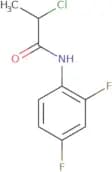
Discontinued productN-(2,4-Difluorophenyl)-2-chloropropanamide
CAS:Please enquire for more information about N-(2,4-Difluorophenyl)-2-chloropropanamide including the price, delivery time and more detailed product information at the technical inquiry form on this pagePurity:Min. 95%Ref: 3D-FD169151
Discontinued product5-Phenyl-3-((3-(trifluoromethyl)phenyl)amino)cyclohex-2-en-1-one
CAS:Please enquire for more information about 5-Phenyl-3-((3-(trifluoromethyl)phenyl)amino)cyclohex-2-en-1-one including the price, delivery time and more detailed product information at the technical inquiry form on this pageFormula:C19H16F3NOPurity:Min. 95%Color and Shape:PowderMolecular weight:331.33 g/molRef: 3D-FP169542
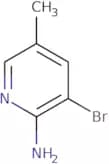
Discontinued product2-Amino-3-bromo-5-methylpyridine
CAS:2-Amino-3-bromo-5-methylpyridine is an imidazopyrazine that interacts with the magnetic field and can be used as a ligand. It has been synthesized from pyrazole derivatives and has been shown to have antimicrobial activity against Cryptococcus neoformans. 2-Amino-3-bromo-5-methylpyridine has also been shown to inhibit the growth of bacterial cells by binding to the nicotinamide adenine dinucleotide phosphate (NADP) cofactor in bacterial cells, thereby preventing ATP production. This drug is structurally related to fluoroquinolones, which are known for their antibacterial activity. 2-Amino-3-bromo-5-methylpyridine is an amido compound that ionizes in acidic environments and transfers electrons via resonance transfer. Its FTIR spectra show strong absorption bands at 3595 cm−1
Formula:C6H7BrN2Purity:Min. 95%Molecular weight:187.04 g/molRef: 3D-FA08146
Discontinued product2,5-Dichlorobenzenesulphonylacetamide oxime
Please enquire for more information about 2,5-Dichlorobenzenesulphonylacetamide oxime including the price, delivery time and more detailed product information at the technical inquiry form on this page
Purity:Min. 95%Ref: 3D-FD169401
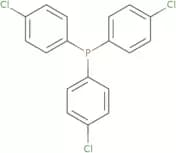
Discontinued productTris(4-chlorophenyl)phosphine
CAS:Tris(4-chlorophenyl)phosphine (PCy3) is a chemical compound that has shown anticancer activity in vitro. It is an acceptor and a potent anti-cancer agent, with the ability to inhibit the growth of human cancer cells and tumor xenografts. PCy3 is also able to inhibit the proliferation of cultured leukemia cells by inducing apoptosis through caspase activation. PCy3 has been used as a crystallization aid for other compounds, such as boronic acids. The crystal system of PCy3 is orthorhombic and it has a space group Pca21. This compound exhibits magnetic resonance spectroscopy properties.
Formula:C18H12Cl3PPurity:Min. 95%Color and Shape:PowderMolecular weight:365.6 g/molRef: 3D-FT168829
Discontinued product2-(4-(4-(Trifluoromethyl)phenylamino)-3,5-thiazolyl)acetic acid
CAS:Please enquire for more information about 2-(4-(4-(Trifluoromethyl)phenylamino)-3,5-thiazolyl)acetic acid including the price, delivery time and more detailed product information at the technical inquiry form on this pagePurity:Min. 95%Ref: 3D-FT169275
Discontinued product1-(4-Bromophenyl)-1H-pyrrole-2,5-dione
CAS:1-(4-Bromophenyl)-1H-pyrrole-2,5-dione is an inhibitor of styrene polymerization. This compound was shown to inhibit styrene polymerization in a concentration dependent manner and has been used as a model for the evaluation of other inhibitors. The inhibition mechanism of 1-(4-bromophenyl)-1H-pyrrole-2,5-dione can be attributed to its ability to bind to the active site of the enzyme Styrene Synthase and block reaction by steric hindrance. It also inhibits fatty acid synthesis by blocking lipases. This compound has been used in copolymerization techniques with styrene and other monomers due to its stability in organic solvents. 1-(4-Bromophenyl)-1H-pyrrole-2,5-dione has also been shown to have a strong radiation sensitive effect on polystyrene films when used as a sensitizer in
Formula:C10H6BrNO2Purity:Min. 95%Color and Shape:PowderMolecular weight:252.06 g/molRef: 3D-FB122375
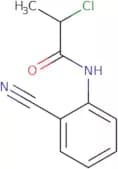
Discontinued productN-(2-Cyanophenyl)-2-chloropropanamide
CAS:Please enquire for more information about N-(2-Cyanophenyl)-2-chloropropanamide including the price, delivery time and more detailed product information at the technical inquiry form on this page
Purity:Min. 95%Ref: 3D-FC169928
Discontinued product


![2-chloro-n-[3-(trifluoromethyl)phenyl]acetamide](/_next/image/?url=https%3A%2Fstatic.cymitquimica.com%2Fproducts%2F3D%2Fthumb-webp%2FFC59251.webp&w=3840&q=75)
![2-Chloro-N-[2-(trifluoromethyl)phenyl]propanamide](/_next/image/?url=https%3A%2Fstatic.cymitquimica.com%2Fproducts%2F3D%2Fthumb-webp%2FFC127364.webp&w=3840&q=75)

![2-{[3-chloro-5-(trifluoromethyl)-2-pyridinyl]sulfanyl}acetohydrazide](/_next/image/?url=https%3A%2Fstatic.cymitquimica.com%2Fproducts%2F3D%2Fthumb-webp%2FFC170011.webp&w=3840&q=75)