Organic Halides
Subcategories of "Organic Halides"
Found 20443 products of "Organic Halides"
N-[1-(4-Fluorophenyl)propan-2-Yl]-N-methylprop-2-Yn-1-amine
CAS:Controlled ProductN-[1-(4-Fluorophenyl)propan-2-Yl]-N-methylprop-2-Yn-1-amine is a synthetic molecule that has been shown to be an inhibitor of the enzyme nitroethane reductase. This drug is also capable of inhibiting the activity of other enzymes and is being investigated for its potential use in the treatment of various types of cancer. N-[1-(4-Fluorophenyl)propan-2-Yl]-N-methylprop-2-Yn-1-amine inhibits nitroethane reductase by binding reversibly to the active site and competitively inhibiting the substrate. The potency of this drug against nitroethane reductase has been shown to be increased by alkylation.br> The inhibition of nitroethane reductase by N-[1-(4-fluorophenyl)propan-2-Yl]-Formula:C13H16FNPurity:Min. 95%Molecular weight:205.27 g/mol5-Chloro-3-phenyl-1,2,4-oxadiazole
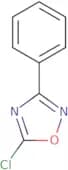
CAS:5-Chloro-3-phenyl-1,2,4-oxadiazole is a potent and selective inhibitor of fatty acid amide hydrolase (FAAH). It is also an inhibitor of the permeability glycoprotein PGP. 5-Chloro-3-phenyl-1,2,4-oxadiazole has a potent inhibitory activity against FAAH and PGP at low concentrations. This inhibition can be improved by optimization of the lead compound. 5-Chloro-3-phenyl-1,2,4-oxadiazole is orally active in rats and in humans. In animal studies it has been shown to produce dose dependent effects on blood pressure and heart rate when administered intravenously or orally.Formula:C8H5ClN2OPurity:Min. 95%Molecular weight:180.59 g/molDelta-9(11)-Fluorometholone acetate
CAS:Controlled ProductPlease enquire for more information about Delta-9(11)-Fluorometholone acetate including the price, delivery time and more detailed product information at the technical inquiry form on this page
Formula:C24H30O4Purity:Min. 95%Molecular weight:382.49 g/molN,N-Diethylaminoethyl 2,2-diphenylvalerate hydrochloride
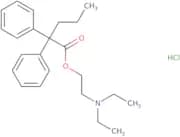
CAS:Controlled ProductN,N-Diethylaminoethyl 2,2-diphenylvalerate hydrochloride is a depressant drug that inhibits the growth of bacteria by inhibiting fatty acid synthesis. It has been shown to inhibit group P2 enzymes that are involved in the production of fatty acids. In this way, it inhibits the formation and release of ATP, which is essential for bacterial growth. N,N-Diethylaminoethyl 2,2-diphenylvalerate hydrochloride also has inhibitory properties against bacteria that cause infectious diseases. This drug is effective against Hl-60 cells and can be used as a diagnostic tool for detection sensitivity and detection time.Formula:C23H32ClNO2Purity:Min. 95%Molecular weight:389.96 g/molDichloromethylsilane
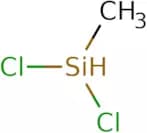
CAS:Dichloromethylsilane (DCS) is a chemical compound that is used in the synthesis of silicone rubber, silicone elastomers, and silicone sealants. It can also be used as a cross-linking agent for polymers such as polyurethane, epoxy resin, and silicone. The synthesis of DCS is achieved by reacting chlorosilanes with methyl alcohol or methyl chloride in the presence of an acid catalyst. DCS exhibits high chemical stability and can be activated at room temperature. This product has been shown to be useful for fabricating medical devices that are implanted into the human body because it does not react with water or blood.
Formula:CH4Cl2SiPurity:Min. 95%Molecular weight:115.03 g/mol2-Dimethylaminoisopropyl chloride hydrochloride
CAS:2-Dimethylaminoisopropyl chloride hydrochloride is a fluorescent molecule that emits light at wavelengths of 370-430 nm. It has a number of uses, such as detecting the presence or absence of chloride ions in water samples, determining the composition of petroleum products, and measuring the concentration of sodium ions in electrolytes. 2-Dimethylamino-1-propanesulfonic acid chloride hydrochloride can be used to identify the transition metal (Cu) in a sample, because it absorbs light at wavelengths below 450 nm.Formula:C5H12ClN·HClPurity:Min. 95%Color and Shape:White to off-white solid.Molecular weight:158.07 g/molBis(trimethylsilyl)bromomethane
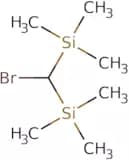
CAS:Bis(trimethylsilyl)bromomethane is an alkali metal compound that is a multinuclear, crystalline solid. It has an x-ray diffraction pattern with peaks at 30, 39, and 44 degrees. The elemental analysis of the compound shows it to be composed of carbon and hydrogen. Bis(trimethylsilyl)bromomethane is a tetrahydrofuran derivative that can be alkylated or silylated with metal compounds. This compound has been shown to have coordination properties when combined with potassium. The molecular structure of bis(trimethylsilyl)bromomethane is composed of two trimethylsiloxy groups linked together by one bromine atom.
Formula:C7H19BrSi2Purity:Min. 95%Color and Shape:Clear LiquidMolecular weight:239.3 g/molDichloro(1,1-bis(diphenylphosphino)ferrocene)palladium(II)acetoneadduct
CAS:Controlled ProductPlease enquire for more information about Dichloro(1,1-bis(diphenylphosphino)ferrocene)palladium(II)acetoneadduct including the price, delivery time and more detailed product information at the technical inquiry form on this page
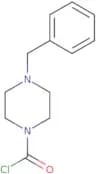
Formula:C37H34Cl2FeOP2PdPurity:Min. 95%Molecular weight:789.78 g/mol4-Benzyl-piperazine-1-carbonylchloride
CAS:Controlled ProductPlease enquire for more information about 4-Benzyl-piperazine-1-carbonylchloride including the price, delivery time and more detailed product information at the technical inquiry form on this page
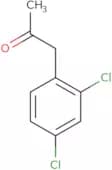
Formula:C12H15ClN2OPurity:Min. 95%Molecular weight:238.71 g/mol(2,4-Dichlorophenyl)acetone
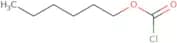
CAS:(2,4-Dichlorophenyl)acetone is a substance that can be found in lichens. The natural occurrence of this substance has been shown by the use of chromatography technique on plates. (2,4-Dichlorophenyl)acetone is also used as a screening agent for lichens.Formula:C9H8Cl2OPurity:Min. 95%Color and Shape:Off-White PowderMolecular weight:203.06 g/molHexyl carbonochloridate
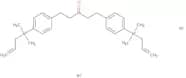
CAS:Hexyl carbonochloridate is a chemical that has been used as a detergent additive. It is also an antimicrobial agent, which has been shown to inactivate enzymes in human serum. Hexyl carbonochloridate is active against hepatitis and other infectious diseases. This compound is also known to be an agonist of toll-like receptor 4 (TLR4), which is a protein that recognizes lipopolysaccharides from gram-negative bacteria. Hexyl carbonochloridate has been shown to have anti-inflammatory properties, possibly due to its hydroxyl group. The analytical method for this compound utilizes gas chromatography with flame ionization detection (GC-FID).Formula:C7H13ClO2Purity:Min. 95%Molecular weight:164.63 g/mol1,5-Bis(4-allyldimethylammoniumphenyl)pentan-3-one, dibromide
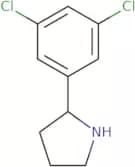
CAS:1,5-Bis(4-allyldimethylammoniumphenyl)pentan-3-one, dibromide is a reversible inhibitor of acetylcholinesterase. It has been shown to inhibit the enzyme activity in vitro and in vivo. 1,5-Bis(4-allyldimethylammoniumphenyl)pentan-3-one, dibromide has been shown to be an effective inhibitor of nicotinic acetylcholine receptors in model organisms such as Xenopus oocytes and Acetylcholine esterase activated rat pheochromocytoma cells. The molecule also inhibits the phosphorylation of pnitrophenyl phosphate by choline kinase. This inhibiting effect on choline kinase leads to a decrease in the concentration of choline available for neurotransmitter synthesis. Monoclonal antibodies against acetylcholinesterase are used to detect thisFormula:C27H38Br2N2OPurity:Min. 95%Molecular weight:566.41 g/mol2-(3,5-Dichlorophenyl)Pyrrolidine
CAS:Please enquire for more information about 2-(3,5-Dichlorophenyl)Pyrrolidine including the price, delivery time and more detailed product information at the technical inquiry form on this page
Formula:C10H11Cl2NPurity:Min. 95%Molecular weight:216.11 g/molN-Chlorosuccinimide
CAS:Chlorinating agents are used in the production of pharmaceutical preparations and other chemical products. They react with amines to form diazonium salts, which can then be reduced to azo compounds. N-Chlorosuccinimide is a chlorinating agent that reacts with amines to form diazonium salts. It is used primarily as an injection solution for the treatment of trichomoniasis and other sexually transmitted diseases, but it also has been used in the preparation of pharmaceutical preparations. The reaction mechanism for N-chlorosuccinimide is not well understood, but it may involve a free radical intermediate or electron transfer from the chlorine atom to the carbon atom. Diazonium salts are formed by the reaction between an amine and an acid chloride. The addition of sodium hydroxide produces the corresponding azo compound. The reaction mechanism for N-chlorosuccinimide is not well understood, but it may involve a free radical intermediate orFormula:C4H4ClNO2Purity:Min. 95%Color and Shape:White PowderMolecular weight:133.53 g/molEtoxeridine hydrochloride
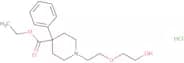
CAS:Controlled ProductPlease enquire for more information about Etoxeridine hydrochloride including the price, delivery time and more detailed product information at the technical inquiry form on this pageFormula:C18H28ClNO4Purity:Min. 95%Molecular weight:357.87 g/molTetrabutylammonium hexafluorophosphate
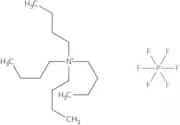
CAS:Tetrabutylammonium hexafluorophosphate is a chemical reagent that is used in organic synthesis. It is a strong Lewis acid that reacts with substrates to form adducts. Tetrabutylammonium hexafluorophosphate reacts with trifluoroacetic acid, ethylene diamine, and hydrogen fluoride to produce the salt tetrabutylammonium hexafluorophosphate dihydrate (TBAPF). The reaction proceeds through an ionic intermediate that involves the abstraction of a proton from the substrate by the tetrabutylammonium cation followed by nucleophilic attack on the anion by water. Tetrabutylammonium hexafluorophosphate dihydrate can be formed via this mechanism as well as through a simple salt metathesis reaction between TBAPF and sodium carbonate. This reagent has been shown to form crystals of good quality forFormula:C16H36F6NPPurity:Min. 98.0%Color and Shape:PowderMolecular weight:387.43 g/mol1-(2-Fluorobenzyl)piperazine
CAS:Controlled Product1-(2-Fluorobenzyl)piperazine (1FP) is an inhibitor of cholinesterase, which is an enzyme that breaks down the neurotransmitter acetylcholine. It binds to the active site of the enzyme and prevents it from functioning. 1FP has a high affinity for benzylpiperazine (BZP), but lower affinity for phenylpiperazine (PP). The conformational kinetic study showed that 1FP inhibits BZP more effectively than PP. This is due to the fact that 1FP has a higher dihedral angle, making it more likely to bind in the active site of BZP.
Purity:Min. 95%Neotetrazolium Chloride
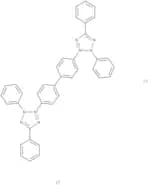
CAS:Neotetrazolium chloride is a tetrazolium dye that is used to detect the presence of living cells in a sample. It has an optimum concentration of 0.2% and significant cytotoxicity at concentrations greater than 1%. Neotetrazolium chloride binds to intracellular targets such as enzymes and nucleic acids, which can be detected by biochemical methods such as polymerase chain reaction (PCR). Neotetrazolium chloride can also bind to cell nuclei, making it useful for determining the number of viable cells in a sample. The bound form of neotetrazolium chloride is soluble in water and its detection limit is 10 fg/mL.Formula:C38H28N8·2ClPurity:Min. 95%Molecular weight:667.59 g/molS-(+)-α-Methoxy-α-(trifluoromethyl)phenylacetic acid chloride
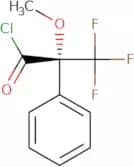
CAS:S-(+)-alpha-Methoxy-alpha-(trifluoromethyl)phenylacetic acid chloride is an optical, amide, and epoxidation derivatizing agent that is used to chiralify amines. It is a liquid at room temperature with a molecular weight of 123.87 g/mol. This chemical reacts with alcohols to form esters, which can be identified by their different retention times in chromatography. It also reacts with hydroxyl groups to form ethers and esters, as well as hydroxyls on other molecules such as amino acids, peptides, and proteins. S-(+)-alpha-Methoxy-alpha-(trifluoromethyl)phenylacetic acid chloride has been used for the synthesis of bisoprolol from metoprolol and triethylphosphite.
Formula:C10H8ClF3O2Purity:Min. 95%Molecular weight:252.62 g/mol1,2,3,4-Tetrahydronaphthalen-2-amine hydrobromide
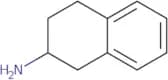
CAS:Controlled Product1,2,3,4-Tetrahydronaphthalen-2-amine hydrobromide (THNA) is an amine that inhibits the enzyme tyrosine hydroxylase. This inhibition leads to a decrease in the synthesis of dopamine and norepinephrine. THNA has been shown to have inhibitory properties on locomotor activity, acid complex formation, and aminotransferases. It also exhibits receptor binding and agonist binding site activity. One study found that THNA had no effect on rat striatal tissue. The drug has been shown to be effective in metabolic disorders such as obesity.
Formula:C10H13NPurity:Min. 95%Molecular weight:147.22 g/mol
![N-[1-(4-Fluorophenyl)propan-2-Yl]-N-methylprop-2-Yn-1-amine](/_next/image/?url=https%3A%2Fstatic.cymitquimica.com%2Fproducts%2F3D%2Fthumb-webp%2FFF95966.webp&w=3840&q=75)