Biochemicals and Reagents
Subcategories of "Biochemicals and Reagents"
- Biomolecules(98,557 products)
- By Biological Target(101,015 products)
- By Pharmacological Effects(6,941 products)
- Cryopreservatives(21 products)
- Desinfectants and Related Compounds(28 products)
- Hormones(530 products)
- Plant Biology(6,903 products)
- Secondary Metabolites(14,371 products)
Found 130589 products of "Biochemicals and Reagents"
Recombinant Dog Troponin I Protein
Recombinant Dog Troponin I (TNNI3) Protein is a life science tool for use in pharmaceutical and diagnostic applications. Please enquire for more information about Recombinant Dog Troponin I Protein including the price, delivery time and more detailed product information at the technical inquiry form on this page.HBsAg Recombinant Protein, Subtype adr
HBsAg Recombinant Protein, Subtype adr is a life science tool for use in pharmaceutical and diagnostic applications. Please enquire for more information about HBsAg Recombinant Protein, Subtype adr including the price, delivery time and more detailed product information at the technical inquiry form on this page.Purity:Purified By Ion Exchange Chromatography. >90%Saterinone
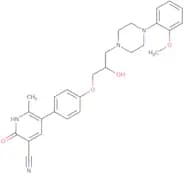
CAS:Saterinone is a cardiac glycoside that binds to the beta-adrenergic receptor. Saterinone has been shown to reduce the incidence of cancer and bowel disease in rats, as well as the severity of bowel disease. It is also used for the treatment of congestive heart failure and inflammatory bowel disease. This drug has inhibitory properties on isolated heart muscle cells, which are mediated by its ability to bind to the beta-adrenergic receptor. Furthermore, saterinone may have a role in blood pressure monitoring because it inhibits angiotensin II-induced contraction of isolated vascular smooth muscle cells.
Saterinone is an inhibitor of nitroprusside-induced hypotension in rabbits, which may be due to its ability to inhibit nitric oxide synthase (NOS).Formula:C27H30N4O4Purity:Min. 95%Molecular weight:474.6 g/molm-dPEG®12-Amido-dPEG®12-TFP Ester
m-dPEG®12-Amido-dPEG®12-TFP Ester is a PEG compound with two different functional groups (also known as heterobifunctional). Unlike homobifunctional PEG compounds (same functional group on both ends), this type of compounds are more versatile as have two different anchor points. m-dPEG®12-Amido-dPEG®12-TFP Ester is used as a linker and spacer to add a PEG moiety, via pegylation (a bioconjugation technique) to proteins, peptides, oligonucleotides, small molecules and nanoparticles.
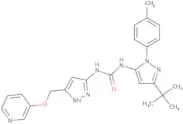
Formula:C59H105F4NO27Purity:Min. 95%Molecular weight:1,336.45 g/molGSK PERK inhibitor
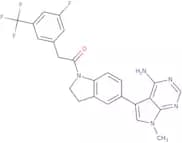
CAS:Inhibitor of EIF2AK3/PERK kinasesFormula:C24H19F4N5OPurity:Min. 95%Molecular weight:469.43 g/molBromoacetamido-dPEG®11-Azide
Bromoacetamido-dPEG®11-Azide is a PEG compound with two different functional groups (also known as heterobifunctional). Unlike homobifunctional PEG compounds (same functional group on both ends), this type of compounds are more versatile as have two different anchor points. Bromoacetamido-dPEG®11-Azide is used as a linker and spacer to add a PEG moiety, via pegylation (a bioconjugation technique) to proteins, peptides, oligonucleotides, small molecules and nanoparticles.Purity:Min. 95%Molecular weight:691.61 g/molBis-dPEG®9-NHS Ester
CAS:Bis-dPEG®9-NHS Ester is a PEG polymer categorised as homobifunctional PEG (X-PEG X). Used as a linker, bis-dPEG®9-NHS Ester is used to attached PEG to proteins, peptides, oligonucleotides, nanoparticles and small molecules via pegylation, a bioconjugation technique.Formula:C34H46N4O7SPurity:(%) Min. 97%Molecular weight:654.82 g/molCmpd101 hydrochloride
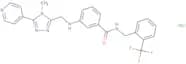
CAS:Cmpd101 is a peptide that blocks the activation of ion channels and inhibits the activity of receptors. It has been shown to inhibit the activity of ion channels, including potassium channels, calcium channels, and sodium channels. Cmpd101 also inhibits ligand-dependent receptor tyrosine kinase (RTK) signal transduction. This inhibition has been shown to be selective for RTKs that have low affinity for the ligands. The high purity of this peptide makes it an excellent research tool for various fields, such as cell biology, pharmacology, and biochemistry.Formula:C24H21N6OF3·HClPurity:Min. 95%Molecular weight:502.92 g/molDBCO-dPEG®24-TFP ester
DBCO-dPEG®24-TFP Ester is a PEG compound with two different functional groups (also known as heterobifunctional). Unlike homobifunctional PEG compounds (same functional group on both ends), this type of compounds are more versatile as have two different anchor points. DBCO-dPEG®24-TFP Ester is used as a linker and spacer to add a PEG moiety, via pegylation (a bioconjugation technique) to proteins, peptides, oligonucleotides, small molecules and nanoparticles.Formula:C77H118F4N2O28Purity:Min. 95%Molecular weight:1,595.75 g/mol1-Decanol-d21
CAS:1-Decanol-d21 is a synthetic, non-natural chemical that is used as an inhibitor of protein interactions. It has been shown to bind to the antibody and activate the receptor. This compound is also used as a research tool for studying ion channels and anti-inflammatory peptides. 1-Decanol-d21 can be used in life science research for determining the effects of ligands on receptors.Formula:C10H22OPurity:Min. 95%Molecular weight:179.41 g/molPhthalimidooxy-dPEG®4-NHS Ester
Phthalimidooxy-dPEG®4-NHS Ester is a PEG compound with two different functional groups (also known as heterobifunctional). Unlike homobifunctional PEG compounds (same functional group on both ends), this type of compounds are more versatile as have two different anchor points. Phthalimidooxy-dPEG®4-NHS Ester is used as a linker and spacer to add a PEG moiety, via pegylation (a bioconjugation technique) to proteins, peptides, oligonucleotides, small molecules and nanoparticles.Formula:C23H28N2O11Purity:Min. 95%Molecular weight:508.48 g/molm-dPEG®12-DSPE
m-dPEG®12-DSPE is a PEG compound with two different functional groups (also known as heterobifunctional). Unlike homobifunctional PEG compounds (same functional group on both ends), this type of compounds are more versatile as have two different anchor points. m-dPEG®12-DSPE is used as a linker and spacer to add a PEG moiety, via pegylation (a bioconjugation technique) to proteins, peptides, oligonucleotides, small molecules and nanoparticles.Formula:C67H132NO21PPurity:Min. 95%Molecular weight:1,318.73 g/molClothixamide
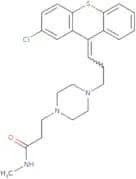
CAS:Clothixamide is a fatty alcohol that binds to the dopamine D2 receptor. It is used in the treatment of psychotic disorders and drug-resistant cases of schizophrenia. Clothixamide has been shown to be effective in patients with a diagnosis of schizophrenia, including those who are resistant to other antipsychotic drugs. The binding of clothixamide to the dopamine D2 receptor results in an increase in the levels of gamma-aminobutyric acid (GABA) and decreases in dopamine levels. This causes a decrease in psychological symptoms such as hallucinations, delusions, and agitation.
Formula:C24H28ClN3OSPurity:Min. 95%Molecular weight:442 g/molPF4618433
CAS:PF4618433 is a molecule that binds to the tyrosine kinase domain of β-catenin, which is a protein implicated in many cellular processes. PF4618433 inhibits β-catenin's binding to other proteins, including the albumin-binding domain of protocadherin 15 and the kinase domain of insulin receptor substrate 2. These interactions are important for the regulation of cell growth and differentiation. In vitro studies show that PF4618433 inhibits the proliferation and migration of ventricular myocytes. The inhibition may be due to its ability to prevent β-catenin from binding with other proteins, including cadherins and insulin receptors. PF4618433 is currently being studied as a potential drug target for treatment of heart disease, osteoporosis, neonatal renal failure, and cancer.Formula:C24H27N7O2Purity:Min. 95%Molecular weight:445.52 g/molCb-te 2a
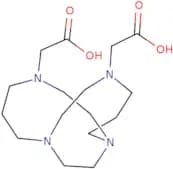
CAS:Cb-te 2a is a novel positron analog that can be used in molecular imaging. It is an analog of the drug Cb-te 2 and has been shown to bind to osteoclasts and cancer cells, but not to other normal tissues. The binding of Cb-te 2a to osteoclasts results in bone resorption and lesions. The binding of this analog to cancer cells leads to the production of angiogenic factors and increased tumor vasculature. The skeleton is also affected by this analog, as it stimulates bone resorption and inhibits new bone formation, leading to a decrease in the amount of bone tissue.Formula:C16H30N4O4Purity:Min. 95%Molecular weight:342.43 g/molAPY29
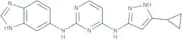
CAS:APY29 is a fatty acid that belongs to the group of polyunsaturated fatty acids. It regulates the transcriptional activity of genes related to body formation and has been shown to have anticancer properties. APY29 has also been shown to be an effective drug for treating autoimmune diseases, such as rheumatoid arthritis and psoriasis, by affecting the inflammatory response pathway in cells. This compound binds to toll-like receptor 4 (TLR4), which is a protein that recognizes bacterial products and initiates an immune response. The TLR4 binding site on APY29 was found to be necessary for its effect on TLR4 activation.Formula:C17H16N8Purity:Min. 95%Molecular weight:332.36 g/molCbz-N-Amido-dPEG®8-Acid
Cbz-N-Amido-dPEG®8-Acid is a PEG compound with two different functional groups (also known as heterobifunctional). Unlike homobifunctional PEG compounds (same functional group on both ends), this type of compounds are more versatile as have two different anchor points. Cbz-N-Amido-dPEG®8-Acid is used as a linker and spacer to add a PEG moiety, via pegylation (a bioconjugation technique) to proteins, peptides, oligonucleotides, small molecules and nanoparticles.Purity:Min. 95%CRAC inhibitor 44
CAS:CRAC inhibitor 44 is a guanine nucleotide-binding protein that inhibits the activity of ABCG2, which is an important drug transporter in the blood-brain barrier. CRAC inhibitor 44 binds to the ABCG2 transporter and prevents it from transporting drugs across the blood-brain barrier. This inhibition leads to neuronal death and has been shown to be effective against oxidative injury. The binding of CRAC inhibitor 44 to ABCG2 also inhibits calcium binding and autophagy, which are important processes in cell survival. In vitro experiments using a polymerase chain reaction (PCR) system on human cells have shown that CRAC inhibitor 44 can inhibit transcriptional regulation by preventing mRNA production. Histological analysis of mice treated with CRAC inhibitor 44 showed that this drug led to brain damage due to its ability to inhibit DNA repair enzymes, such as polymerase chain reaction (PCR) activity and transcriptional regulation.Formula:C26H41N3O5Purity:Min. 95%Molecular weight:475.6 g/molHSP70-IN-1
CAS:HSP70-IN-1 is a recombinant protein that is expressed in E. coli and purified with a His tag. It is an activator of the Hsp70 protein, which is involved in the folding of other proteins and the assembly of multiprotein complexes. This protein has been shown to bind to a variety of ligands, including ion channels, receptors, and ligands.
Formula:C24H28N6O2SPurity:Min. 95%Molecular weight:464.58 g/molCPN-116
CPN-116 is an ion channel ligand that binds to the voltage-gated sodium channels of excitable cells. It is used for research purposes in pharmacology and cell biology. CPN-116 has been shown to activate the TRPM8 receptor, which is a ligand-gated cation channel expressed in cold sensing neurons. The purified peptide is supplied as a lyophilized powder containing at least 98% CPN-116 by weight.Purity:Min. 95%