Antibiotics
Antibiotics are compounds designed to destroy or inhibit the growth of various microorganisms, playing a crucial role in treating infections and preventing the spread of diseases. This category offers a diverse range of active ingredients specifically for research in the biochemical field. These compounds are essential tools in studying bacterial mechanisms, resistance patterns, and the development of new therapeutic agents. Researchers can explore a wide variety of antibiotics to understand their effects, optimize their use, and develop novel treatments to combat emerging microbial threats. The availability of such a broad spectrum of antibiotics supports advanced research and innovation in microbiology and pharmaceutical sciences.
Subcategories of "Antibiotics"
- Macrolide Antibiotics(26 products)
- Steroidal Antibiotics(31 products)
- Tetracycline Antibiotics(20 products)
- β-Lactam Antibiotics(11 products)
Found 4100 products of "Antibiotics"
Sort by
Purity (%)
0
100
|
0
|
50
|
90
|
95
|
100
7-Deazaadenosine
CAS:Antibiotic; RNA and DNA synthesis inhibitor; adenosine analogueFormula:C11H14N4O4Purity:Min. 97 Area-%Color and Shape:Off-White To Light (Or Pale) Brown SolidMolecular weight:266.26 g/molAmikacin disulfate
CAS:<p>Inhibitor of protein synthesis; aminoglycoside</p>Formula:C22H43N5O13·2H2SO4Purity:674 To 786 Usp U/MgColor and Shape:White PowderMolecular weight:781.76 g/molMitomycin C - High Purity
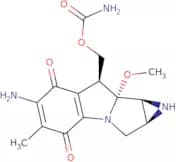
CAS:<p>Mitomycin C is a cytotoxic agent that inhibits DNA synthesis. This product is tested according to USP specification. Mitomycin C has been shown to be effective against resistant mutants and carcinoma cell lines. It also has genotoxic activity and induces statistically significant chromosome aberrations in mammalian cells. Mitomycin C is toxic to the mitochondria, which may be due to its ability to induce mitochondrial membrane potential collapse, leading to apoptosis. Mitomycin C binds to the response element in the genome, causing transcriptional repression of a number of genes involved in cell proliferation, differentiation, or apoptosis. Mitomycin C inhibits squamous carcinoma cells by binding to their DNA and preventing RNA synthesis.</p>Formula:C15H18N4O5Purity:Cas Rn [50-07-7] M. F. C15H18N4O5Color and Shape:PowderMolecular weight:334.33 g/molLincomycin 2,7-dipalmitate
Lincomycin 2,7-dipalmitate is an antibiotic compound that is a semi-synthetic derivative originating from the natural antibiotic lincomycin, which itself is produced by the actinobacterium Streptomyces lincolnensis. This compound functions by inhibiting bacterial protein synthesis. Specifically, it binds to the 23S rRNA component of the 50S subunit of the bacterial ribosome, thereby disrupting the process of RNA translocation and inhibiting the synthesis of essential proteins needed for bacterial growth and replication.Formula:C51H95NO8SPurity:Min. 95%Molecular weight:882.37 g/molArbekacin hydrochloride
CAS:<p>Inhibitor of DNA replication; aminoglycoside class</p>Formula:C22H44N6O10·xHclPurity:Min. 95%Molecular weight:552.62 g/molMarbofloxacin - Bio-X ™
CAS:<p>Marbofloxacin is an antibiotic belonging to the class of fluoroquinolones. It is used in veterinary medicine to treat bacterial infections in animals. This drug inhibits the bacterial enzyme DNA gyrase and topoisomerase IV. As a result, this drug prevents bacterial DNA replication.</p>Formula:C17H19N4O4FPurity:Min. 95%Color and Shape:PowderMolecular weight:362.36 g/molNovobiocin
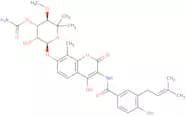
CAS:<p>Novobiocin is an aminocoumarin antibiotic with action on bacterial DNA gyrase to inhibit ATPase activity and is used for treating staphylococcal infections and research on DNA replication.</p>Formula:C31H36N2O11Purity:(%) Min. 94%Color and Shape:White PowderMolecular weight:612.62 g/molCeftriaxone disodium hemiheptahydrate
CAS:Ceftriaxone disodium hemiheptahydrate is a third-generation cephalosporin antibiotic, which is a semisynthetic derivative of cephalosporin C. This compound is sourced from the fungus Acremonium, which is known for its role in deriving crucial β-lactam antibiotics. Ceftriaxone acts by inhibiting bacterial cell wall synthesis, specifically targeting the penicillin-binding proteins (PBPs). This action disrupts peptidoglycan cross-linking, leading to bacterial cell lysis and death.Formula:(C18H18N8Na2O7S3)2•(H2O)7Purity:Min. 94 Area-%Color and Shape:White Yellow PowderMolecular weight:1,327.23 g/molHerbicidin H
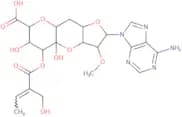
CAS:<p>Herbicidin H is a naturally occurring microbial herbicide, which is derived from specific strains of soil-borne bacteria. This compound is primarily isolated from Streptomyces species, known for their prolific production of various bioactive secondary metabolites. The mode of action of Herbicidin H involves the disruption of essential cellular processes within plant cells, particularly affecting nucleic acid synthesis. This disruption leads to impaired growth and eventual plant death, making it a potent agent against a range of undesirable plant species.</p>Formula:C22H27N5O11Purity:Min. 95%Molecular weight:537.48 g/mol3'-N,N-Di(desmethyl) azithromycin
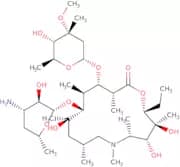
CAS:A derivative of azithromycin, used as an antibioticFormula:C36H68N2O12Purity:Min. 95%Color and Shape:Off-white solid.Molecular weight:720.93 g/mol9’-deoxy-8’,8’-dihydroxyherbicidin
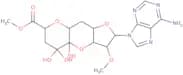
CAS:<p>9’-Deoxy-8’,8’-dihydroxyherbicidin is a specialized compound, classified as an antibacterial agent and secondary metabolite, which is naturally derived from microbial sources, specifically certain strains of actinomycetes. These microorganisms are prolific producers of bioactive secondary metabolites, including antibiotics and herbicidins, which exhibit diverse biological activities.</p>Formula:C18H23N5O9Purity:Min. 95%Molecular weight:453.4 g/molCefotetan
CAS:<p>Inhibitor of cell wall synthesis; cephalosporin class</p>Formula:C17H17N7O8S4Purity:Min. 96 Area-%Color and Shape:PowderMolecular weight:575.62 g/molPosizolid
CAS:<p>Posizolid is an oxazolidinone antibiotic, which is a synthetic compound derived from chemical synthesis. It acts by inhibiting bacterial protein synthesis through binding to the 50S subunit of the bacterial ribosome, thereby interfering with the translation process essential for bacterial growth and reproduction.</p>Formula:C21H21F2N3O7Purity:Min. 95%Color and Shape:SolidMolecular weight:465.4 g/molGentamicin C1a pentaacetate
CAS:<p>Gentamicin C1a pentaacetate is an aminoglycoside antibiotic derivative, which is synthesized through the acetylation of the hydroxyl groups in gentamicin C1a. This compound is derived from the fermentation products of Micromonospora species, a genus of actinobacteria. Its mode of action is similar to that of standard aminoglycosides, primarily involving the binding to bacterial 30S ribosomal subunits. This binding interferes with protein synthesis by causing misreading of mRNA, ultimately leading to the inhibition of protein production and bacterial cell death.</p>Formula:C29H59N5O17Purity:Min. 95%Color and Shape:Off-White PowderMolecular weight:749.8 g/molGentamycin sulphate
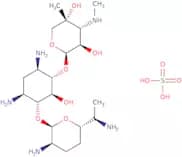
CAS:<p>Gentamycin sulphate is the salt form of the broad-spectrum antibiotic gentamycin (a.k.a. gentamicin). Gentamycin is active against clinically relevant bacteria, such as: Pseudomonas aeruginosa, Klebsiella pneumoniae, Escherichia coli, Serratia marcescens, and is used to fight infections from Staphylococcus, Citrobacter and Enterobacteriaceae species. Gentamycin is a natural mixture of four congeners, one of which is gentamicin C2a. Gentamycin has been included in biomedical implantable materials, such as, bone grafts, to reduce the risk of infection.</p>Formula:C21H43N5O7·H2SO4Color and Shape:White PowderMolecular weight:575.68 g/molRosaramicin butyrate
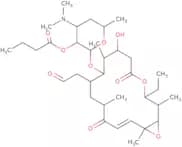
CAS:Rosaramicin butyrate is a macrolide antibiotic, which is derived from the fermentation of Streptomyces bacteria. With a mechanism of action that involves the inhibition of bacterial protein synthesis, it binds to the 50S subunit of the bacterial ribosome. This interference prevents the translocation step during protein translation, effectively halting the growth of susceptible bacterial strains.Formula:C35H57NO10Purity:Min. 95%Molecular weight:651.83 g/molDesfuroyl ceftiofur sodium
CAS:<p>Desfuroyl ceftiofur sodium is a veterinary cephalosporin antibiotic, which is derived from cephalosporin C, a beta-lactam antibiotic produced by the fungus Cephalosporium acremonium. Its mode of action involves the inhibition of bacterial cell wall synthesis by binding to and inactivating penicillin-binding proteins (PBPs). This prevents the cross-linking of peptidoglycan layers, leading to cell lysis and bacterial death, particularly effective against Gram-negative and some Gram-positive bacteria.</p>Formula:C14H15N5O5S3•NaPurity:Min. 95%Molecular weight:452.5 g/molValidoxylamine A
CAS:<p>Validoxylamine A is an antibiotic, which is a secondary metabolite produced by certain strains of the Actinomyces species. It functions as a potent inhibitor of the enzyme glucose isomerase, which plays a crucial role in the isomerization of glucose to fructose, an important biochemical reaction in various microbial and plant systems.</p>Formula:C14H25NO8Purity:Min. 95%Molecular weight:335.35 g/molRifaximin
CAS:<p>Rifaximin is a rifamycin antibiotic with action on bacterial RNA polymerase to inhibit transcription and is used for treating travelers' diarrhea, irritable bowel syndrome, and hepatic encephalopathy.</p>Formula:C43H51N3O11Purity:Min. 98 Area-%Color and Shape:Red PowderMolecular weight:785.88 g/molNitrofurantoin - Bio-X ™
CAS:Nitrofurantoin is an antibiotic that binds to the bacterial ribosome and inhibits protein synthesis. It is used to treat a wide range of infections, including urinary tract infections and its common causes such as E. coli, Citrobacter and Enterococcus.Formula:C8H6N4O5Purity:Min. 95%Color and Shape:PowderMolecular weight:238.16 g/mol