


Building Blocks
This section contains fundamental products for the synthesis of organic and biological compounds. Building blocks are the essential starting materials used to construct complex molecules through various chemical reactions. They play a critical role in drug discovery, material science, and chemical research. At CymitQuimica, we offer a diverse range of high-quality building blocks to support your innovative research and industrial projects, ensuring you have the essential components for successful synthesis.
Subcategories of "Building Blocks"
- Boronic Acids & Boronic Acid Derivatives(5,756 products)
- Chiral Building Blocks(1,242 products)
- Hydrocarbon Building Blocks(6,095 products)
- Organic Building Blocks(61,055 products)
Found 199650 products of "Building Blocks"
Sort by
Purity (%)
0
100
|
0
|
50
|
90
|
95
|
100
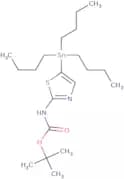
2-(N-Boc-amino)-5-(tributylstannyl)thiazole
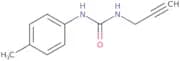
CAS:Controlled Product<p>Versatile small molecule scaffold</p>Formula:C20H38N2O2SSnPurity:Min. 95%Molecular weight:489.3 g/mol1-(4-Methylphenyl)-3-(prop-2-yn-1-yl)urea
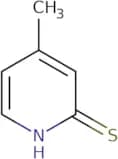
CAS:<p>1-(4-Methylphenyl)-3-(prop-2-yn-1-yl)urea is a fluorescent derivative that can be detected with certain techniques. It has been used to detect phosphatases in cervical cancer cells and tumor cells. This compound is a ligand for the surface antigen of placental alkaline phosphatase (PLAP). It can also bind to other organic ligands, such as recombinant human erythropoietin (EPO), which may be useful for redirecting the action of this protein. 1-(4-Methylphenyl)-3-(prop-2-yn-1-yl)urea is an organic bispecific molecule that binds to two receptors, one on tumor cells and one on normal cells. This binding leads to cell death by apoptosis through the release of cytochrome c from mitochondria.</p>Formula:C11H12N2OPurity:Min. 95%Molecular weight:188.23 g/mol4-Methylpyridine-2-thiol
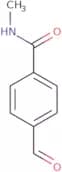
CAS:<p>4-Methylpyridine-2-thiol is a ligand that binds to metal ions. It has been shown to be an effective photoelectron scavenger for mercury and lead, as well as a wide variety of other metals. 4-Methylpyridine-2-thiol is also an important monomer in the preparation of polymers and resins. This ligand has been used in the synthesis of compounds with cyclic structures and hydrochloric acid, as well as being crystallized with x-ray crystallography. The properties of this ligand have been studied by voltammetry, spectroscopies, and crystallography. 4-Methylpyridine-2-thiol interacts with chloride ions in acetonitrile to form a salt called methylpyridinium chloride.</p>Formula:C6H7NSPurity:Min. 95%Molecular weight:125.19 g/mol4-Formyl-N-methyl-benzamide
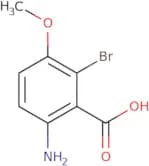
CAS:<p>Versatile small molecule scaffold</p>Formula:C9H9NO2Purity:Min. 95%Molecular weight:163.18 g/mol6-Amino-2-bromo-3-methoxybenzoic acid
CAS:<p>Versatile small molecule scaffold</p>Formula:C8H8BrNO3Purity:Min. 95%Molecular weight:246.06 g/molRef: 3D-CGA94638
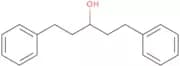
Discontinued product1,5-Diphenylpentan-3-ol
CAS:<p>Flindersia laevicarpa is a small tree native to Australia. The leaves of the tree are used for medicinal purposes and contain 1,5-diphenylpentan-3-ol. Flindersia laevicarpa has been shown to have anti-inflammatory and antioxidant properties, as well as an ability to inhibit platelet aggregation.</p>Formula:C17H20OPurity:Min. 95%Molecular weight:240.34 g/molRef: 3D-SAA48686
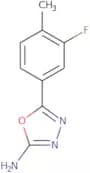
Discontinued product5-(3-Fluoro-4-methylphenyl)-1,3,4-oxadiazol-2-amine
CAS:<p>Versatile small molecule scaffold</p>Formula:C9H8FN3OPurity:Min. 95%Molecular weight:193.18 g/mol4-Bromo-1-cyclohexyl-1H-pyrazole
CAS:<p>Versatile small molecule scaffold</p>Formula:C9H13BrN2Purity:Min. 95%Molecular weight:229.12 g/molPyrazolo[1,5-a]pyridin-4-ol
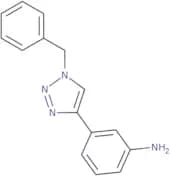
CAS:<p>Pyrazolo[1,5-a]pyridin-4-ol is a heteroaromatic compound that acts as an inhibitor of phosphodiesterase (PDE). It prevents the breakdown of cyclic nucleotides and thus leads to increased levels of cAMP and cGMP. Pyrazolo[1,5-a]pyridin-4-ol has been shown to have bronchodilatory activity in animal models. The drug also inhibits the production of inflammatory mediators such as prostaglandins by inhibiting cyclooxygenases. In addition, pyrazolo[1,5-a]pyridin-4-ol has been shown to be a potential PDE inhibitor replacement for the more commonly used PDE inhibitors such as sildenafil and tadalafil. However, due to its lack of stereochemistry and its bicyclic chemical structure, pyrazolo[1,5-a]</p>Formula:C7H6N2OPurity:Min. 95%Molecular weight:134.14 g/mol3-(1-Benzyl-1H-1,2,3-triazol-4-yl)aniline
CAS:<p>Versatile small molecule scaffold</p>Formula:C15H14N4Purity:Min. 95%Molecular weight:250.3 g/molRef: 3D-BWB92000
Discontinued product3-Chloro-1,2,4-benzotriazine
CAS:<p>3-Chloro-1,2,4-benzotriazine is an organic compound that is used as an anti-cancer agent. It is a cytotoxin that inhibits the growth of cells by binding to DNA. The Suzuki reaction was used to synthesize this compound in high yields. 3-Chloro-1,2,4-benzotriazine has potential anti-cancer activity and can be used in conjunction with other cytotoxic agents to treat cancer. This drug has been shown to have cytotoxic effects on tumor cells by inhibiting DNA synthesis and cell division.</p>Formula:C7H4ClN3Purity:Min. 95%Molecular weight:165.58 g/molRef: 3D-RDA66921
Discontinued product3-[(4-Chlorophenyl)amino]propanenitrile
CAS:<p>Versatile small molecule scaffold</p>Formula:C9H9ClN2Purity:Min. 95%Molecular weight:180.63 g/molRef: 3D-RBA83357
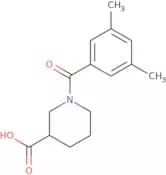
Discontinued product1-(3,5-Dimethylbenzoyl)piperidine-3-carboxylic acid
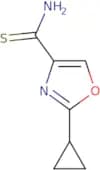
CAS:<p>Versatile small molecule scaffold</p>Formula:C15H19NO3Purity:Min. 95%Molecular weight:261.32 g/mol2-Cyclopropyl-1,3-oxazole-4-carbothioamide
CAS:<p>Versatile small molecule scaffold</p>Formula:C7H8N2OSPurity:Min. 95%Molecular weight:168.22 g/molRef: 3D-BKD17844
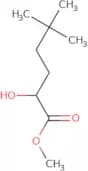
Discontinued productMethyl 2-hydroxy-5,5-dimethylhexanoate
CAS:<p>Versatile small molecule scaffold</p>Formula:C9H18O3Purity:Min. 95%Molecular weight:174.24 g/molRef: 3D-NJC68939
Discontinued product3-Methyl-2-[3-(trifluoromethyl)phenyl]butanoic acid
CAS:<p>Versatile small molecule scaffold</p>Formula:C12H13F3O2Purity:Min. 95%Molecular weight:246.22 g/molRef: 3D-BCA63232
Discontinued product(5-bromo-2-methoxypyridin-3-yl)methanamine
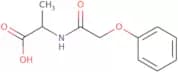
CAS:<p>Versatile small molecule scaffold</p>Formula:C7H9BrN2OPurity:Min. 95%Molecular weight:217.1 g/mol2-(2-Phenoxyacetamido)propanoic acid
CAS:<p>Versatile small molecule scaffold</p>Formula:C11H13NO4Purity:Min. 95%Molecular weight:223.22 g/molRef: 3D-EKB12384
Discontinued product[(1-Amino-2-methylpropan-2-yl)oxy]benzene hydrochloride
CAS:<p>Versatile small molecule scaffold</p>Formula:C10H16ClNOPurity:Min. 95%Molecular weight:201.69 g/molRef: 3D-LCC31526
Discontinued producttert-Butyl 6,6-dioxo-6λ6-thia-2,7-diazaspiro[3.4]octane-2-carboxylate
CAS:<p>Versatile small molecule scaffold</p>Formula:C10H18N2O4SPurity:Min. 95%Molecular weight:262.3 g/mol2-Chloro-1-[4-(furan-2-carbonyl)piperazin-1-yl]ethan-1-one
CAS:<p>Versatile small molecule scaffold</p>Formula:C11H13ClN2O3Purity:Min. 95%Molecular weight:256.68 g/mol2,4-Dimethyl-5-[4-(trifluoromethyl)phenyl]pyrimidine
CAS:<p>Versatile small molecule scaffold</p>Formula:C13H11F3N2Purity:Min. 95%Molecular weight:252.23 g/molRef: 3D-LAC75867
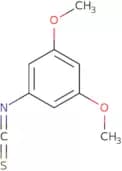
Discontinued product3,5-dimethoxyphenyl isothiocyanate
CAS:<p>3,5-dimethoxyphenyl isothiocyanate (3,5-DMPIC) is a benzimidazole derivative that has been shown to be a potent and selective antagonist of the gonadotropin-releasing hormone (GnRH). 3,5-DMPIC has been shown to desensitize GnRH receptors on the pituitary gland and may have applications in the treatment of prostate cancer. It also inhibits the release of luteinizing hormone and follicle stimulating hormone from the pituitary gland.</p>Formula:C9H9NO2SPurity:Min. 95%Molecular weight:195.24 g/molRef: 3D-EEA96858
Discontinued product1-(4-Methylphenyl)-1H,4H,5H-pyrazolo[3,4-d]pyrimidin-4-one
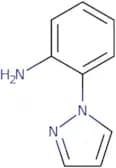
CAS:<p>Versatile small molecule scaffold</p>Formula:C12H10N4OPurity:Min. 95%Molecular weight:226.23 g/mol1-(2-Aminophenyl)-1H-pyrazole
CAS:<p>1-(2-Aminophenyl)-1H-pyrazole is a chemical compound that is used in the synthesis of other compounds. It can be produced by various reactions from benzyl chloride and ammonia. The reactivity of 1-(2-aminophenyl)-1H-pyrazole has been studied using single crystal X-ray diffraction. This technique was used to determine the structure and reaction pathway of this molecule as well as to study its catalytic properties. 1-(2-Aminophenyl)-1H-pyrazole is a ligand that binds to metal ions, such as aluminium, in order to form complexes with different functional groups.</p>Formula:C9H9N3Purity:Min. 95%Molecular weight:159.19 g/mol(2-Bromo-5-chlorophenyl)methanesulfonyl chloride
CAS:<p>Versatile small molecule scaffold</p>Formula:C7H5BrCl2O2SPurity:Min. 95%Molecular weight:303.99 g/molRef: 3D-AKC85158
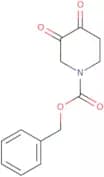
Discontinued productBenzyl 3,4-dioxopiperidine-1-carboxylate
CAS:<p>Versatile small molecule scaffold</p>Formula:C13H13NO4Purity:Min. 95%Molecular weight:247.25 g/molRef: 3D-JHD94774
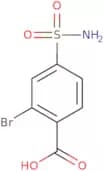
Discontinued product2-Bromo-4-sulfamoylbenzoic acid
CAS:<p>Versatile small molecule scaffold</p>Formula:C7H6BrNO4SPurity:Min. 95%Molecular weight:280.1 g/molRef: 3D-JGA73367
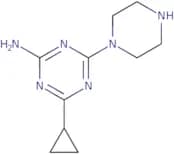
Discontinued product4-Cyclopropyl-6-(piperazin-1-yl)-1,3,5-triazin-2-amine
CAS:<p>Versatile small molecule scaffold</p>Formula:C10H16N6Purity:Min. 95%Molecular weight:220.27 g/molRef: 3D-AAD33568
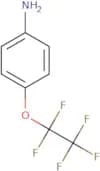
Discontinued product4-(Perfluoroethoxy)aniline
CAS:<p>Versatile small molecule scaffold</p>Formula:C8H6F5NOPurity:Min. 95%Molecular weight:227.13 g/molRef: 3D-AAA71785
Discontinued product2-[1-(Difluoromethyl)-1H-imidazol-2-yl]-1-phenylethan-1-amine
CAS:<p>Versatile small molecule scaffold</p>Formula:C12H13F2N3Purity:Min. 95%Molecular weight:237.25 g/molRef: 3D-BAC92276
Discontinued product1-({2-Methyl-5H,6H,7H,8H-imidazo[1,2-a]pyridin-3-yl}methyl)piperazine
CAS:<p>Versatile small molecule scaffold</p>Formula:C13H22N4Purity:Min. 95%Molecular weight:234.34 g/molRef: 3D-CHC38025
Discontinued product5-(Propan-2-yl)-1-(pyridin-4-yl)-1H-pyrazole-3-carboxylic acid
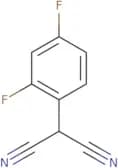
CAS:<p>Versatile small molecule scaffold</p>Formula:C12H13N3O2Purity:Min. 95%Molecular weight:231.25 g/mol2-(2,4-Difluorophenyl)propanedinitrile
CAS:<p>Versatile small molecule scaffold</p>Formula:C9H4F2N2Purity:Min. 95%Molecular weight:178.14 g/molRef: 3D-DXC58290
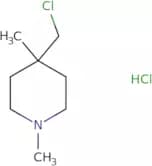
Discontinued product4-(Chloromethyl)-1,4-dimethylpiperidine hydrochloride
CAS:<p>Versatile small molecule scaffold</p>Formula:C8H17Cl2NPurity:Min. 95%Molecular weight:198.13 g/molRef: 3D-DXC58362
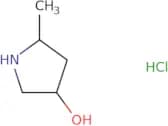
Discontinued product5-Methylpyrrolidin-3-ol hydrochloride
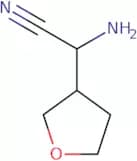
CAS:<p>Versatile small molecule scaffold</p>Formula:C5H12ClNOPurity:Min. 95%Molecular weight:137.61 g/mol2-Amino-2-(oxolan-3-yl)acetonitrile
CAS:<p>Versatile small molecule scaffold</p>Formula:C6H10N2OPurity:Min. 95%Molecular weight:126.16 g/molRef: 3D-ENB57845
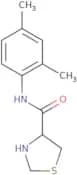
Discontinued productN-(2,4-Dimethylphenyl)-1,3-thiazolidine-4-carboxamide
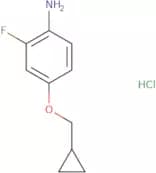
CAS:<p>Versatile small molecule scaffold</p>Formula:C12H16N2OSPurity:Min. 95%Molecular weight:236.34 g/mol4-(Cyclopropylmethoxy)-2-fluoroaniline hydrochloride
CAS:<p>Versatile small molecule scaffold</p>Formula:C10H13ClFNOPurity:Min. 95%Molecular weight:217.67 g/mol7-Bromopyrazolo[1,5-a]pyrimidine
CAS:<p>Versatile small molecule scaffold</p>Formula:C6H4BrN3Purity:Min. 95%Molecular weight:198.02 g/molRef: 3D-JWB98304
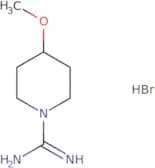
Discontinued product4-Methoxypiperidine-1-carboximidamide hydrobromide
CAS:<p>Versatile small molecule scaffold</p>Formula:C7H16BrN3OPurity:Min. 95%Molecular weight:238.13 g/molRef: 3D-THC98095
Discontinued product5-(Iodomethyl)-6-azaspiro[3.4]octan-7-one
CAS:Versatile small molecule scaffoldFormula:C8H12INOPurity:Min. 95%Molecular weight:265.1 g/molRef: 3D-TLD44509
Discontinued product5-Oxa-12-azadispiro[3.1.4{6}.3{4}]tridecane hydrochloride
CAS:<p>Versatile small molecule scaffold</p>Formula:C11H20ClNOPurity:Min. 95%Molecular weight:217.7 g/molRef: 3D-TPD51274
Discontinued product(2S,5S)-1-{[(9H-Fluoren-9-yl)methoxy]carbonyl}-5-phenylpyrrolidine-2-carboxylic acid
CAS:<p>Versatile small molecule scaffold</p>Formula:C26H23NO4Purity:Min. 95%Molecular weight:413.5 g/molRef: 3D-UYB95360
Discontinued productQuinoline-5-carbonitrile
CAS:<p>Quinoline-5-carbonitrile is a cyanide compound that can be used in the synthesis of heterocyclic compounds. The reaction between quinoline and 5-cyanovaleric acid produces 6-nitroquinoline, which is then converted to dimethyl sulfoxide by alcoholysis. This reaction product can then be used to synthesize an amide or nucleophile. Quinoline-5-carbonitrile reacts with potassium in the presence of bifunctional hydrazide to produce a cyanide ion, which can be hydrolyzed by an acid to release hydrogen cyanide gas. This experiment has been shown as a model for reactions involving cyano compounds.</p>Formula:C10H6N2Purity:Min. 95%Molecular weight:154.17 g/molRef: 3D-JCA55102
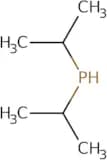
Discontinued productDiisopropylphosphine, 10wt.% in hexane
CAS:<p>Please enquire for more information about Diisopropylphosphine, 10wt.% in hexane including the price, delivery time and more detailed product information at the technical inquiry form on this page</p>Formula:C6H15PPurity:Min. 95%Molecular weight:118.16 g/molRef: 3D-VAA49153
Discontinued productThieno[2,3-b]pyridine-5-carbonitrile
CAS:<p>Thienopyridine analogs are a class of chemical compounds that function as agonists of the receptor α. These compounds have been shown to inhibit fatty acid oxidation and ATP production in rat liver cells, which may be due to their ability to activate AMP-activated protein kinase (AMPK). Thienopyridine analogs are being investigated for use as anti-inflammatory agents and cancer treatments.</p>Formula:C8H4N2SPurity:Min. 95%Molecular weight:160.2 g/molRef: 3D-WAA34431
Discontinued productrac-2-[(1R,3S)-3-(Propan-2-yl)-2,3-dihydro-1H-inden-1-yl]acetic acid
CAS:<p>Versatile small molecule scaffold</p>Formula:C14H18O2Purity:Min. 95%Molecular weight:218.29 g/molRef: 3D-ZLD00010
Discontinued product3-Boc-3-azabicyclo[3.2.1]octan-8-amine
CAS:<p>Versatile small molecule scaffold</p>Formula:C12H22N2O2Purity:Min. 95%Molecular weight:226.32 g/mol2-Bromo-3,3,3-trifluoro-1-propene
CAS:Controlled Product<p>2-Bromo-3,3,3-trifluoro-1-propene is a chemical compound that has been synthesized in an asymmetric reaction. The reactant is bromopropane and the product is 2,2,2-trifluoropropene. The methylene group on the propene molecule is activated by the nucleophilic attack of a fluoride ion from hydrogen fluoride to form a cavity with a highly strained bond. The kinetic study of this reaction revealed that the activation energy for the reaction is 42 kJ/mol. Palladium-catalyzed coupling reactions are catalyzed by palladium and require nonpolar solvents such as toluene or dichloromethane. This type of reaction has been shown to be exothermic with an isolated yield of 1%.</p>Formula:C3H2BrF3Purity:Min. 95%Color and Shape:Colorless PowderMolecular weight:174.95 g/mol


![Pyrazolo[1,5-a]pyridin-4-ol](/_next/image/?url=https%3A%2Fstatic.cymitquimica.com%2Fproducts%2F3D%2Fthumb-webp%2FRFA03272.webp&w=3840&q=75)

![3-[(4-Chlorophenyl)amino]propanenitrile](/_next/image/?url=https%3A%2Fstatic.cymitquimica.com%2Fproducts%2F3D%2Fthumb-webp%2FRBA83357.webp&w=3840&q=75)
![3-Methyl-2-[3-(trifluoromethyl)phenyl]butanoic acid](/_next/image/?url=https%3A%2Fstatic.cymitquimica.com%2Fproducts%2F3D%2Fthumb-webp%2FBCA63232.webp&w=3840&q=75)

![[(1-Amino-2-methylpropan-2-yl)oxy]benzene hydrochloride](/_next/image/?url=https%3A%2Fstatic.cymitquimica.com%2Fproducts%2F3D%2Fthumb-webp%2FLCC31526.webp&w=3840&q=75)
![tert-Butyl 6,6-dioxo-6λ6-thia-2,7-diazaspiro[3.4]octane-2-carboxylate](/_next/image/?url=https%3A%2Fstatic.cymitquimica.com%2Fproducts%2F3D%2Fthumb-webp%2FAVD27336.webp&w=3840&q=75)
![2-Chloro-1-[4-(furan-2-carbonyl)piperazin-1-yl]ethan-1-one](/_next/image/?url=https%3A%2Fstatic.cymitquimica.com%2Fproducts%2F3D%2Fthumb-webp%2FEEB57887.webp&w=3840&q=75)
![2,4-Dimethyl-5-[4-(trifluoromethyl)phenyl]pyrimidine](/_next/image/?url=https%3A%2Fstatic.cymitquimica.com%2Fproducts%2F3D%2Fthumb-webp%2FLAC75867.webp&w=3840&q=75)
![1-(4-Methylphenyl)-1H,4H,5H-pyrazolo[3,4-d]pyrimidin-4-one](/_next/image/?url=https%3A%2Fstatic.cymitquimica.com%2Fproducts%2F3D%2Fthumb-webp%2FECA73875.webp&w=3840&q=75)

![2-[1-(Difluoromethyl)-1H-imidazol-2-yl]-1-phenylethan-1-amine](/_next/image/?url=https%3A%2Fstatic.cymitquimica.com%2Fproducts%2F3D%2Fthumb-webp%2FBAC92276.webp&w=3840&q=75)
![1-({2-Methyl-5H,6H,7H,8H-imidazo[1,2-a]pyridin-3-yl}methyl)piperazine](/_next/image/?url=https%3A%2Fstatic.cymitquimica.com%2Fproducts%2F3D%2Fthumb-webp%2FCHC38025.webp&w=3840&q=75)

![7-Bromopyrazolo[1,5-a]pyrimidine](/_next/image/?url=https%3A%2Fstatic.cymitquimica.com%2Fproducts%2F3D%2Fthumb-webp%2FJWB98304.webp&w=3840&q=75)
![5-(Iodomethyl)-6-azaspiro[3.4]octan-7-one](/_next/image/?url=https%3A%2Fstatic.cymitquimica.com%2Fproducts%2F3D%2Fthumb-webp%2FTLD44509.webp&w=3840&q=75)
![5-Oxa-12-azadispiro[3.1.4{6}.3{4}]tridecane hydrochloride](/_next/image/?url=https%3A%2Fstatic.cymitquimica.com%2Fproducts%2F3D%2Fthumb-webp%2FTPD51274.webp&w=3840&q=75)
![(2S,5S)-1-{[(9H-Fluoren-9-yl)methoxy]carbonyl}-5-phenylpyrrolidine-2-carboxylic acid](/_next/image/?url=https%3A%2Fstatic.cymitquimica.com%2Fproducts%2F3D%2Fthumb-webp%2FUYB95360.webp&w=3840&q=75)
![Thieno[2,3-b]pyridine-5-carbonitrile](/_next/image/?url=https%3A%2Fstatic.cymitquimica.com%2Fproducts%2F3D%2Fthumb-webp%2FWAA34431.webp&w=3840&q=75)
![rac-2-[(1R,3S)-3-(Propan-2-yl)-2,3-dihydro-1H-inden-1-yl]acetic acid](/_next/image/?url=https%3A%2Fstatic.cymitquimica.com%2Fproducts%2F3D%2Fthumb-webp%2FZLD00010.webp&w=3840&q=75)
![3-Boc-3-azabicyclo[3.2.1]octan-8-amine](/_next/image/?url=https%3A%2Fstatic.cymitquimica.com%2Fproducts%2F3D%2Fthumb-webp%2FFDC76351.webp&w=3840&q=75)
