


Building Blocks
This section contains fundamental products for the synthesis of organic and biological compounds. Building blocks are the essential starting materials used to construct complex molecules through various chemical reactions. They play a critical role in drug discovery, material science, and chemical research. At CymitQuimica, we offer a diverse range of high-quality building blocks to support your innovative research and industrial projects, ensuring you have the essential components for successful synthesis.
Subcategories of "Building Blocks"
- Boronic Acids & Boronic Acid Derivatives(5,756 products)
- Chiral Building Blocks(1,242 products)
- Hydrocarbon Building Blocks(6,095 products)
- Organic Building Blocks(61,038 products)
Found 196817 products of "Building Blocks"
Sort by
Purity (%)
0
100
|
0
|
50
|
90
|
95
|
100
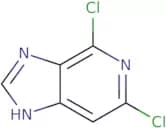
2,6-Dichloro-3-deazapurine
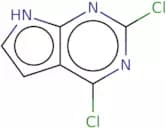
CAS:<p>2,6-Dichloro-3-deazapurine is an isomer of the nucleoside guanosine. It has been shown to inhibit the synthesis of viruses in cell cultures and may be useful in the treatment of leukemia. The synthesis of 2,6-dichloro-3-deazapurine can be achieved through a solid-phase synthesis that uses synthons as starting materials. The molecular modelling studies have shown that this molecule has a potential to bind to adenosine receptor subtypes A2a, A2b, and A3.</p>Formula:C6H3Cl2N3Purity:Min. 95%Color and Shape:Off-White PowderMolecular weight:188.02 g/mol2,6-Dichloro-7-deazapurine
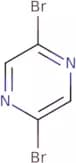
CAS:<p>Intermediate in the synthesis of tofacitinib</p>Formula:C6H3Cl2N3Purity:Min. 95%Color and Shape:Off-White PowderMolecular weight:188.02 g/mol2,5-Dibromopyrazine
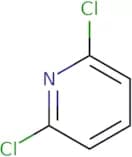
CAS:<p>2,5-Dibromopyrazine is a heterocyclic compound that can be synthesized by the Suzuki coupling reaction of 2-bromo-1,3-dibromopropane with an acceptor. It has been shown to have glycemic parameters and a high rate enhancement for the water molecule photophysical isomerization reaction. Structural isomers of 2,5-dibromopyrazine exist as well and are thought to have different rates of photocatalytic activity. The rate enhancement may be due to the increase in electron density on the heteroatoms in the ring.</p>Formula:C4H2Br2N2Purity:Min. 98%Color and Shape:Brown White Off-White Yellow Clear LiquidMolecular weight:237.88 g/mol2,6-Dichloropyridine
CAS:<p>2,6-Dichloropyridine is an organohalide used as a reagent for asymmetric catalysis. It is use as a precursor for the synthesis of antibacterial agents, for example the synthesis of the antibiotic enoxacin.</p>Formula:C5H3Cl2NPurity:Min. 98%Color and Shape:White To Yellowish To Pink To Grey To Light Brown SolidMolecular weight:147.99 g/mol4-[2-(Dimethylamino)ethoxy]benzene-1-carboximidamide
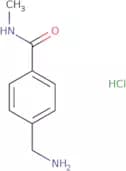
CAS:Controlled Product<p>Versatile small molecule scaffold</p>Formula:C11H17N3OPurity:Min. 90%Color and Shape:PowderMolecular weight:207.27 g/mol4-(Aminomethyl)-N-methylbenzamide hydrochloride
CAS:<p>4-(Aminomethyl)-N-methylbenzamide hydrochloride is a reaction component, reagent, and fine chemical that is useful in the synthesis of high-quality research chemicals, speciality chemicals, and versatile building blocks. This compound has been shown to be useful as a building block or intermediate in the synthesis of complex compounds. 4-(Aminomethyl)-N-methylbenzamide hydrochloride is also used as a reaction component in the production of pharmaceuticals and other organic chemicals. It is soluble in water and has a boiling point of 210°C.</p>Formula:C9H13ClN2OPurity:Min. 95%Color and Shape:PowderMolecular weight:200.66 g/mol5-Bromo-1H-pyrrolo[2,3-b]pyridine-2-carboxylic acid
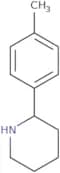
CAS:<p>5-Bromo-1H-pyrrolo[2,3-b]pyridine-2-carboxylic acid is a chemical compound with the molecular formula C6H4BrNO2. It is used as a reaction component and reagent in organic synthesis. This compound has been shown to have high quality and can be used for research purposes. 5-Bromo-1H-pyrrolo[2,3-b]pyridine-2-carboxylic acid is a versatile building block that can be used as an intermediate or building block in the synthesis of complex compounds. This compound is also a fine chemical that can be used in the production of pharmaceuticals and other commercial products.</p>Formula:C8H5BrN2O2Purity:Min. 95%Molecular weight:241.04 g/mol2-(4-Methylphenyl)piperidine
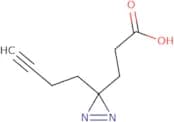
CAS:<p>Versatile small molecule scaffold</p>Formula:C12H17NPurity:Min. 95%Color and Shape:Clear LiquidMolecular weight:175.27 g/mol3-(3-(But-3-yn-1-yl)-3H-diazirin-3-yl)propanoic acid
CAS:<p>3-(3-(But-3-yn-1-yl)-3H-diazirin-3-yl)propanoic acid (BDPA) is a reagent that is used as a starting material or intermediate for the synthesis of pharmaceuticals and other chemical compounds. This compound has been shown to be an excellent scaffold for the synthesis of complex structures, such as peptides and natural products. BDPA is also a versatile building block for organic syntheses, which can be used in reactions with other chemicals to form new compounds. Research chemicals such as BDPA are not approved by the FDA, so they should only be handled and used by professionals.</p>Formula:C8H10N2O2Purity:Min. 95%Color and Shape:PowderMolecular weight:166.18 g/mol5-[(4-Chlorophenyl)sulfanyl]furan-2-carboxylic acid
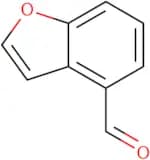
CAS:<p>Versatile small molecule scaffold</p>Formula:C11H7ClO3SPurity:Min. 95%Color and Shape:PowderMolecular weight:254.69 g/molBenzofuran-4-carbaldehyde
CAS:<p>Benzofuran-4-carbaldehyde is a reactive, low molecular weight compound. It is an oxidative and thermally labile compound that can be used for the preparation of other compounds. Benzofuran-4-carbaldehyde is a colorless liquid with a boiling point of 124°C and a melting point of -27°C. It has a molecular weight of 92.07 g/mol and has a density of 0.91 g/mL at 20°C, which means it will have an octanol:water partition coefficient of 1.2. The molecule has two chiral centers, meaning there are four possible stereoisomers that can be made from it. This compound is primarily broken down into furan, formic acid, and methanol by oxidation mechanisms or by thermal decomposition pathways such as pyrolysis or condensation reactions to produce additional compounds.br>br>Benzofuran-4-carbaldehyde can be oxidized to produce reactive oxygen species</p>Formula:C9H6O2Purity:Min. 95%Molecular weight:146.14 g/molAP1867
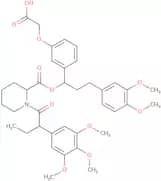
CAS:<p>AP1867 is a small molecule that targets the protein–protein interactions of lipid kinases. It is being developed for the treatment of cancers, including breast, prostate and lung cancer. AP1867 has been shown to inhibit the growth of human cancer cells in tissue culture and animal models, with some effects on cell viability. AP1867 has also demonstrated an ability to induce genetic ablation in cultured cells and to modulate signal detection pathways. Target gene expression profiling has identified a number of potential molecular targets for this drug.</p>Formula:C38H47NO11Purity:Min. 80%Color and Shape:PowderMolecular weight:693.8 g/molDL-Asparagine monohydrate
CAS:<p>DL-Asparagine monohydrate is a white crystalline powder that is soluble in water. It has been used as a building block for the synthesis of various compounds and as a reaction component in chemical research.</p>Formula:C4H10N2O4Molecular weight:150.14 g/mol6-Azaindole
CAS:<p>6-Azaindole is a fine chemical that can be used as a reagent, building block, and intermediate. It is a versatile compound that has been shown to have high quality and complex chemistry. 6-Azaindole is an important reaction component in the synthesis of other compounds with pharmaceutical applications such as amide synthons, amino acid esters, and pharmaceutical intermediates. 6-Azaindole can also be used as a scaffold for the preparation of indoles. CAS No: 271-29-4</p>Formula:C7H6N2Molecular weight:118.14 g/mol7-Azaindole
CAS:<p>7-Azaindole is a chemical compound that can be used as a building block in organic synthesis. It can be used as a reactant in the preparation of other chemicals, such as dyes, rubber accelerators, and pharmaceuticals. 7-Azaindole is also useful as an intermediate in the production of polymers, such as polyurethanes and polyesters. This chemical is soluble in water and alcohols, but insoluble in ethers and chloroform. 7-Azaindole has been classified by the International Agency for Research on Cancer (IARC) as Group 3: Not Classifiable as to its Carcinogenicity to Humans.</p>Formula:C7H6N2Purity:Min. 98.0 Area-%Molecular weight:118.14 g/molRef: 3D-A-9500
1kgTo inquire5kgTo inquire250gTo inquire500gTo inquire2500gTo inquire-Unit-kgkgTo inquire4-Methoxycyclohexane-1-sulfonyl chloride
CAS:<p>Versatile small molecule scaffold</p>Formula:C7H13ClO3SPurity:Min. 95%Color and Shape:Clear LiquidMolecular weight:212.7 g/mol1-(Azidomethyl)-4-ethenylbenzene
CAS:<p>1-(Azidomethyl)-4-ethenylbenzene is a vinyl alcohol that can be used to enhance the properties of polymers. This compound has been shown in FT-IR spectroscopy to react with carbon tetrachloride and nitrogen atoms to form a functional group. The copolymerization of styrene with 1-(azidomethyl)-4-ethenylbenzene can be used for patterning. This compound also has fluorescence properties, enabling it to be used as a fluorescent tag in microscopy and other imaging techniques.</p>Formula:C9H9N3Purity:Min. 95%Color and Shape:PowderMolecular weight:159.19 g/molN-Fmoc-4-ethynyl-L-phenylalanine
CAS:<p>Versatile small molecule scaffold</p>Formula:C26H21NO4Purity:Min. 95%Color and Shape:PowderMolecular weight:411.45 g/molMethyl 2-[1-(3-hydroxyphenyl)-N-methylformamido]acetate
CAS:<p>Versatile small molecule scaffold</p>Formula:C11H13NO4Purity:Min. 95%Color and Shape:Clear LiquidMolecular weight:223.22 g/molDichloroacetic anhydride
CAS:<p>Please enquire for more information about Dichloroacetic anhydride including the price, delivery time and more detailed product information at the technical inquiry form on this page</p>Formula:C4H2Cl4O3Purity:Min. 95%Color and Shape:Solidified MassMolecular weight:239.9 g/mol

![4-[2-(Dimethylamino)ethoxy]benzene-1-carboximidamide](/_next/image/?url=https%3A%2Fstatic.cymitquimica.com%2Fproducts%2F3D%2Fthumb-webp%2FSQB04906.webp&w=3840&q=75)
![5-Bromo-1H-pyrrolo[2,3-b]pyridine-2-carboxylic acid](/_next/image/?url=https%3A%2Fstatic.cymitquimica.com%2Fproducts%2F3D%2Fthumb-webp%2FXYB17520.webp&w=3840&q=75)
![5-[(4-Chlorophenyl)sulfanyl]furan-2-carboxylic acid](/_next/image/?url=https%3A%2Fstatic.cymitquimica.com%2Fproducts%2F3D%2Fthumb-webp%2FLCA94222.webp&w=3840&q=75)


![Methyl 2-[1-(3-hydroxyphenyl)-N-methylformamido]acetate](/_next/image/?url=https%3A%2Fstatic.cymitquimica.com%2Fproducts%2F3D%2Fthumb-webp%2FVQB93340.webp&w=3840&q=75)
