Building Blocks
This section contains fundamental products for the synthesis of organic and biological compounds. Building blocks are the essential starting materials used to construct complex molecules through various chemical reactions. They play a critical role in drug discovery, material science, and chemical research. At CymitQuimica, we offer a diverse range of high-quality building blocks to support your innovative research and industrial projects, ensuring you have the essential components for successful synthesis.
Subcategories of "Building Blocks"
- Boronic Acids & Boronic Acid Derivatives(5,778 products)
- Chiral Building Blocks(1,242 products)
- Hydrocarbon Building Blocks(6,098 products)
- Organic Building Blocks(61,084 products)
Found 198714 products of "Building Blocks"
Sort by
Purity (%)
0
100
|
0
|
50
|
90
|
95
|
100
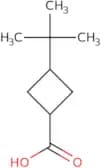
3-tert-Butylcyclobutane-1-carboxylic acid
CAS:<p>Versatile small molecule scaffold</p>Formula:C9H16O2Purity:Min. 95%Molecular weight:156.22 g/mol3-phenylcyclobutanecarboxylic acid
CAS:<p>3-Phenylcyclobutanecarboxylic acid is a cyclopropylcarbinyl compound with the molecular formula CHCOCO. It has the chemical structure of a carbanion and is an example of keto-enol tautomerism. 3-Phenylcyclobutanecarboxylic acid can be used as a keyword to indicate that the compound is an organic compound containing a cyclopropane ring.</p>Formula:C11H12O2Purity:Min. 95%Molecular weight:176.21 g/mol2-Methoxy-3-methylbutanoic acid
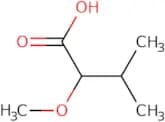
CAS:<p>Versatile small molecule scaffold</p>Formula:C6H12O3Purity:Min. 95%Molecular weight:132.16 g/mol2-Methoxypentanoic acid
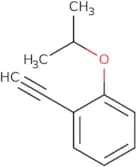
CAS:<p>Versatile small molecule scaffold</p>Formula:C6H12O3Purity:Min. 95%Molecular weight:132.16 g/mol1-Ethynyl-2-(propan-2-yloxy)benzene
CAS:<p>The yield of 1-ethynyl-2-(propan-2-yloxy)benzene (EBP) is the most important parameter for its commercial viability. The transfer of EBP from the reactor to the next step in the process is a critical part of this process. The transformation of EBP can be accomplished by a variety of methods, including radical and atom transfer reactions. Dihydrobenzofurans are an important class of compounds that can be synthesized using this process because it is not limited by substituents on the aromatic ring.</p>Formula:C11H12OPurity:Min. 95%Molecular weight:160.21 g/mol3-(5-Amino-1,3,4-thiadiazol-2-yl)propanoic acid
CAS:<p>Versatile small molecule scaffold</p>Formula:C5H7N3O2SPurity:Min. 95%Molecular weight:173.2 g/mol6-Bromo-3-methylbenzo[d]isoxazole
CAS:<p>Versatile small molecule scaffold</p>Formula:C8H6BrNOPurity:Min. 95%Molecular weight:212.04 g/mol5-Bromo-3-methyl-1,2-benzoxazole
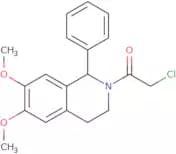
CAS:5-Bromo-3-methyl-1,2-benzoxazole is a chemical compound that can be synthesized by reacting 5-bromoindazole with methyl iodide. This chemical has been shown to react with hypochlorite in the presence of base to produce reactive oxygen species. Reactive oxygen species are known to cause cell death and DNA damage. 5-Bromo-3-methyl-1,2-benzoxazole has also been shown to undergo cyclisation upon reaction with sodium hypochlorite.Formula:C8H6BrNOPurity:Min. 95%Molecular weight:212.04 g/mol2-Chloro-1-(6,7-dimethoxy-1-phenyl-1,2,3,4-tetrahydroisoquinolin-2-yl)ethan-1-one
CAS:Versatile small molecule scaffoldFormula:C19H20ClNO3Purity:Min. 95%Molecular weight:345.8 g/mol4-Chloro-2,3-dihydro-1H-indene-1-carboxylic acid
CAS:<p>Versatile small molecule scaffold</p>Formula:C10H9ClO2Purity:Min. 95%Molecular weight:196.63 g/mol7-chloro-2,3-dihydro-1H-indene-1-carboxylic acid
CAS:<p>Versatile small molecule scaffold</p>Formula:C10H9ClO2Purity:Min. 95%Molecular weight:196.63 g/mol[2-(Benzyloxy)ethyl](methyl)amine hydrochloride
CAS:Versatile small molecule scaffoldFormula:C10H16ClNOPurity:Min. 95%Molecular weight:201.69 g/molN-[4-(Bromomethyl)phenyl]acetamide
CAS:<p>4-Aminobenzoic acid is a chemical that is used as an intermediate in the production of other chemicals and pharmaceuticals. It is an organic compound that has been shown to be an inhibitor of potassium channels, which are involved in the propagation of nerve impulses. 4-Aminobenzoic acid has also been shown to have anti-inflammatory properties, which may be due to its ability to inhibit prostaglandin synthesis.</p>Formula:C9H10BrNOPurity:Min. 95%Molecular weight:228.09 g/mol2-Methyl-4-(4-methylphenyl)-1,3-thiazole
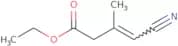
CAS:<p>Versatile small molecule scaffold</p>Formula:C11H11NSPurity:Min. 95%Molecular weight:189.28 g/molEthyl 4-cyano-3-methylbut-3-enoate
CAS:<p>Versatile small molecule scaffold</p>Formula:C8H11NO2Purity:Min. 95%Molecular weight:153.18 g/mol1-Bromobicyclo[3.3.1]nonan-3-one
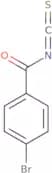
CAS:Versatile small molecule scaffoldFormula:C9H13BrOPurity:Min. 95%Molecular weight:217.1 g/mol4-Bromo-N-(sulfanylidenemethylidene)benzamide
CAS:<p>4-Bromo-N-(sulfanylidenemethylidene)benzamide is a nitro compound that has been shown to be carcinogenic in rats. It was synthesized by reaction of 4-bromobenzoyl chloride with dimethylamine and thiourea. The nitro group on the benzene ring is reduced to the amine group, while the nitro group on the amino group is oxidized to the mixed anhydride, which undergoes acid hydrolysis to form picric acid. This residue was then neutralized with sodium hydroxide and converted into a chloride salt. The chemical structure of this compound resembles that of heterocyclic amines, which are known carcinogens.</p>Formula:C8H4BrNOSPurity:Min. 95%Molecular weight:242.09 g/mol2-[(2-Methoxy-4-nitrophenyl)amino]ethan-1-ol
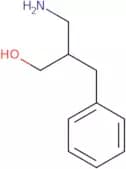
CAS:<p>2-[(2-Methoxy-4-nitrophenyl)amino]ethan-1-ol is a scientific chemical that is used in the production of care products. It is an allergen, as it has been shown to cause allergic reactions in population studies. Care products containing 2-[(2-Methoxy-4-nitrophenyl)amino]ethan-1-ol can cause sensitization, even if they are not directly applied to the skin. This chemical is tested for use in human subjects and for sensitization tests in animals. 2-[(2-Methoxy-4-nitrophenyl)amino]ethan-1-ol can be found in the environment due to its widespread use and accidental spills.</p>Formula:C9H12N2O4Purity:Min. 95%Molecular weight:212.2 g/mol3-Amino-2-benzylpropan-1-ol
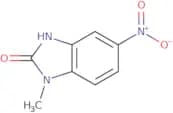
CAS:<p>Versatile small molecule scaffold</p>Formula:C10H15NOPurity:Min. 95%Molecular weight:165.23 g/mol1-Methyl-5-nitro-2,3-dihydro-1H-1,3-benzodiazol-2-one
CAS:<p>Versatile small molecule scaffold</p>Formula:C8H7N3O3Purity:Min. 95%Molecular weight:193.16 g/mol



![6-Bromo-3-methylbenzo[d]isoxazole](/_next/image/?url=https%3A%2Fstatic.cymitquimica.com%2Fproducts%2F3D%2Fthumb-webp%2FRCA03369.webp&w=3840&q=75)



amine hydrochloride](/_next/image/?url=https%3A%2Fstatic.cymitquimica.com%2Fproducts%2F3D%2Fthumb-webp%2FRCA04664.webp&w=3840&q=75)
![N-[4-(Bromomethyl)phenyl]acetamide](/_next/image/?url=https%3A%2Fstatic.cymitquimica.com%2Fproducts%2F3D%2Fthumb-webp%2FRCA04705.webp&w=3840&q=75)

![1-Bromobicyclo[3.3.1]nonan-3-one](/_next/image/?url=https%3A%2Fstatic.cymitquimica.com%2Fproducts%2F3D%2Fthumb-webp%2FRCA07798.webp&w=3840&q=75)
![2-[(2-Methoxy-4-nitrophenyl)amino]ethan-1-ol](/_next/image/?url=https%3A%2Fstatic.cymitquimica.com%2Fproducts%2F3D%2Fthumb-webp%2FRCA09581.webp&w=3840&q=75)