Building Blocks
This section contains fundamental products for the synthesis of organic and biological compounds. Building blocks are the essential starting materials used to construct complex molecules through various chemical reactions. They play a critical role in drug discovery, material science, and chemical research. At CymitQuimica, we offer a diverse range of high-quality building blocks to support your innovative research and industrial projects, ensuring you have the essential components for successful synthesis.
Subcategories of "Building Blocks"
- Boronic Acids & Boronic Acid Derivatives(5,756 products)
- Chiral Building Blocks(1,242 products)
- Hydrocarbon Building Blocks(6,095 products)
- Organic Building Blocks(61,051 products)
Found 199813 products of "Building Blocks"
Sort by
Purity (%)
0
100
|
0
|
50
|
90
|
95
|
100
5-Methylthiophene-2-thiol
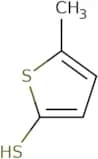
CAS:<p>5-Methylthiophene-2-thiol is a mercaptan with a thiol group at the 5 position. The sulfur atom in the thiol group is electron deficient and can serve as an electron donor. This compound has been used in food chemistry to make a diacetyl-free butter flavor. It has also been studied for its ability to inhibit the expansion of polystyrene foam. Mercaptans are found in fossil fuels, but are also produced synthetically by alkylation of hydrocarbons with hydrogen sulfide. The term "mercaptan" was coined by combining the words "mercury" and "sulfur." <br>Mercaptans are functionally important because they have both an alkylthio group and a mercapto group, which allow them to act as both an acid and an alcohol. 5-Methylthiophene-2-thiol can be used for many applications such as detergents, textile d</p>Formula:C5H6S2Purity:Min. 95%Molecular weight:130.2 g/mol4-Methylthiophene-2-thiol
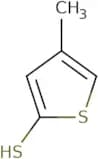
CAS:<p>Versatile small molecule scaffold</p>Formula:C5H6S2Purity:Min. 95%Molecular weight:130.2 g/mol2-Chloro-3-nitroaniline
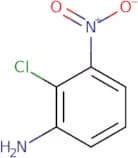
CAS:<p>2-Chloro-3-nitroaniline is a trifluoroacetic acid derivative that has been synthesized from anilines. This chemical is used in the synthesis of quinoline derivatives and other synthetic intermediates. It can be used as a ligand to form metal complexes with metals such as copper, lead, or zinc. 2-Chloro-3-nitroaniline is also used as a chromatographic chiral stationary phase or to generate solutes with specific functional groups for use in chemical interactions.</p>Formula:C6H5ClN2O2Purity:Min. 95%Molecular weight:172.57 g/mol6-Chloro-1H-indene
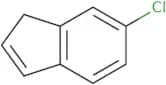
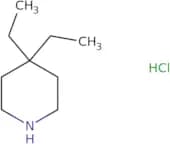
CAS:<p>6-Chloro-1H-indene is a versatile molecule that can be used as an acceptor for cyclopropanation reactions. It is a monoadduct and the product of a unique reaction that involves carbenes. 6-Chloro-1H-indene has been shown to be selective for alkenes in photovoltaic experiments, with high conversion rates and low levels of polymers. It has also been shown to have potential in organic chemistry as a scalable synthesis.</p>Formula:C9H7ClPurity:Min. 95%Molecular weight:150.6 g/mol4,4-Diethylpiperidine hydrochloride
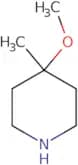
CAS:<p>Versatile small molecule scaffold</p>Formula:C9H20ClNPurity:Min. 95%Molecular weight:177.71 g/mol4-Methoxy-4-methylpiperidine
CAS:<p>Versatile small molecule scaffold</p>Formula:C7H15NOPurity:Min. 95%Molecular weight:129.2 g/mol2-Methyl-1,4-dioxa-8-azaspiro[4.5]decane hydrochloride
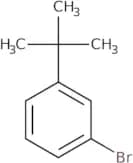
CAS:Controlled ProductVersatile small molecule scaffoldFormula:C8H16ClNO2Purity:Min. 95%Molecular weight:193.7 g/mol1-Bromo-3-tert-butylbenzene
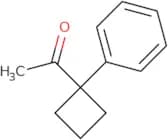
CAS:<p>1-Bromo-3-tert-butylbenzene is a chemical compound that is used in the synthesis of pharmaceuticals, pesticides, and other organic compounds. It has been shown to be an effective inhibitor of NF-κB, which plays a key role in the inflammatory response. 1-Bromo-3-tert-butylbenzene has also been shown to inhibit colon cancer cells and phosphatase activity. The inhibition of these two activities can lead to a decrease in human diseases such as cancer and diabetes. This compound can be synthesized by using solvents such as dichloromethane or chloroform, or by using phosphatase enzymes from bacteria or fungi.</p>Formula:C10H13BrPurity:Min. 95%Molecular weight:213.11 g/mol1-(1-Phenylcyclobutyl)ethanone
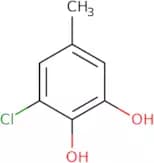
CAS:<p>Versatile small molecule scaffold</p>Formula:C12H14OPurity:Min. 95%Molecular weight:174.24 g/mol3-Chloro-5-methylbenzene-1,2-diol
CAS:<p>3-Chloro-5-methylbenzene-1,2-diol is an organic compound that is used as a substrate in assays to measure the activity of enzymes that oxidize it. This compound has been shown to be mineralized by a number of bacterial strains, and its formation rate has been shown to be dependent on the presence of oxygen. 3-Chloro-5-methylbenzene-1,2-diol can also be dechlorinated by a number of bacterial strains and its gene product (3CMB) has been identified in Bacillus subtilis. Magnetic resonance analysis revealed that 3CMB is produced from 3CMB by a dehydrogenase enzyme in the active site. The enzyme is homologous to the dehydrogenases found in Escherichia coli and Pseudomonas aeruginosa.</p>Formula:C7H7ClO2Purity:Min. 95%Molecular weight:158.58 g/mol1-[(2-Bromoethyl)sulfanyl]-3-methylbenzene
CAS:<p>Versatile small molecule scaffold</p>Formula:C9H11BrSPurity:Min. 95%Molecular weight:231.15 g/mol1-[(2-Bromoethyl)sulfanyl]-3-chlorobenzene
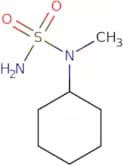
CAS:<p>Versatile small molecule scaffold</p>Formula:C8H8BrClSPurity:Min. 95%Molecular weight:251.57 g/molN-Cyclohexyl-N-methylaminosulfonamide
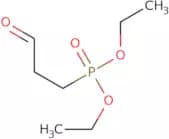
CAS:<p>Versatile small molecule scaffold</p>Formula:C7H16N2O2SPurity:Min. 95%Molecular weight:192.28 g/molDiethyl (3-oxopropyl)phosphonate
CAS:<p>Diethyl (3-oxopropyl)phosphonate is a synthetic compound that is used as an intermediate in the synthesis of pharmaceuticals. The asymmetric synthesis of diethyl (3-oxopropyl)phosphonate was catalyzed by amide and fluorine. Crystallographic data for this molecule were obtained using n-oxide, which focuses on tuberculosis. This drug is an anti-tuberculosis drug.</p>Formula:C7H15O4PPurity:Min. 95%Molecular weight:194.17 g/mol2-Cinnamoylthiophene
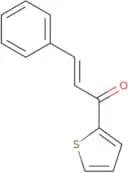
CAS:<p>2-Cinnamoylthiophene is a synthetic compound that has been shown to have an apoptotic effect on cancer cells in culture. It is produced by the reaction of 2-aminothiophenol with acetic anhydride and cinnamic acid. The molecular structure of 2-cinnamoylthiophene has been determined using nuclear magnetic resonance (NMR) spectroscopy and quantum chemical calculations. This molecule is oxidized by hydrogen peroxide to generate reactive intermediates, which then react with DNA bases to form DNA adducts. These adducts are detected by the tetrazolium dye MTT, which is used as a cell viability assay. 2-Cinnamoylthiophene also contains functional groups that can be used for further study.</p>Formula:C13H10OSPurity:Min. 95%Molecular weight:214.28 g/molChroman-2-ylmethanamine
CAS:<p>Chroman-2-ylmethanamine is an indole alkaloid that has been shown to have high affinity for the 5-HT1A receptor. It also has neuroprotective properties and prevents apoptotic cell death in a dose-dependent manner. This drug has also been shown to reduce extracellular glutamate levels in brain tissue and inhibit dopamine release. Chroman-2-ylmethanamine is an agonist at the 5-HT1A receptor, which causes it to inhibit extracellular acidification by hydrochloric acid. It also inhibits glutamate release by binding to the AMPA receptor, which leads to its anti-ischemic effects.</p>Formula:C10H13NOPurity:Min. 95%Molecular weight:163.22 g/mol6-Methoxynaphthalen-2-amine hydrochloride
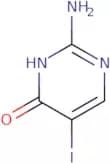
CAS:<p>Versatile small molecule scaffold</p>Formula:C11H12ClNOPurity:Min. 95%Molecular weight:209.67 g/mol2-Amino-5-iodopyrimidin-4(1H)-one
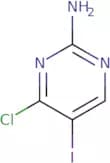
CAS:<p>Versatile small molecule scaffold</p>Formula:C4H4IN3OPurity:Min. 95%Molecular weight:237 g/mol4-chloro-5-iodopyrimidin-2-amine
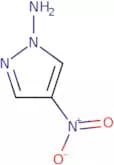
CAS:<p>Versatile small molecule scaffold</p>Formula:C4H3ClIN3Purity:Min. 95%Molecular weight:255.4 g/mol4-Nitro-1H-pyrazol-1-amine
CAS:<p>Versatile small molecule scaffold</p>Formula:C3H4N4O2Purity:Min. 95%Molecular weight:128.09 g/mol

![2-Methyl-1,4-dioxa-8-azaspiro[4.5]decane hydrochloride](/_next/image/?url=https%3A%2Fstatic.cymitquimica.com%2Fproducts%2F3D%2Fthumb-webp%2FDAA97083.webp&w=3840&q=75)
![1-[(2-Bromoethyl)sulfanyl]-3-methylbenzene](/_next/image/?url=https%3A%2Fstatic.cymitquimica.com%2Fproducts%2F3D%2Fthumb-webp%2FDAA98369.webp&w=3840&q=75)
![1-[(2-Bromoethyl)sulfanyl]-3-chlorobenzene](/_next/image/?url=https%3A%2Fstatic.cymitquimica.com%2Fproducts%2F3D%2Fthumb-webp%2FDAA98371.webp&w=3840&q=75)