


Building Blocks
This section contains fundamental products for the synthesis of organic and biological compounds. Building blocks are the essential starting materials used to construct complex molecules through various chemical reactions. They play a critical role in drug discovery, material science, and chemical research. At CymitQuimica, we offer a diverse range of high-quality building blocks to support your innovative research and industrial projects, ensuring you have the essential components for successful synthesis.
Subcategories of "Building Blocks"
- Boronic Acids & Boronic Acid Derivatives(5,778 products)
- Chiral Building Blocks(1,242 products)
- Hydrocarbon Building Blocks(6,098 products)
- Organic Building Blocks(61,084 products)
Found 198714 products of "Building Blocks"
Sort by
Purity (%)
0
100
|
0
|
50
|
90
|
95
|
100
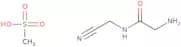
2-Amino-N-(cyanomethyl)acetamide methanesulfonate
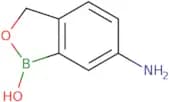
CAS:<p>Versatile small molecule scaffold</p>Formula:C5H11N3O4SPurity:Min. 95%Molecular weight:209.23 g/mol5-Amino-2-(hydroxymethyl)phenylboronic Acid Cyclic Monoester
CAS:<p>5-Amino-2-(hydroxymethyl)phenylboronic acid cyclic monoester is an organic compound that is a ligand for metal ions. It binds to metal ions by donating a hydrogen atom from the hydroxyl group and forming a covalent bond with the metal ion. This ligand has been used in the synthesis of nanoparticles and it has also been used as a ligand in binding constants and affinity constants. 5-Amino-2-(hydroxymethyl)phenylboronic acid cyclic monoester has been shown to have high affinity for phenylboronic acid. This ligand undergoes nucleophilic attack by water, which leads to the release of boric acid and alcohol.</p>Formula:C7H8BNO2Purity:Min. 95%Molecular weight:148.96 g/mol4-{[(tert-Butyldimethylsilyl)oxy]methyl}cyclohexan-1-ol
CAS:<p>Versatile small molecule scaffold</p>Formula:C13H28O2SiPurity:Min. 95%Molecular weight:244.44 g/mol1-[2-(4-Methoxy-phenoxy)-ethyl]-piperazine
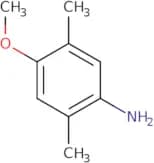
CAS:Versatile small molecule scaffoldFormula:C13H20N2O2Purity:Min. 95%Molecular weight:236.32 g/mol4-Methoxy-2,5-dimethylaniline
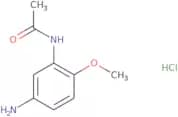
CAS:Versatile small molecule scaffoldFormula:C9H13NOPurity:Min. 95%Molecular weight:151.21 g/molN-(5-Amino-2-methoxyphenyl)acetamide hydrochloride
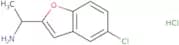
CAS:<p>Versatile small molecule scaffold</p>Formula:C9H13ClN2O2Purity:Min. 95%Molecular weight:216.66 g/mol1-(5-Chloro-1-benzofuran-2-yl)ethan-1-amine hydrochloride
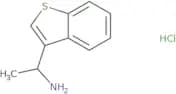
CAS:<p>Versatile small molecule scaffold</p>Formula:C10H11Cl2NOPurity:Min. 95%Molecular weight:232.1 g/mol1-(1-Benzothiophen-3-yl)ethan-1-amine hydrochloride
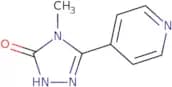
CAS:<p>Versatile small molecule scaffold</p>Formula:C10H12ClNSPurity:Min. 95%Molecular weight:213.73 g/mol4-Methyl-3-(pyridin-4-yl)-4,5-dihydro-1H-1,2,4-triazol-5-one
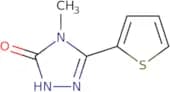
CAS:Versatile small molecule scaffoldFormula:C8H8N4OPurity:Min. 95%Molecular weight:176.18 g/mol4-Methyl-3-(thiophen-2-yl)-4,5-dihydro-1H-1,2,4-triazol-5-one
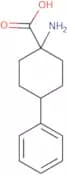
CAS:<p>Versatile small molecule scaffold</p>Formula:C7H7N3OSPurity:Min. 95%Molecular weight:181.22 g/mol1-Amino-4-phenylcyclohexane-1-carboxylic acid
CAS:<p>1-Amino-4-phenylcyclohexane-1-carboxylic acid (APC) is a neurohypophyseal hormone that has been found in the brain of various mammals. It is an agonist at the neurohypophyseal receptors, which are located in the hypothalamus and regulates water balance. APC also has antagonist activity at pressor receptors, which are located in the vasculature and regulate blood pressure. 1-Amino-4-phenylcyclohexane-1-carboxylic acid is a pentapeptide that is structurally related to oxytocin and vasopressin. It was first isolated from bovine hypothalami by affinity chromatography and then synthesized chemically. The crystal structure of APC has shown that it forms an L shape with two amino groups at one end and a carboxyl group at the other end, with no side chains. This conformationally restricted</p>Formula:C13H17NO2Purity:Min. 95%Molecular weight:219.28 g/molN-[1-(Hydrazinecarbonyl)ethyl]methanesulfonamide
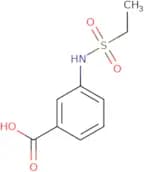
CAS:<p>Versatile small molecule scaffold</p>Formula:C4H11N3O3SPurity:Min. 95%Molecular weight:181.22 g/mol3-Ethanesulfonamidobenzoic acid
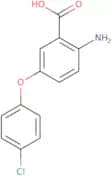
CAS:<p>Versatile small molecule scaffold</p>Formula:C9H11NO4SPurity:Min. 95%Molecular weight:229.26 g/mol2-Amino-5-(4-chlorophenoxy)benzoic acid
CAS:<p>Versatile small molecule scaffold</p>Formula:C13H10ClNO3Purity:Min. 95%Molecular weight:263.67 g/mol2-Oxo-1H,2H,5H,6H,7H,8H,9H-cyclohepta[b]pyridine-3-carbonitrile
CAS:Versatile small molecule scaffoldFormula:C11H12N2OPurity:Min. 95%Molecular weight:188.2 g/mol1-[4-(1-Phenylethoxy)phenyl]ethan-1-one
CAS:<p>Versatile small molecule scaffold</p>Formula:C16H16O2Purity:Min. 95%Molecular weight:240.3 g/mol8-Chloro-6,7-dihydro-5H-cyclopenta[D][1,2,4]triazolo[1,5-a]pyrimidine
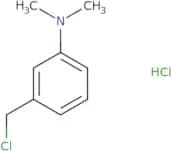
CAS:<p>Versatile small molecule scaffold</p>Formula:C8H7ClN4Purity:Min. 95%Molecular weight:194.62 g/mol3-(Chloromethyl)-N,N-dimethylaniline hydrochloride
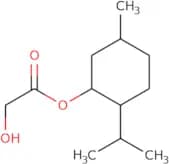
CAS:<p>Versatile small molecule scaffold</p>Formula:C9H13Cl2NPurity:Min. 95%Molecular weight:206.11 g/mol5-Methyl-2-(propan-2-yl)cyclohexyl 2-hydroxyacetate
CAS:5-Methyl-2-(propan-2-yl)cyclohexyl 2-hydroxyacetate is a compound that is used as a corrosion inhibitor in wastewater treatment. It reacts with anions, such as chloride and bromide ions, to form an insoluble salt. This salt can be removed from the wastewater through filtration or adsorption. 5-Methyl-2-(propan-2-yl)cyclohexyl 2-hydroxyacetate has been shown to be effective against aluminium, zirconium, and hydrochloric acid without affecting the reaction selectivity. The product does not react with amines or other organic substances.Formula:C12H22O3Purity:Min. 95%Molecular weight:214.3 g/mol4-[4-(Aminomethyl)phenyl]-1,3-thiazol-2-amine
CAS:Versatile small molecule scaffoldFormula:C10H11N3SPurity:Min. 95%Molecular weight:205.28 g/mol

![4-{[(tert-Butyldimethylsilyl)oxy]methyl}cyclohexan-1-ol](/_next/image/?url=https%3A%2Fstatic.cymitquimica.com%2Fproducts%2F3D%2Fthumb-webp%2FSEA10708.webp&w=3840&q=75)
![1-[2-(4-Methoxy-phenoxy)-ethyl]-piperazine](/_next/image/?url=https%3A%2Fstatic.cymitquimica.com%2Fproducts%2F3D%2Fthumb-webp%2FSEA13244.webp&w=3840&q=75)
![N-[1-(Hydrazinecarbonyl)ethyl]methanesulfonamide](/_next/image/?url=https%3A%2Fstatic.cymitquimica.com%2Fproducts%2F3D%2Fthumb-webp%2FSEA26737.webp&w=3840&q=75)
![2-Oxo-1H,2H,5H,6H,7H,8H,9H-cyclohepta[b]pyridine-3-carbonitrile](/_next/image/?url=https%3A%2Fstatic.cymitquimica.com%2Fproducts%2F3D%2Fthumb-webp%2FSEA31118.webp&w=3840&q=75)
![1-[4-(1-Phenylethoxy)phenyl]ethan-1-one](/_next/image/?url=https%3A%2Fstatic.cymitquimica.com%2Fproducts%2F3D%2Fthumb-webp%2FSEA32140.webp&w=3840&q=75)
![8-Chloro-6,7-dihydro-5H-cyclopenta[D][1,2,4]triazolo[1,5-a]pyrimidine](/_next/image/?url=https%3A%2Fstatic.cymitquimica.com%2Fproducts%2F3D%2Fthumb-webp%2FSEA34312.webp&w=3840&q=75)
![4-[4-(Aminomethyl)phenyl]-1,3-thiazol-2-amine](/_next/image/?url=https%3A%2Fstatic.cymitquimica.com%2Fproducts%2F3D%2Fthumb-webp%2FSEA36026.webp&w=3840&q=75)