Building Blocks
This section contains fundamental products for the synthesis of organic and biological compounds. Building blocks are the essential starting materials used to construct complex molecules through various chemical reactions. They play a critical role in drug discovery, material science, and chemical research. At CymitQuimica, we offer a diverse range of high-quality building blocks to support your innovative research and industrial projects, ensuring you have the essential components for successful synthesis.
Subcategories of "Building Blocks"
- Boronic Acids & Boronic Acid Derivatives(5,783 products)
- Chiral Building Blocks(1,242 products)
- Hydrocarbon Building Blocks(6,105 products)
- Organic Building Blocks(61,055 products)
Found 205383 products of "Building Blocks"
Sort by
Purity (%)
0
100
|
0
|
50
|
90
|
95
|
100
1-(2-Hydroxy-4,6-dimethylphenyl)ethan-1-one
CAS:1-(2-Hydroxy-4,6-dimethylphenyl)ethan-1-one is an experimental molecule that is a hydrogen bond acceptor. It has a C3v conformation with the H atom in the hydroxymethyl group in a trans position and the methyl group on the opposite side of the ring. The experimentally determined frequencies for this molecule are in good agreement with those predicted by theory. This molecule has been observed to have a conformational change when it is protonated or deprotonated. In addition, this molecule can be used as an intermediate for polyhalogenating benzonitrile derivatives and carboxylic acids.Formula:C10H12O2Purity:Min. 95%Molecular weight:164.2 g/mol1-[Amino(phenyl)methyl]cyclohexan-1-ol hydrochloride
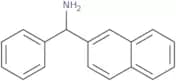
CAS:Versatile small molecule scaffoldFormula:C13H20ClNOPurity:Min. 95%Molecular weight:241.8 g/molNaphthalen-2-yl(phenyl)methanamine
CAS:Versatile small molecule scaffold
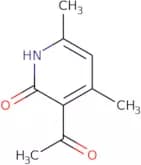
Formula:C17H15NPurity:Min. 95%Molecular weight:233.31 g/mol3-Acetyl-4,6-dimethyl-1,2-dihydropyridin-2-one
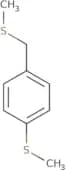
CAS:3-Acetyl-4,6-dimethyl-1,2-dihydropyridin-2-one is an organic compound with the chemical formula CHNO. It is a white crystalline solid that is soluble in water and polar organic solvents. The molecule features a cyclic amide group that can be cleaved to give three equivalents of ammonia. This acid has been shown to react with morpholine to form an acidic, basic isomeric mixture of 3-(morpholinomethyl)pyridine (3MP). The structure of the 3MP was determined by x-ray structural analysis and found to have a similar structure to pyridine.Formula:C9H11NO2Purity:Min. 95%Molecular weight:165.19 g/mol4-(Methylsulfanyl)benzyl methyl sulfide
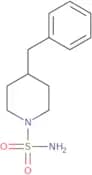
CAS:Versatile small molecule scaffoldFormula:C9H12S2Purity:Min. 95%Molecular weight:184.3 g/mol4-Benzylpiperidine-1-sulfonamide
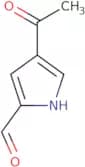
CAS:Versatile small molecule scaffoldFormula:C12H18N2O2SPurity:Min. 95%Molecular weight:254.35 g/mol4-Acetyl-1H-pyrrole-2-carboxaldehyde
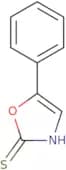
CAS:4-Acetyl-1H-pyrrole-2-carboxaldehyde is a molecule that can be used to regulate proton transfer. It has been shown to have a photophysical effect, in which it absorbs light and transfers the energy to a nearby acceptor. 4-Acetyl-1H-pyrrole-2-carboxaldehyde also facilitates the transfer of protons from one compound to another. The thermodynamics of this reaction are dependent on substituent effects as well as pyrazole ring geometry. 4-Acetyl-1H-pyrrole-2-carboxaldehyde is able to undergo Friedel–Crafts reactions, where it forms an ethoxycarbonyl group by attacking a double bond with carbon monoxide and hydrogen chloride. This can be done in two ways: the dihedral or syn orientation, which results in different products.Formula:C7H7NO2Purity:Min. 95%Molecular weight:137.14 g/mol5-Phenyl-1,3-oxazole-2-thiol
CAS:Versatile small molecule scaffoldFormula:C9H7NOSPurity:Min. 95%Molecular weight:177.22 g/mol4-(Piperidin-3-yl)-1H-indole
CAS:Versatile small molecule scaffoldFormula:C13H16N2Purity:Min. 95%Molecular weight:200.3 g/mol1-Bromo-4-[(2-chloroethyl)sulfanyl]benzene
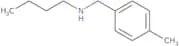
CAS:Versatile small molecule scaffoldFormula:C8H8BrClSPurity:Min. 95%Molecular weight:251.57 g/molN-(4-Methylbenzyl)butan-1-amine
CAS:Versatile small molecule scaffoldFormula:C12H19NPurity:Min. 95%Molecular weight:177.29 g/molButyl[(2-chlorophenyl)methyl]amine
CAS:Versatile small molecule scaffold
Formula:C11H16ClNPurity:Min. 95%Molecular weight:197.7 g/mol2-[(4-Methanesulfonylphenyl)sulfanyl]benzoic acid
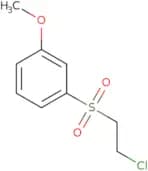
CAS:Versatile small molecule scaffoldFormula:C14H12O4S2Purity:Min. 95%Molecular weight:308.4 g/mol1-(2-Chloroethanesulfonyl)-3-methoxybenzene
CAS:Versatile small molecule scaffoldFormula:C9H11ClO3SPurity:Min. 95%Molecular weight:234.7 g/mol1-Chloro-4-[(2-chloroethyl)sulfonyl]benzene
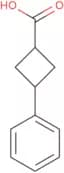
CAS:Versatile small molecule scaffoldFormula:C8H8Cl2O2SPurity:Min. 95%Molecular weight:239.12 g/molrac-(1S,3S)-3-Phenylcyclobutane-1-carboxylic acid
CAS:Rac-1-phenylcyclobutane-1-carboxylic acid is a carbanion that contains a cyclopropylcarbinyl group. It can be prepared by the reaction of ketones with lithium diisopropylamide. Rac-1-phenylcyclobutane-1-carboxylic acid is used as an intermediate in the synthesis of drugs such as ampicillin and erythromycin.
Formula:C11H12O2Purity:Min. 95%Molecular weight:176.21 g/mol7-Methylpyrazolo[1,5-a]pyridine-3-carboxylic acid
CAS:Versatile small molecule scaffoldFormula:C9H8N2O2Purity:Min. 95%Molecular weight:176.17 g/mol3-Oxo-1-cyclohexanecarboxylic acid
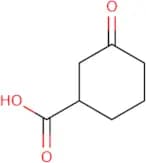
CAS:3-Oxo-1-cyclohexanecarboxylic acid is a structural isomer of cyclohexanecarboxylic acid. It is a white crystalline solid that can react with monoxide to form 3-oxocyclohexane carboxylic acid or with chlorine to form 3-chlorocyclohexane carboxylic acid. The reaction rate and regioselectivity are dependent on the catalyst used. With catalytic amounts of copper and air, 3-oxocyclohexane carboxylic acid is formed preferentially, but when using an excess of copper, the chlorinated product is obtained in higher yields. This reaction occurs because the orthoformic carbon atom has a greater electron density than the meta formic carbon atom. The reaction mechanism begins with oxidation of the metal to form a metal oxide which then reacts with CO to produce CO2 and H2O.Formula:C7H10O3Purity:Min. 95%Molecular weight:142.15 g/mol2-Methyl-4-(naphthalen-2-yl)-4-oxobutanoic acid
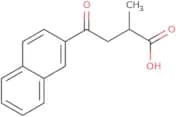
CAS:Versatile small molecule scaffoldFormula:C15H14O3Purity:Min. 95%Molecular weight:242.27 g/mol4-(1H-Pyrazol-1-yl)phenol
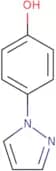
CAS:Versatile small molecule scaffoldFormula:C9H8N2OPurity:Min. 95%Molecular weight:160.17 g/mol


![1-[Amino(phenyl)methyl]cyclohexan-1-ol hydrochloride](/_next/image/?url=https%3A%2Fstatic.cymitquimica.com%2Fproducts%2F3D%2Fthumb-webp%2FRAA11293.webp&w=3840&q=75)

![1-Bromo-4-[(2-chloroethyl)sulfanyl]benzene](/_next/image/?url=https%3A%2Fstatic.cymitquimica.com%2Fproducts%2F3D%2Fthumb-webp%2FRAA18114.webp&w=3840&q=75)
![Butyl[(2-chlorophenyl)methyl]amine](/_next/image/?url=https%3A%2Fstatic.cymitquimica.com%2Fproducts%2F3D%2Fthumb-webp%2FRAA18339.webp&w=3840&q=75)
![2-[(4-Methanesulfonylphenyl)sulfanyl]benzoic acid](/_next/image/?url=https%3A%2Fstatic.cymitquimica.com%2Fproducts%2F3D%2Fthumb-webp%2FRAA18513.webp&w=3840&q=75)
![1-Chloro-4-[(2-chloroethyl)sulfonyl]benzene](/_next/image/?url=https%3A%2Fstatic.cymitquimica.com%2Fproducts%2F3D%2Fthumb-webp%2FRAA19184.webp&w=3840&q=75)
![7-Methylpyrazolo[1,5-a]pyridine-3-carboxylic acid](/_next/image/?url=https%3A%2Fstatic.cymitquimica.com%2Fproducts%2F3D%2Fthumb-webp%2FRAA20547.webp&w=3840&q=75)