Building Blocks
This section contains fundamental products for the synthesis of organic and biological compounds. Building blocks are the essential starting materials used to construct complex molecules through various chemical reactions. They play a critical role in drug discovery, material science, and chemical research. At CymitQuimica, we offer a diverse range of high-quality building blocks to support your innovative research and industrial projects, ensuring you have the essential components for successful synthesis.
Subcategories of "Building Blocks"
- Boronic Acids & Boronic Acid Derivatives(5,756 products)
- Chiral Building Blocks(1,242 products)
- Hydrocarbon Building Blocks(6,095 products)
- Organic Building Blocks(61,051 products)
Found 199813 products of "Building Blocks"
Sort by
Purity (%)
0
100
|
0
|
50
|
90
|
95
|
100
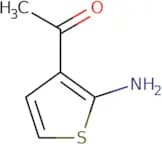
1-(2-Aminothiophen-3-yl)ethanone
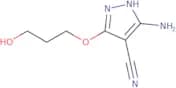
CAS:<p>1-(2-Aminothiophen-3-yl)ethanone is a reagent that is used in cross-coupling reactions. It is also an efficient method for the synthesis of 1,2,3-triazoles from pyridines and thiophenes and it has been shown to be a potent inhibitor of bacterial infection. This compound inhibits the production of proinflammatory cytokines such as TNF-α. 1-(2-Aminothiophen-3-yl)ethanone has been found to have antidepressant effects, which may be due to its ability to inhibit the uptake of serotonin by neurons.</p>Formula:C6H7NOSPurity:Min. 95%Molecular weight:141.19 g/mol5-Amino-3-(3-hydroxypropoxy)-1H-pyrazole-4-carbonitrile
CAS:<p>Versatile small molecule scaffold</p>Formula:C7H10N4O2Purity:Min. 95%Molecular weight:182.18 g/mol1-[2-(Pyridin-4-yl)ethyl]-1H-pyrrole-2-carbaldehyde
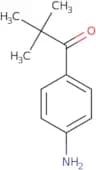
CAS:<p>Versatile small molecule scaffold</p>Formula:C12H12N2OPurity:Min. 95%Molecular weight:200.24 g/mol1-(4-Aminophenyl)-2,2-dimethylpropan-1-one
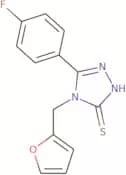
CAS:<p>Versatile small molecule scaffold</p>Formula:C11H15NOPurity:Min. 95%Molecular weight:177.24 g/mol5-(4-Fluorophenyl)-4-(furan-2-ylmethyl)-4H-1,2,4-triazole-3-thiol
CAS:Versatile small molecule scaffoldFormula:C13H10FN3OSPurity:Min. 95%Molecular weight:275.3 g/mol1-[2-(2-Chlorophenoxy)ethyl]-1H-indole-3-carboxylic acid
CAS:Controlled Product<p>Versatile small molecule scaffold</p>Formula:C17H14ClNO3Purity:Min. 95%Molecular weight:315.7 g/molMethyl 4-hydroxy-2-sulfanylquinoline-3-carboxylate
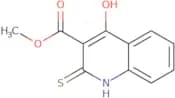
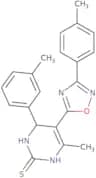
CAS:<p>Methyl 4-hydroxy-2-sulfanylquinoline-3-carboxylate (MSQ) is a synthetic molecule that has shown to have antiviral activity against the hepatitis B virus. This compound is a competitive inhibitor of the virus and prevents it from infecting cells. MSQ has also been shown to inhibit other viruses, such as herpes simplex virus, influenza A and C, rotavirus, and human immunodeficiency virus type 1 (HIV-1). The high inhibition of MSQ can be attributed to its ability to form hydrogen bonds with the amino acid residues in viral proteins. Additionally, MSQ interacts with anions in the active site of the enzymes that are necessary for viral replication through alkylation reactions.<br>MSQ has been found to be selective for influenza A and C by binding at different sites on the enzyme compared to other compounds like zanamivir and oseltamivir. The single-crystal x</p>Formula:C11H9NO3SPurity:Min. 95%Molecular weight:235.26 g/mol6-Methyl-4-(m-tolyl)-5-(3-(p-tolyl)-1,2,4-oxadiazol-5-yl)-3,4-dihydropyrimidine-2(1H)-thione
CAS:<p>Versatile small molecule scaffold</p>Formula:C21H20N4OSPurity:Min. 95%Molecular weight:376.5 g/mol[(2S)-1-[(3-Fluorophenyl)methyl]pyrrolidin-2-yl]methanol
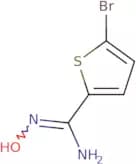
CAS:<p>Versatile small molecule scaffold</p>Formula:C12H16FNOPurity:Min. 95%Molecular weight:209.26 g/mol5-Bromo-N'-hydroxythiophene-2-carboximidamide
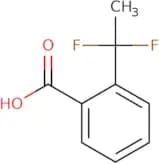
CAS:<p>Versatile small molecule scaffold</p>Formula:C5H5BrN2OSPurity:Min. 95%Molecular weight:221.08 g/mol2-(1,1-Difluoroethyl)benzoic acid
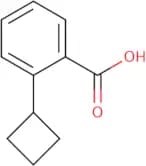
CAS:<p>Versatile small molecule scaffold</p>Formula:C9H8F2O2Purity:Min. 95%Molecular weight:186.16 g/mol2-Cyclobutylbenzoic acid
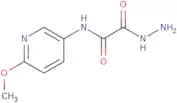
CAS:<p>Versatile small molecule scaffold</p>Formula:C11H12O2Purity:Min. 95%Molecular weight:176.21 g/mol2-Hydrazino-N-(6-methoxypyridin-3-yl)-2-oxoacetamide
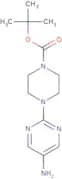
CAS:<p>Versatile small molecule scaffold</p>Formula:C8H10N4O3Purity:Min. 95%Molecular weight:210.19 g/moltert-Butyl 4-(5-aminopyrimidin-2-yl)piperazine-1-carboxylate
CAS:<p>Versatile small molecule scaffold</p>Formula:C13H21N5O2Purity:Min. 95%Molecular weight:279.34 g/mol[4-(1H-Pyrazol-1-ylmethyl)phenyl]methanamine
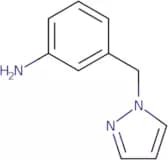
CAS:<p>Versatile small molecule scaffold</p>Formula:C11H13N3Purity:Min. 95%Molecular weight:187.24 g/mol3-Pyrazol-1-ylmethyl-phenylamine
CAS:<p>Versatile small molecule scaffold</p>Formula:C10H11N3Purity:Min. 95%Molecular weight:173.21 g/mol2-Methyl-2-[(phenylcarbamoyl)amino]propanoic acid
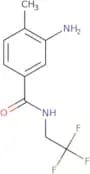
CAS:<p>Versatile small molecule scaffold</p>Formula:C11H14N2O3Purity:Min. 95%Molecular weight:222.24 g/mol3-Amino-4-methyl-N-(2,2,2-trifluoroethyl)benzamide
CAS:<p>Versatile small molecule scaffold</p>Formula:C10H11N2OF3Purity:Min. 95%Molecular weight:232.2 g/mol2-Methyl-1-{[1,2,4]triazolo[4,3-a]pyridin-3-yl}propan-1-amine
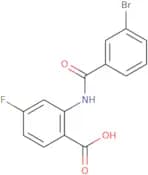
CAS:<p>Versatile small molecule scaffold</p>Formula:C10H14N4Purity:Min. 95%Molecular weight:190.25 g/mol2-(3-Bromobenzamido)-4-fluorobenzoic acid
CAS:<p>2-(3-Bromobenzamido)-4-fluorobenzoic acid is a small molecule that can be used to study the function of ion channels. It may inhibit ion channels by binding to a site outside the pore, or it may block the pore entirely. This compound is a ligand for nicotinic acetylcholine receptors (nAChRs). It has been shown to activate these receptors in both rat and human brain tissue.</p>Formula:C14H9BrFNO3Purity:Min. 95%Molecular weight:338.13 g/mol

![1-[2-(Pyridin-4-yl)ethyl]-1H-pyrrole-2-carbaldehyde](/_next/image/?url=https%3A%2Fstatic.cymitquimica.com%2Fproducts%2F3D%2Fthumb-webp%2FSKB14912.webp&w=3840&q=75)
![1-[2-(2-Chlorophenoxy)ethyl]-1H-indole-3-carboxylic acid](/_next/image/?url=https%3A%2Fstatic.cymitquimica.com%2Fproducts%2F3D%2Fthumb-webp%2FSKB25506.webp&w=3840&q=75)
![[(2S)-1-[(3-Fluorophenyl)methyl]pyrrolidin-2-yl]methanol](/_next/image/?url=https%3A%2Fstatic.cymitquimica.com%2Fproducts%2F3D%2Fthumb-webp%2FSKB38687.webp&w=3840&q=75)
![[4-(1H-Pyrazol-1-ylmethyl)phenyl]methanamine](/_next/image/?url=https%3A%2Fstatic.cymitquimica.com%2Fproducts%2F3D%2Fthumb-webp%2FSKB50207.webp&w=3840&q=75)
![2-Methyl-2-[(phenylcarbamoyl)amino]propanoic acid](/_next/image/?url=https%3A%2Fstatic.cymitquimica.com%2Fproducts%2F3D%2Fthumb-webp%2FSQA71574.webp&w=3840&q=75)
![2-Methyl-1-{[1,2,4]triazolo[4,3-a]pyridin-3-yl}propan-1-amine](/_next/image/?url=https%3A%2Fstatic.cymitquimica.com%2Fproducts%2F3D%2Fthumb-webp%2FSQB01983.webp&w=3840&q=75)