Building Blocks
Subcategories of "Building Blocks"
- Boronic Acids & Boronic Acid Derivatives(5,781 products)
- Chiral Building Blocks(1,242 products)
- Hydrocarbon Building Blocks(6,101 products)
- Organic Building Blocks(61,033 products)
Found 205320 products of "Building Blocks"
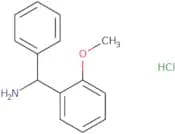
(2-Methoxyphenyl)(phenyl)methanamine hydrochloride
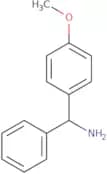
CAS:Versatile small molecule scaffoldFormula:C14H16ClNOPurity:Min. 95%Molecular weight:249.73 g/mol(4-Methoxyphenyl)(phenyl)methanamine hydrochloride
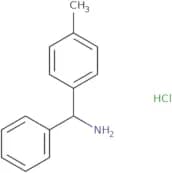
CAS:Versatile small molecule scaffoldFormula:C14H15NOPurity:Min. 95%Molecular weight:213.27 g/mol(4-Methylphenyl)(phenyl)methanamine hydrochloride
CAS:4-Methylphenyl)(phenyl)methanamine hydrochloride (4MPHM) is an antimicrobial agent that disrupts the cell membrane of mammalian cells. It also inhibits pancreatic regeneration and has been shown to inhibit the production of natural toxins, such as antimicrobial peptides. 4MPHM has been shown to enhance antibiotic drugs, such as fluconazole, and can be used in regenerative medicine to treat pancreatic cancer and other diseases. 4MPHM binds to a molecule on the cell membrane, which enhances permeability and causes a disruption in the integrity of the bacterial cell membrane.Formula:C14H16ClNPurity:Min. 95%Molecular weight:233.73 g/molNaphthalen-1-yl(phenyl)methanamine hydrochloride
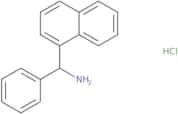
CAS:Versatile small molecule scaffoldFormula:C17H16ClNPurity:Min. 95%Molecular weight:269.8 g/mol2-(1-Bromoethyl)-1,3-dioxolane
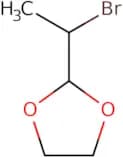
CAS:2-(1-Bromoethyl)-1,3-dioxolane is an organic compound with a molecular weight of 214.2 g/mol. It has two isomers: the cis form and the trans form. The cis form is more stable and less reactive than the trans form, although both have approximately equal binding affinity for human cytochrome P450. 2-(1-Bromoethyl)-1,3-dioxolane can be found in the metabolic profiles of many anticancer drugs such as abscisic acid, carboxylic acid and ethyl group derivatives. Furthermore, it can be used to synthesize polymers that are used in cancer treatments.Formula:C5H9BrO2Purity:Min. 95%Molecular weight:181.03 g/mol4-Bromo-1,6-naphthyridine
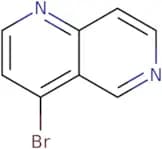
CAS:Versatile small molecule scaffoldFormula:C8H5BrN2Purity:Min. 95%Molecular weight:209.04 g/mol2,8-Dioxaspiro[4.5]decane-1,3-dione
CAS:Versatile small molecule scaffoldFormula:C8H10O4Purity:Min. 95%Molecular weight:170.16 g/mol4-Oxooxane-2-carboxylic acid
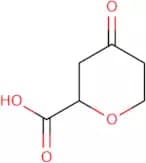
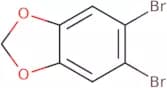
CAS:4-Oxooxane-2-carboxylic acid is a molecule that is involved in the stabilization of organic compounds. It is also used as a reaction rate catalyst for the ring-opening of orotic acid. 4-Oxooxane-2-carboxylic acid can stabilize carbanions and zwitterions, which are reactive intermediates in organic reactions. The mechanism of 4-Oxooxane-2-carboxylic acid's activity involves nucleophilic attack on the carbonyl carbon atom, leading to decarboxylation and formation of the corresponding carboxylate anion. This model system can be used to study nucleophilic reactions.Formula:C6H8O4Purity:Min. 95%Molecular weight:144.12 g/mol5,6-Dibromo-1,3-benzodioxole
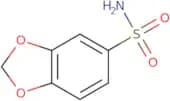
CAS:Versatile small molecule scaffoldFormula:C7H4Br2O2Purity:Min. 95%Molecular weight:279.92 g/mol1,3-Dioxaindane-5-sulfonamide
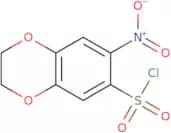
CAS:Versatile small molecule scaffoldFormula:C7H7NO4SPurity:Min. 95%Molecular weight:201.2 g/mol7-Nitro-2,3-dihydro-1,4-benzodioxine-6-sulfonyl chloride
CAS:Versatile small molecule scaffold
Formula:C8H6ClNO6SPurity:Min. 95%Molecular weight:279.65 g/mol[(4-Methylphenyl)sulfanyl]formonitrile
CAS:[(4-Methylphenyl)sulfanyl]formonitrile is a reactive chemical that is used in the synthesis of organic and organometallic compounds. It has been shown to be an effective thiocyanation agent, which may be due to its ability to form cyanate upon reaction with sulfide. The cross-coupling mechanism for [(4-Methylphenyl)sulfanyl]formonitrile is not well understood, but it does not appear to involve the formation of sulfur transfer or a mechanistic intermediate. This reactive compound has two functional groups that are similar to those found in biomolecules such as amino acids and nucleic acids.Formula:C8H7NSPurity:Min. 95%Molecular weight:149.21 g/mol(Phenylsulfanyl)formonitrile
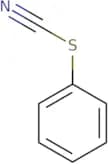
CAS:Phenylsulfanyl)formonitrile is a trimethylaliphatic hydrocarbon that has been used in the synthesis of many other organic compounds. It can be produced by reacting phenylhydrazine with formaldehyde and hydrogen chloride gas, or by reacting aminobutyric acid with hydroxylacetone. This compound is a reactive functional group which can undergo nucleophilic attack. Phenylsulfanyl)formonitrile has an absorption maxima at 275 nm and is sensitive to ultraviolet light. It is used in sample preparation for bacterial strains and mutant strains as well as analytical methods for determining the inhibitory effect of this compound on these organisms. Phenylsulfanyl)formonitrile also inhibits the growth of Trichomonas vaginalis.Formula:C7H5NSPurity:Min. 95%Color and Shape:PowderMolecular weight:135.19 g/molThiocyanic acid, 4-methoxyphenyl ester
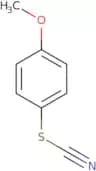
CAS:Thiocyanic acid, 4-methoxyphenyl ester is a functionalised molecule that has been used as a reagent in organic chemistry. This compound contains a heteroaromatic ring with a perfluoroalkyl group and copper. Thiocyanic acid, 4-methoxyphenyl ester has been used as a catalyst for the conversion of chloride to elemental chlorine. The reactivity of this molecule is dependent on the presence of other functional groups such as oxo or thiol groups.Formula:C8H7NOSPurity:Min. 95%Molecular weight:165.21 g/mol(2R)-2-Amino-3-[(3-methylbut-2-en-1-yl)sulfanyl]propanoic acid
CAS:(2R)-2-Amino-3-[(3-methylbut-2-en-1-yl)sulfanyl]propanoic acid is a fatty acid ester that has been used as a model system for the study of growth factor activity. It is a zwitterion with an acidic pH and it is soluble in water. This drug is used to manufacture pharmaceutical dosage forms, such as reconstituted tablets. (2R)-2-Amino-3-[(3-methylbut-2-en-1-yl)sulfanyl]propanoic acid has been studied for its targetable properties, which may be useful in diagnostic applications. The compound can also be used to implant therapeutic factors into cells or tissues circumferentially.Formula:C8H15NO2SPurity:Min. 95%Molecular weight:189.28 g/molDiethyl Benzylidenemalonate
CAS:Diethyl benzylidenemalonate is a polymerization catalyst that can be used in the synthesis of polyesters. It is used as a homogeneous catalyst for reactions involving trifluoroacetic acid, x-ray diffraction data and solid catalysts. This polymerization catalyst has been shown to be active with methylene groups and carbonyl groups. Diethyl benzylidenemalonate has been shown to be able to catalyze the synthesis of β-unsaturated ketones in an isolated yield.
Formula:C14H16O4Purity:Min. 95%Color and Shape:Clear LiquidMolecular weight:248.28 g/mol2-[(Phenylsulfanyl)methyl]oxirane
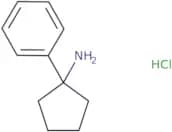
CAS:2-[(Phenylsulfanyl)methyl]oxirane is an unsaturated heterocyclic that can be synthesized by the reaction of ethylene and acrylonitrile on-line. The metal surface catalyzes this reaction, which is used as a corrosion inhibitor in magnesium. 2-[(Phenylsulfanyl)methyl]oxirane has been shown to inhibit insulin resistance in mice by targeting the metal salt in the body. It also inhibits hyperglycemia in diabetic mice, which may be due to its ability to bind with carboxyalkyl groups and block their interactions with insulin receptor sites.Formula:C9H10OSPurity:Min. 95%Molecular weight:166.24 g/mol1-Phenylcyclopentanamine hydrochloride
CAS:Versatile small molecule scaffoldFormula:C11H16ClNPurity:Min. 95%Molecular weight:197.7 g/molEthyl 6-Hydroxyhexanoate
CAS:Ethyl 6-hydroxyhexanoate is an ester with the chemical formula CH3COOC2H5. It is a colorless liquid that can be prepared by the reaction of ethyl alcohol and acetyl chloride. Ethyl 6-hydroxyhexanoate has been shown to react with amines at a rate that is faster than the reaction rate for fatty acids, which may be due to its higher surface area. This ester also reacts with primary alcohols to form esters or ethers. The functional groups on ethyl 6-hydroxyhexanoate include carboxylic acid, hydroxyl group, and primary alcohol.
Formula:C8H16O3Purity:Min. 95%Molecular weight:160.21 g/mol5-(Bromomethyl)-3-(4-chlorophenyl)-1,2-oxazole
CAS:Versatile small molecule scaffoldFormula:C10H7BrClNOPurity:Min. 95%Molecular weight:272.52 g/mol

![2,8-Dioxaspiro[4.5]decane-1,3-dione](/_next/image/?url=https%3A%2Fstatic.cymitquimica.com%2Fproducts%2F3D%2Fthumb-webp%2FFAA27049.webp&w=3840&q=75)
![[(4-Methylphenyl)sulfanyl]formonitrile](/_next/image/?url=https%3A%2Fstatic.cymitquimica.com%2Fproducts%2F3D%2Fthumb-webp%2FFAA28574.webp&w=3840&q=75)
![(2R)-2-Amino-3-[(3-methylbut-2-en-1-yl)sulfanyl]propanoic acid](/_next/image/?url=https%3A%2Fstatic.cymitquimica.com%2Fproducts%2F3D%2Fthumb-webp%2FFAA28746.webp&w=3840&q=75)

![2-[(Phenylsulfanyl)methyl]oxirane](/_next/image/?url=https%3A%2Fstatic.cymitquimica.com%2Fproducts%2F3D%2Fthumb-webp%2FFAA29621.webp&w=3840&q=75)