Building Blocks
This section contains fundamental products for the synthesis of organic and biological compounds. Building blocks are the essential starting materials used to construct complex molecules through various chemical reactions. They play a critical role in drug discovery, material science, and chemical research. At CymitQuimica, we offer a diverse range of high-quality building blocks to support your innovative research and industrial projects, ensuring you have the essential components for successful synthesis.
Subcategories of "Building Blocks"
- Boronic Acids & Boronic Acid Derivatives(5,756 products)
- Chiral Building Blocks(1,242 products)
- Hydrocarbon Building Blocks(6,095 products)
- Organic Building Blocks(61,037 products)
Found 196200 products of "Building Blocks"
Sort by
Purity (%)
0
100
|
0
|
50
|
90
|
95
|
100
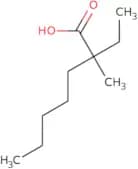
2-Ethyl-2-methylheptanoic acid
CAS:<p>2-Ethyl-2-methylheptanoic acid is a monoester of 2-ethylhexanol. It has a crystalline structure and can be found in the form of spherical particles. 2-Ethyl-2-methylheptanoic acid has been shown to have synergistic effects with other surfactants, such as phosphoric acid solution, to extract organic compounds from various surfaces. The extraction process involves lowering the surface tension by adsorbing at least one molecule of the organic compound on the surface and then extracting it by contacting it with an appropriate solvent. Techniques such as scanning electron microscopy (SEM) are used to study the morphology of these spherical particles.</p>Formula:C10H20O2Purity:Min. 95%Molecular weight:172.26 g/mol4-[2-(Pyridin-4-yl)ethenyl]phenol
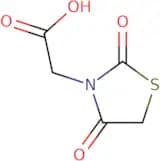
CAS:<p>4-[2-(Pyridin-4-yl)ethenyl]phenol is a reactive compound that reacts with nucleophiles in the presence of an activation system to generate reactive intermediates or reactive products. This chemical is used as a substrate in assays to quantify substances, such as proteins, nucleic acids, and enzymes. The signal generated by these reactions can be quantitated and measured using various detection systems. 4-[2-(Pyridin-4-yl)ethenyl]phenol reacts with nucleophiles through electrophilic addition reactions to generate reactive intermediates or reactive products. This chemical is often used as a substrate in assays to quantify substances such as proteins, nucleic acids, and enzymes. The signal generated by these reactions can be quantitated and measured using various detection systems.</p>Formula:C13H11NOPurity:Min. 95%Molecular weight:197.23 g/mol(2,4-Dioxo-thiazolidin-3-yl)-acetic acid
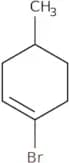
CAS:<p>(2,4-Dioxo-thiazolidin-3-yl)-acetic acid is a 2,4-dioxo-thiazolidine derivative that can form adducts with dialkyl or isocyanides. The product of this reaction is a 1,3,5,7-tetrahydro-1H-[1]benzothiopyran (1).<br> <br>The product of this reaction is a 1,3,5,7-tetrahydro-[1]benzothiopyran (1).</p>Formula:C5H5NO4SPurity:Min. 95%Molecular weight:175.16 g/mol1-Bromo-4-methylcyclohex-1-ene
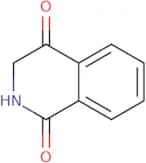
CAS:<p>Versatile small molecule scaffold</p>Formula:C7H11BrPurity:Min. 95%Molecular weight:175.07 g/mol2,3-Dihydro-1,4-isoquinolinedione
CAS:<p>Versatile small molecule scaffold</p>Formula:C9H7NO2Purity:Min. 95%Molecular weight:161.16 g/mol[1,2,4]Triazolo[1,5-a]pyridin-8-amine
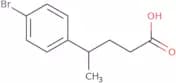
CAS:<p>1,2,4-Triazolo[1,5-a]pyridin-8-amine is a heterocyclic compound that contains an aromatic ring and a heteroaryl group. The aromatic ring consists of six carbon atoms in a hexagon shape with one nitrogen atom at the center of the ring. It has two substituents on the ring: one unsubstituted and one substituted. The six-membered heteroaryl group is located on the opposite side of the aromatic ring from the halogen group. The amide group is attached to the 6-membered heteroatom.</p>Formula:C6H6N4Purity:Min. 95%Molecular weight:134.14 g/mol4-(4-Bromophenyl)pentanoic acid
CAS:<p>Versatile small molecule scaffold</p>Formula:C11H13BrO2Purity:Min. 95%Molecular weight:257.12 g/mol3-Benzyl-2-methylphenol
CAS:<p>Versatile small molecule scaffold</p>Formula:C14H14OPurity:Min. 95%Molecular weight:198.3 g/mol6-nitro-[1,2,4]triazolo[1,5-a]pyridin-2-amine
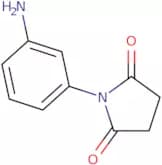
CAS:<p>Versatile small molecule scaffold</p>Formula:C6H5N5O2Purity:Min. 95%Molecular weight:179.13 g/mol1-(3-Aminophenyl)-pyrrolidin-2,5-dione
CAS:<p>Versatile small molecule scaffold</p>Formula:C10H10N2O2Purity:Min. 95%Molecular weight:190.2 g/mol6-Hydroxy-1H-indole-3-acetic acid
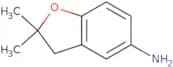
CAS:<p>6-Hydroxy-1H-indole-3-acetic acid (6HOIA) is a natural product that is synthesized by radical cyclization of an acylpolyamine. It contains an indole ring and can be used as a blocker for the nuclei in nerve cells, which may lead to death of the cell. 6HOIA has been shown to be toxic for both nephila and backbones.</p>Formula:C10H9NO3Purity:Min. 95%Molecular weight:191.18 g/mol2,2-Dimethyl-2,3-dihydro-1-benzofuran-5-amine
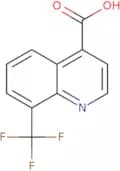
CAS:<p>Versatile small molecule scaffold</p>Formula:C10H13NOPurity:Min. 95%Molecular weight:163.22 g/mol8-(Trifluoromethyl)quinoline-4-carboxylic acid
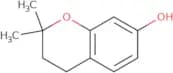
CAS:<p>Versatile small molecule scaffold</p>Formula:C11H6F3NO2Purity:Min. 95%Molecular weight:241.17 g/mol2,2-Dimethyl-3,4-dihydro-2H-1-benzopyran-7-ol
CAS:<p>Versatile small molecule scaffold</p>Formula:C11H14O2Purity:Min. 95%Molecular weight:178.23 g/mol2-(3-Chlorophenyl)propan-2-ol
CAS:<p>Versatile small molecule scaffold</p>Formula:C9H11ClOPurity:Min. 95%Molecular weight:170.64 g/mol[4-(Trifluoromethyl)thiophen-3-yl]methanol
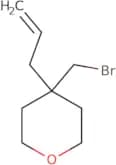
CAS:<p>Versatile small molecule scaffold</p>Formula:C6H5F3OSPurity:Min. 95%Molecular weight:182.17 g/mol4-(Bromomethyl)-4-(prop-2-en-1-yl)oxane
CAS:<p>Versatile small molecule scaffold</p>Formula:C9H15BrOPurity:Min. 95%Molecular weight:219.12 g/mol7,7-Dimethyl-5H,7H-furo[3,4-d]pyrimidin-2-amine
CAS:<p>Versatile small molecule scaffold</p>Formula:C8H11N3OPurity:Min. 95%Molecular weight:165.19 g/mol1-[3-(Benzyloxy)propyl]cyclopropane-1-carboxylic acid
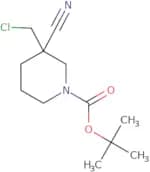
CAS:<p>Versatile small molecule scaffold</p>Formula:C14H18O3Purity:Min. 95%Molecular weight:234.29 g/moltert-Butyl 3-(chloromethyl)-3-cyanopiperidine-1-carboxylate
CAS:<p>Versatile small molecule scaffold</p>Formula:C12H19ClN2O2Purity:Min. 95%Molecular weight:258.74 g/mol

![4-[2-(Pyridin-4-yl)ethenyl]phenol](/_next/image/?url=https%3A%2Fstatic.cymitquimica.com%2Fproducts%2F3D%2Fthumb-webp%2FGBA06732.webp&w=3840&q=75)
![[1,2,4]Triazolo[1,5-a]pyridin-8-amine](/_next/image/?url=https%3A%2Fstatic.cymitquimica.com%2Fproducts%2F3D%2Fthumb-webp%2FGBA05295.webp&w=3840&q=75)

![6-nitro-[1,2,4]triazolo[1,5-a]pyridin-2-amine](/_next/image/?url=https%3A%2Fstatic.cymitquimica.com%2Fproducts%2F3D%2Fthumb-webp%2FGBA04015.webp&w=3840&q=75)


![[4-(Trifluoromethyl)thiophen-3-yl]methanol](/_next/image/?url=https%3A%2Fstatic.cymitquimica.com%2Fproducts%2F3D%2Fthumb-webp%2FGAD92570.webp&w=3840&q=75)
![7,7-Dimethyl-5H,7H-furo[3,4-d]pyrimidin-2-amine](/_next/image/?url=https%3A%2Fstatic.cymitquimica.com%2Fproducts%2F3D%2Fthumb-webp%2FGAD75656.webp&w=3840&q=75)
![1-[3-(Benzyloxy)propyl]cyclopropane-1-carboxylic acid](/_next/image/?url=https%3A%2Fstatic.cymitquimica.com%2Fproducts%2F3D%2Fthumb-webp%2FGAD56683.webp&w=3840&q=75)