Building Blocks
This section contains fundamental products for the synthesis of organic and biological compounds. Building blocks are the essential starting materials used to construct complex molecules through various chemical reactions. They play a critical role in drug discovery, material science, and chemical research. At CymitQuimica, we offer a diverse range of high-quality building blocks to support your innovative research and industrial projects, ensuring you have the essential components for successful synthesis.
Subcategories of "Building Blocks"
- Boronic Acids & Boronic Acid Derivatives(5,805 products)
- Chiral Building Blocks(1,248 products)
- Hydrocarbon Building Blocks(6,118 products)
- Organic Building Blocks(61,447 products)
Found 208423 products of "Building Blocks"
Sort by
Purity (%)
0
100
|
0
|
50
|
90
|
95
|
100
Methyl 2-{[(2-chlorophenyl)methyl]amino}acetate hydrochloride
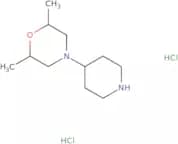
CAS:Versatile small molecule scaffoldFormula:C10H13Cl2NO2Purity:Min. 95%Molecular weight:250.12 g/mol2,6-Dimethyl-4-(piperidin-4-yl)morpholine dihydrochloride
CAS:Versatile small molecule scaffoldFormula:C11H24Cl2N2OPurity:Min. 95%Molecular weight:271.22 g/molN-{1-[3-(Trifluoromethyl)phenyl]ethyl}cyclopropanamine hydrochloride
CAS:Versatile small molecule scaffoldFormula:C12H15ClF3NPurity:Min. 95%Molecular weight:265.7 g/mol3-Amino-N-[2-(dimethylamino)ethyl]benzamide dihydrochloride
CAS:Versatile small molecule scaffoldFormula:C11H19Cl2N3OPurity:Min. 95%Molecular weight:280.19 g/molN-[(4-Methylphenyl)methyl]-2,3-dihydro-1H-inden-1-amine hydrochloride
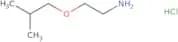
CAS:Versatile small molecule scaffoldFormula:C17H20ClNPurity:Min. 95%Molecular weight:273.8 g/mol2-(2-Methylpropoxy)ethan-1-amine hydrochloride
CAS:Versatile small molecule scaffoldFormula:C6H16ClNOPurity:Min. 95%Molecular weight:153.65 g/mol1-(2-Aminoethyl)indoline dihydrochloride
CAS:Versatile small molecule scaffold
Formula:C10H16Cl2N2Purity:Min. 95%Molecular weight:235.15 g/mol[3-(Pyridin-4-yl)-1,2,4-oxadiazol-5-yl]methanamine dihydrochloride
CAS:Versatile small molecule scaffold
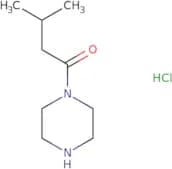
Formula:C8H10Cl2N4OPurity:Min. 95%Molecular weight:249.09 g/mol3-Methyl-1-(1-piperazinyl)-1-butanone hydrochloride
CAS:Versatile small molecule scaffoldFormula:C9H19ClN2OPurity:Min. 95%Molecular weight:206.71 g/mol2-[(5-Chloro-7-iodoquinolin-8-yl)oxy]propanoic acid hydrochloride
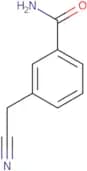
CAS:Versatile small molecule scaffoldFormula:C12H10Cl2INO3Purity:Min. 95%Molecular weight:414.02 g/mol3-(Cyanomethyl)benzamide
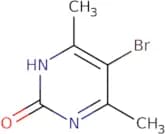
CAS:Versatile small molecule scaffoldFormula:C9H8N2OPurity:Min. 95%Molecular weight:160.17 g/mol5-Bromo-4,6-dimethylpyrimidin-2-ol
CAS:Versatile small molecule scaffoldFormula:C6H7BrN2OPurity:Min. 95%Molecular weight:203.04 g/mol3-Methyl-2-phenylpentanoic acid
CAS:Versatile small molecule scaffold
Formula:C12H16O2Purity:Min. 95%Molecular weight:192.25 g/mol3-Chloropropyldichloromethylsilane
CAS:3-Chloropropyldichloromethylsilane is an inorganic particle that is used as a substrate film. It has been shown to have thermal expansion properties and hydrophobic effects, which are advantageous for use in a variety of applications. 3-Chloropropyldichloromethylsilane can be used to coat copper oxide particles, which provides the substrate film with anti-fouling properties. 3-Chloropropyldichloromethylsilane also has potential application in the treatment of the pandemic flu virus covid-19. Covid-19 is a virus that causes severe respiratory illness and death in humans. 3-Chloropropyldichloromethylsilane has been found to inhibit covid-19 replication and may be able to reduce its severity or prevent infection altogether.Formula:C4H9Cl3SiPurity:Min. 95%Molecular weight:191.55 g/mol1-Phenyl-1H-indazole
CAS:1-Phenyl-1H-indazole is a molecule that has antiinflammatory, analgesic, and antipyretic properties. It has been shown to inhibit the production of aldehydes such as prostaglandin PGE2 and thromboxane A2, which are involved in the inflammatory response. 1-Phenyl-1H-indazole also inhibits platelet aggregation by means of its ability to yield an alkoxy radical. The molecule is used as a starting point for the synthesis of pyrazole derivatives with therapeutic activity against c. glabrata, which are fungi that cause mucormycosis.Formula:C13H10N2Purity:Min. 95%Molecular weight:194.23 g/molCadmium bromide ar
CAS:Cadmium bromide is a carcinogenic inorganic compound that has been shown to induce cancer in animals. Cadmium bromide is used as a model system for the study of cancer regression and women's health. It is also used as an approximation of the viscosity of gases and liquids. The Database of Interacting Proteins contains information on interactions between proteins and small molecules, such as cadmium bromide. This database can be accessed via the Internet. The solubility and volatility of cadmium bromide are low, making it a good solvent for organic compounds. Cadmium bromide is classified as a flammable liquid with a high degree of toxicity to humans when inhaled or ingested; it may cause skin irritation or burns upon contact with skin, eyes, or mucous membranes.Formula:Br2CdPurity:Min. 95%Molecular weight:272.22 g/mol1-Ethyl-3-pyrrolidinamine 2HCl
CAS:Versatile small molecule scaffoldFormula:C6H16Cl2N2Purity:Min. 95%Molecular weight:187.11 g/mol4-Formyl-7-methoxy-1-benzofuran-2-carboxylic acid
CAS:Versatile small molecule scaffold
Formula:C11H8O5Purity:Min. 95%Molecular weight:220.18 g/mol1-Octanesulfonyl Chloride
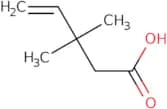
CAS:1-Octanesulfonyl chloride is a chemical compound that belongs to the group of heterocyclic compounds. It is used in the synthesis of pharmaceutical drugs, such as ophthalmic drugs. 1-Octanesulfonyl chloride has been shown to inhibit methionine aminopeptidase, an enzyme that degrades proteins and peptides, which may be due to its proximity to hydroxy groups. This compound also has a phase transition temperature of -103°C, which means it can exist as a liquid or solid at room temperature. The presence of fluorine in this compound gives it a sharp nmr spectrum with signals seen between 0.8 and 1.2 ppm. This chemical reacts with water and other molecules to form new molecules that have different properties, such as the formation of chlorides from hydrogen chloride gas and 1-octanesulfonyl chloride.Formula:C8H17ClO2SPurity:Min. 95%Molecular weight:212.73 g/mol3,3-Dimethylpent-4-enoic acid
CAS:3,3-Dimethylpent-4-enoic acid (DMPA) is a solid catalyst that is used in the synthesis of chrysanthemic acid. DMPA is prepared by reacting methyl alcohol with chlorine and trimethylchloride in a cavity of an acid catalyst at high temperature. The reaction yield increases with increasing reaction time. DMPA reacts with carbon tetrachloride to produce filtrate and residue. The filtrate contains DMPA, which can be recovered easily by distillation of the solvent. DMPA has been used as an organic solvent for various reactions involving organic compounds.
Formula:C7H12O2Purity:Min. 95%Molecular weight:128.17 g/mol
![Methyl 2-{[(2-chlorophenyl)methyl]amino}acetate hydrochloride](/_next/image/?url=https%3A%2Fstatic.cymitquimica.com%2Fproducts%2F3D%2Fthumb-webp%2FGXB45790.webp&w=3840&q=75)

![N-{1-[3-(Trifluoromethyl)phenyl]ethyl}cyclopropanamine hydrochloride](/_next/image/?url=https%3A%2Fstatic.cymitquimica.com%2Fproducts%2F3D%2Fthumb-webp%2FGXB45792.webp&w=3840&q=75)
![3-Amino-N-[2-(dimethylamino)ethyl]benzamide dihydrochloride](/_next/image/?url=https%3A%2Fstatic.cymitquimica.com%2Fproducts%2F3D%2Fthumb-webp%2FGXB45795.webp&w=3840&q=75)
![N-[(4-Methylphenyl)methyl]-2,3-dihydro-1H-inden-1-amine hydrochloride](/_next/image/?url=https%3A%2Fstatic.cymitquimica.com%2Fproducts%2F3D%2Fthumb-webp%2FGXB45797.webp&w=3840&q=75)

![[3-(Pyridin-4-yl)-1,2,4-oxadiazol-5-yl]methanamine dihydrochloride](/_next/image/?url=https%3A%2Fstatic.cymitquimica.com%2Fproducts%2F3D%2Fthumb-webp%2FGXB45805.webp&w=3840&q=75)
![2-[(5-Chloro-7-iodoquinolin-8-yl)oxy]propanoic acid hydrochloride](/_next/image/?url=https%3A%2Fstatic.cymitquimica.com%2Fproducts%2F3D%2Fthumb-webp%2FGXB45809.webp&w=3840&q=75)