


Building Blocks
This section contains fundamental products for the synthesis of organic and biological compounds. Building blocks are the essential starting materials used to construct complex molecules through various chemical reactions. They play a critical role in drug discovery, material science, and chemical research. At CymitQuimica, we offer a diverse range of high-quality building blocks to support your innovative research and industrial projects, ensuring you have the essential components for successful synthesis.
Subcategories of "Building Blocks"
- Boronic Acids & Boronic Acid Derivatives(5,756 products)
- Chiral Building Blocks(1,242 products)
- Hydrocarbon Building Blocks(6,095 products)
- Organic Building Blocks(61,037 products)
Found 196200 products of "Building Blocks"
Sort by
Purity (%)
0
100
|
0
|
50
|
90
|
95
|
100
(2R)-2-Amino-3-[(3-methylbut-2-en-1-yl)sulfanyl]propanoic acid
CAS:<p>(2R)-2-Amino-3-[(3-methylbut-2-en-1-yl)sulfanyl]propanoic acid is a fatty acid ester that has been used as a model system for the study of growth factor activity. It is a zwitterion with an acidic pH and it is soluble in water. This drug is used to manufacture pharmaceutical dosage forms, such as reconstituted tablets. (2R)-2-Amino-3-[(3-methylbut-2-en-1-yl)sulfanyl]propanoic acid has been studied for its targetable properties, which may be useful in diagnostic applications. The compound can also be used to implant therapeutic factors into cells or tissues circumferentially.</p>Formula:C8H15NO2SPurity:Min. 95%Molecular weight:189.28 g/molDiethyl Benzylidenemalonate
CAS:<p>Diethyl benzylidenemalonate is a polymerization catalyst that can be used in the synthesis of polyesters. It is used as a homogeneous catalyst for reactions involving trifluoroacetic acid, x-ray diffraction data and solid catalysts. This polymerization catalyst has been shown to be active with methylene groups and carbonyl groups. Diethyl benzylidenemalonate has been shown to be able to catalyze the synthesis of β-unsaturated ketones in an isolated yield.</p>Formula:C14H16O4Purity:Min. 95%Color and Shape:Clear LiquidMolecular weight:248.28 g/mol2,2'-dichlorobenzophenone
CAS:<p>2,2'-dichlorobenzophenone is a benzophenone derivative that is used as a precursor in the production of dyes, flame retardants, and plasticizers. It has the molecular conformations of both cis and trans isomers. In the cis conformation, the dipole moment points towards the 2 position on the ring. The trans conformation has a dipole moment pointing to the 3 position on the ring.</p>Formula:C13H8Cl2OPurity:Min. 95%Molecular weight:251.11 g/mol2-[(Phenylsulfanyl)methyl]oxirane
CAS:<p>2-[(Phenylsulfanyl)methyl]oxirane is an unsaturated heterocyclic that can be synthesized by the reaction of ethylene and acrylonitrile on-line. The metal surface catalyzes this reaction, which is used as a corrosion inhibitor in magnesium. 2-[(Phenylsulfanyl)methyl]oxirane has been shown to inhibit insulin resistance in mice by targeting the metal salt in the body. It also inhibits hyperglycemia in diabetic mice, which may be due to its ability to bind with carboxyalkyl groups and block their interactions with insulin receptor sites.</p>Formula:C9H10OSPurity:Min. 95%Molecular weight:166.24 g/mol2-[(2,6-Dimethylphenoxy)methyl]oxirane
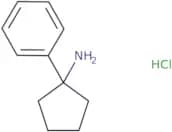
CAS:<p>Versatile small molecule scaffold</p>Formula:C11H14O2Purity:Min. 95%Molecular weight:178.23 g/mol1-Phenylcyclopentanamine hydrochloride
CAS:<p>Versatile small molecule scaffold</p>Formula:C11H16ClNPurity:Min. 95%Molecular weight:197.7 g/mol{2-[(3-Carboxypropanoyl)oxy]ethyl}trimethylammonium chloride
CAS:<p>Succinylcholine is a depolarizing neuromuscular blocking agent that is used in surgical procedures. Succinylcholine hydrolyzes to succinic acid and choline in vivo and is metabolized by the liver. The half-life of succinylcholine is about 2 minutes in humans. It has been shown that this drug causes respiratory paralysis, but only at high doses. Succinylcholine also has potent cardiac effects, which are due to its ability to block nicotinic acetylcholine receptors on the heart muscle. It was found that succinylmonocholine (a metabolite of succinylcholine) can be detected in urine samples after administration of this drug with a kinetic data analysis method. This method uses LC-MS/MS to measure the concentration of succinylmonocholine in human serum and isolated heart tissue samples. A pharmacokinetic study showed that succinycholines accumulation rate constant was 0.051 ± 0.</p>Formula:C9H18ClNO4Purity:Min. 95%Molecular weight:239.69 g/molEthyl 6-Hydroxyhexanoate
CAS:<p>Ethyl 6-hydroxyhexanoate is an ester with the chemical formula CH3COOC2H5. It is a colorless liquid that can be prepared by the reaction of ethyl alcohol and acetyl chloride. Ethyl 6-hydroxyhexanoate has been shown to react with amines at a rate that is faster than the reaction rate for fatty acids, which may be due to its higher surface area. This ester also reacts with primary alcohols to form esters or ethers. The functional groups on ethyl 6-hydroxyhexanoate include carboxylic acid, hydroxyl group, and primary alcohol.</p>Formula:C8H16O3Purity:Min. 95%Molecular weight:160.21 g/mol5-(Bromomethyl)-3-(4-chlorophenyl)-1,2-oxazole
CAS:<p>Versatile small molecule scaffold</p>Formula:C10H7BrClNOPurity:Min. 95%Molecular weight:272.52 g/mol5-(Bromomethyl)-3-(2,4-dichlorophenyl)-1,2-oxazole
CAS:<p>Versatile small molecule scaffold</p>Formula:C10H6BrCl2NOPurity:Min. 95%Molecular weight:306.97 g/mol3-Amino-1-(4-chlorophenyl)pyrrolidin-2-one
CAS:<p>Versatile small molecule scaffold</p>Formula:C10H11ClN2OPurity:Min. 95%Molecular weight:210.66 g/mol4-Methylazetidin-2-one
CAS:<p>Versatile small molecule scaffold</p>Formula:C4H7NOPurity:Min. 95%Molecular weight:85.1 g/mol2,3-Dimethylbenzene-1,4-diamine
CAS:<p>Versatile small molecule scaffold</p>Formula:C8H12N2Purity:Min. 95%Molecular weight:136.2 g/mol4-(4-Methoxyphenyl)cyclohexan-1-one
CAS:<p>Versatile small molecule scaffold</p>Formula:C13H16O2Purity:Min. 95%Molecular weight:204.26 g/molN-Methylbenzenecarbothioamide
CAS:<p>N-Methylbenzenecarbothioamide is a chemical compound that has a molecular weight of 269.3 g/mol, and is a colorless liquid with a boiling point of 115°C. It is soluble in water and alcohols, but insoluble in ether. N-Methylbenzenecarbothioamide has low toxicity to animals when used at sublethal doses. The uptake of this substance by the lungs can be increased by exposure to chloride ions or serotonin. This chemical has shown to have an effect on the central nervous system as well, which may be due to its ability to release serotonin from the presynaptic nerve terminal. <br>N-Methylbenzenecarbothioamide can also form hydrogen bonds with other molecules, including protonated amines, hydroxyl groups, and sulfuric acid groups. This chemical was first synthesized by Emil Fischer in 1894 and was later named "carboxylic acid methyl ester"</p>Formula:C8H9NSPurity:Min. 95%Molecular weight:151.23 g/mol2-Methyl-1H-imidazole-4,5-dicarboxylic acid
CAS:<p>2-Methyl-1H-imidazole-4,5-dicarboxylic acid is a dicarboxylic acid that has both acidic and basic properties. It can be found in architectures such as the nitrogen atom (N) and hydrogen sulfate (HSO). The molecular formula is C2H3N3O4 and the chemical name is 2-methyl-1H-imidazole-4,5-dicarboxylic acid. This compound stabilizes metal ligands in coordination geometry. Crystal x-ray diffraction studies have shown that 2MIDA forms a fluorescence complex with protonated carboxylate groups. The fluorescent properties of this compound are due to its supramolecular interactions with other molecules and its ability to coordinate with metal ions. Photocatalytic activity has been observed for this substance when it was mixed with titanium dioxide nanoparticles.</p>Formula:C6H6N2O4Purity:Min. 95%Molecular weight:170.12 g/mol2-Amino-5-chloro-4-methyl-1,3-thiazole
CAS:<p>Versatile small molecule scaffold</p>Formula:C4H5ClN2SPurity:Min. 95%Molecular weight:148.61 g/molN-(4-Acetylphenyl)-4-methylbenzene-1-sulfonamide
CAS:<p>Versatile small molecule scaffold</p>Formula:C15H15NO3SPurity:Min. 95%Molecular weight:289.4 g/mol3-[(2-Hydroxyethyl)sulfanyl]propan-1-ol
CAS:<p>3-[(2-Hydroxyethyl)sulfanyl]propan-1-ol is a sulfide metabolite that is formed in the body from the sulfhydryl group of cysteine. It is an aliphatic compound that can be found in plants, animals, and microorganisms. 3-[(2-Hydroxyethyl)sulfanyl]propan-1-ol has been shown to inhibit bacterial growth by binding to DNA and RNA. This process inhibits transcription and replication of bacterial DNA, which leads to cell death.</p>Formula:C5H12O2SPurity:Min. 95%Molecular weight:136.22 g/mol2,3-Dichloro-1-benzothiophene
CAS:<p>2,3-Dichloro-1-benzothiophene is an organochlorine compound that is a colorless solid. It has the formula CHClS and it is used as a precursor to other compounds. 2,3-Dichloro-1-benzothiophene can be prepared by reacting phenylphosphine with hydrogen chloride in the presence of chlorine:<br>2PCl + 2HCl → 2CHClS + PCl <br>It can also be synthesized from 1,4-dichlorobenzene and sulfuric acid. The chemical reactions for this are shown below:<br>2C6H4Cl2 + H2SO4 → (CH)5CO2H + Cl2 <br>The product is purified by recrystallization or distillation. The major use of 2,3-dichloro-1-benzothiophene is as a precursor to other compounds such as</p>Formula:C8H4Cl2SPurity:Min. 95%Molecular weight:203.09 g/mol
![(2R)-2-Amino-3-[(3-methylbut-2-en-1-yl)sulfanyl]propanoic acid](/_next/image/?url=https%3A%2Fstatic.cymitquimica.com%2Fproducts%2F3D%2Fthumb-webp%2FFAA28746.webp&w=3840&q=75)


![2-[(Phenylsulfanyl)methyl]oxirane](/_next/image/?url=https%3A%2Fstatic.cymitquimica.com%2Fproducts%2F3D%2Fthumb-webp%2FFAA29621.webp&w=3840&q=75)
![2-[(2,6-Dimethylphenoxy)methyl]oxirane](/_next/image/?url=https%3A%2Fstatic.cymitquimica.com%2Fproducts%2F3D%2Fthumb-webp%2FFAA29634.webp&w=3840&q=75)
![{2-[(3-Carboxypropanoyl)oxy]ethyl}trimethylammonium chloride](/_next/image/?url=https%3A%2Fstatic.cymitquimica.com%2Fproducts%2F3D%2Fthumb-webp%2FFAA29717.webp&w=3840&q=75)


![3-[(2-Hydroxyethyl)sulfanyl]propan-1-ol](/_next/image/?url=https%3A%2Fstatic.cymitquimica.com%2Fproducts%2F3D%2Fthumb-webp%2FFAA32360.webp&w=3840&q=75)
