Nitro
Found 2518 products of "Nitro"
1,8-Dinitropyrene
CAS:1,8-Dinitropyrene is a genotoxic and mutagenic potential agent. It has been shown to induce nitric oxide synthase activity in rat liver microsomes, which may be due to its ability to activate the redox potential of the cells. 1,8-Dinitropyrene also induces enzyme activities such as p450 and nitroreductase in rat liver microsomes. This chemical has an analytical detection limit of 0.05 ppm and can be used as a marker for environmental exposure. 1,8-Dinitropyrene is genotoxic and carcinogenic in rats but not mice. It has been shown to induce mutations at the thymidine position of calf-thymus DNA and is potent inducer of genetic mutation in vitro.Formula:C16H8N2O4Purity:Min. 95%Color and Shape:PowderMolecular weight:292.25 g/mol3-Nitrobenzyl bromide
CAS:3-Nitrobenzyl bromide (3NB) is a lectin that binds to the carbohydrate moieties of glycoproteins. It has been shown to inhibit protease activity and be an inhibitor of nitro group formation by reacting with sodium carbonate. 3NB has also been used in sample preparation for monoclonal antibody production. 3-Nitrobenzyl bromide can be used as a probe for hydrogen bonds, which may be due to its ability to form an intermolecular hydrogen bond with other molecules. 3NB inhibits fatty acid synthesis and cardiac contractile function, which is likely due to its inhibitory properties on hydrogen bonding.
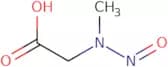
Formula:C7H6BrNO2Purity:Min. 95%Color and Shape:Off-White PowderMolecular weight:216.03 g/molN-Nitrososarcosine
CAS:N-Nitrososarcosine is a nonsteroidal anti-inflammatory drug (NSAID) that belongs to the group of ester hydrochloride. It inhibits the synthesis of prostaglandins, which are chemical mediators of inflammation and pain. N-Nitrososarcosine has been shown to be effective for the treatment of arthritis in animal models. In vitro studies have shown that this drug inhibits polymerase chain reaction and can be used for genotyping bacterial DNA. N-Nitrososarcosine has been found in urine samples from patients with autoimmune diseases, as well as in pharmaceutical preparations. The use of this drug as a model system for studying enzyme hydrolysis has also been studied.
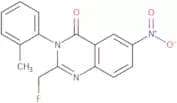
Formula:C3H6N2O3Purity:Min. 95%Color and Shape:Off-White PowderMolecular weight:118.09 g/mol2-(Fluoromethyl)-3-(2-methylphenyl)-6-nitro-3H-quinazolin-4-one
CAS:Controlled ProductPlease enquire for more information about 2-(Fluoromethyl)-3-(2-methylphenyl)-6-nitro-3H-quinazolin-4-one including the price, delivery time and more detailed product information at the technical inquiry form on this page
Formula:C16H12FN3O3Purity:Min. 95%Molecular weight:313.28 g/mol5-Nitropseudocumene
CAS:5-Nitropseudocumene (5NPC) is a molecule that belongs to the group of methylbenzenes. It is a precursor to dyes such as nitrobenzene, which are used in the production of nylon. 5NPC is also an intermediate in the synthesis of trifluoroacetic acid, which is used as an industrial solvent and chemical reagent. The acetoxylation of 5NPC with acetic acid yields methylbenzoate. This reaction requires two molecules of acetic acid for each molecule of 5NPC. Desorption from the catalyst can be achieved by treatment with methyl groups or nitrous acid. Naphthalene reacts with 5NPC to form biphenyl and nitric oxide gas, which are released into the atmosphere. The inorganic residue can be removed by filtration.Formula:C9H11NO2Purity:Min. 95%Color and Shape:PowderMolecular weight:165.19 g/molH-Lys(4-nitro-Z)-pyrrolidide·HCl
CAS:Please enquire for more information about H-Lys(4-nitro-Z)-pyrrolidide·HCl including the price, delivery time and more detailed product information at the technical inquiry form on this page
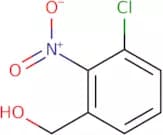
Formula:C18H26N4O5·HClPurity:Min. 95%Molecular weight:414.88 g/mol3-Chloro-2-nitrobenzyl alcohol
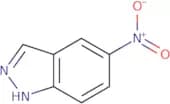
CAS:3-Chloro-2-nitrobenzyl alcohol is a chemical compound that has a molecular formula of C6H5ClNO2. This substance was synthesized by the reaction of 3-chloro-2-nitrobenzyl chloride with sodium hydroxide in methanol. The optimized geometry and vibrational frequencies were calculated using density functional theory (DFT) and theory of Raman scattering. The IR spectra were measured with Fourier transform infrared (FTIR) spectroscopy, which showed that the compound has a strong absorption in the region from 2,600 to 2,800 cm−1.Formula:C7H6ClNO3Purity:Min. 95%Color and Shape:PowderMolecular weight:187.58 g/mol5-Nitroindazole
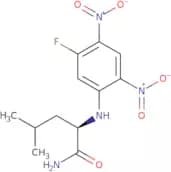
CAS:5-Nitroindazole is a nitro compound that has been shown to have antineoplastic properties. It inhibits the division of cells by binding to DNA and preventing the formation of hydrogen bonds between purine bases, ultimately preventing DNA replication. 5-Nitroindazole has also been shown to inhibit mitochondrial membrane potential and induce apoptosis in human cancer cells. The antimicrobial activities of 5-nitroindazole are due to its chemical structure which allows for hydrogen bonding with cell walls or other components of bacteria. It is also possible that this compound exerts its action by reacting with nitric acid to form a hydroxyl radical, which can cause oxidative damage to bacterial membranes.Formula:C7H5N3O2Purity:Min. 95%Molecular weight:163.13 g/molNalpha-(5-fluoro-2,4-dinitrophenyl)-D-leucinamide
CAS:Nalpha-(5-fluoro-2,4-dinitrophenyl)-D-leucinamide is a chemical compound that inhibits the activity of proteases. It has been shown to inhibit leukemia cells and actinomycetes. This chemical binds to the active site of proteases, inhibiting the hydrolysis of peptides by blocking the access of water molecules to the reactive site. In addition, Nalpha-(5-fluoro-2,4-dinitrophenyl)-D-leucinamide can also be used as a fluorescent probe for protease activity in analytical methods. The product research on this compound has shown that it is a potent inhibitor of cyclic peptide synthetases and can be used as an anti-inflammatory agent.Formula:C12H15FN4O5Purity:Min. 95%Color and Shape:Off-White To Yellow SolidMolecular weight:314.27 g/mol2-Chloro-5-nitrobenzyl alcohol
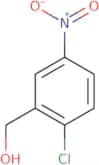
CAS:2-Chloro-5-nitrobenzyl alcohol is a vibrational spectroscopy technique that can be used to study the interactions between molecules. The technique can be used to measure the population of molecules in a system and to determine the thermodynamic properties of systems. It has been shown that 2-chloro-5-nitrobenzyl alcohol is an inhibitor for macrocyclic compounds with electron withdrawing groups, such as carbonyl groups. This molecule has been studied using statistical strategies, which have been shown to be effective in predicting the binding affinity of 2-chloro-5-nitrobenzyl alcohol and other inhibitors for macrocyclic compounds.Formula:C7H6ClNO3Purity:Min. 95%Color and Shape:PowderMolecular weight:187.58 g/mol6-(7-Nitro-benzo[2,1,3]oxadiazol-4-ylamino)-hexanoyl-Arg-Pro-Lys-Pro-Leu-Ala-Nva-Trp-Lys((7-dimethylaminocoumarin-4-yl)-acetyl)-NH2 trifluoroacetate salt
CAS:Please enquire for more information about 6-(7-Nitro-benzo[2,1,3]oxadiazol-4-ylamino)-hexanoyl-Arg-Pro-Lys-Pro-Leu-Ala-Nva-Trp-Lys((7-dimethylaminocoumarin-4-yl)-acetyl)-NH2 trifluoroacetate salt including the price, delivery time and more detailed product information at the technical inquiry form on this pageFormula:C78H111N21O16Purity:Min. 95%Molecular weight:1,598.85 g/mol(1-Nitroethyl)benzene
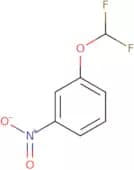
CAS:(1-Nitroethyl)benzene is a chloride that belongs to the family of muscarinic receptor antagonists. Its amide form is used in medicine as an antiviral agent, and it has been shown to be effective against HIV. (1-Nitroethyl)benzene also binds to the adenosine A3 receptor, which inhibits autoimmune diseases by preventing the proliferation of lymphocytes. The nitro group on this molecule can undergo a number of chemical reactions, including addition with alkylsulfonyl chloride or nitration with nitric acid.Formula:C8H9NO2Purity:Min. 95%Color and Shape:PowderMolecular weight:151.16 g/mol3-(Difluoromethoxy)nitrobenzene
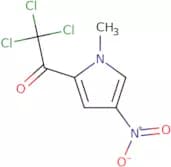
CAS:Please enquire for more information about 3-(Difluoromethoxy)nitrobenzene including the price, delivery time and more detailed product information at the technical inquiry form on this pageFormula:C7H5F2NO3Purity:Min. 95%Molecular weight:189.12 g/mol1-Methyl-4-nitro-2-(trichloroacetyl)-1H-pyrrole
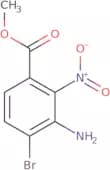
CAS:1-Methyl-4-nitro-2-(trichloroacetyl)-1H-pyrrole is an organic compound that is used in the synthesis of carboxylic acid derivatives. It is a synthetic intermediate, which can be converted to other compounds by intramolecular hydrogen bonding. The efficiency of this method has been shown through a number of experiments. In nature, 1-methyl-4-nitro-2-(trichloroacetyl)-1H-pyrrole may be found as a hydrogen bond donor.Formula:C7H5Cl3N2O3Purity:Min. 95%Molecular weight:271.48 g/molMethyl 3-amino-4-bromo-2-nitrobenzoate
CAS:Please enquire for more information about Methyl 3-amino-4-bromo-2-nitrobenzoate including the price, delivery time and more detailed product information at the technical inquiry form on this pageFormula:C8H7BrN2O4Purity:Min. 95%Molecular weight:275.06 g/mol3-Fluoro-4-nitrobenzoic acid
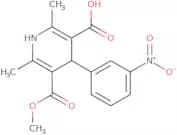
CAS:3-Fluoro-4-nitrobenzoic acid is an organic solvent that is used as a reagent in the synthesis of peptidomimetics. 3-Fluoro-4-nitrobenzoic acid has been shown to be a nucleophilic addition agent, which can react with serine proteases in the presence of benzamidine. This reaction results in the formation of an amide bond between the amino group and carboxylic acid moiety of the serine protease, thereby inhibiting its activity. 3-Fluoro-4-nitrobenzoic acid is also used as a synthetic intermediate for peptides and other organic compounds.Formula:C7H4FNO4Purity:Min. 95%Color and Shape:PowderMolecular weight:185.11 g/mol1,4-Dihydro-2,6-dimethyl-4-(3-nitrophenyl)-3,5-pyridinedicarboxylic acid 3-methyl ester
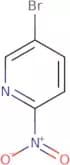
CAS:Lercanidipine is a calcium antagonist that binds to the calcium channels in the membranes of cells, preventing the entry of calcium ions. Lercanidipine is water soluble and can be synthesized using techniques such as elemental analysis and pharmacological techniques. It is also an ionizable drug, which means that its affinity for chloride varies with pH. Lercanidipine has been shown to have strong affinity for erythrocyte membranes and thus has a high selectivity for vascular smooth muscle cells. This drug also has a low toxicity profile and does not affect tissues other than vascular smooth muscle cells.Formula:C16H16N2O6Purity:Min. 95%Color and Shape:White PowderMolecular weight:332.31 g/mol5-Bromo-2-nitropyridine
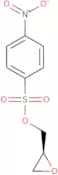
CAS:5-Bromo-2-nitropyridine is a hydrogen bond donor. It is an organic molecule with the chemical formula C5H5BrN3. The compound has been used in the synthesis of other molecules, such as nicotinic acetylcholine and mitochondrial membrane potential inhibitors. 5-Bromo-2-nitropyridine is also a good candidate for cancer treatment due to its ability to inhibit cell cycle progression at G2/M phase. 5-Bromo-2-nitropyridine can be synthesized by reacting 2,4,6-trinitrobenzenesulfonic acid with bromine and potassium carbonate in a reaction vessel at 200 °C for about 30 minutes.Formula:C5H3BrN2O2Color and Shape:PowderMolecular weight:202.99 g/mol(S)-(+)-Glycidyl-4-nitrobenzoate
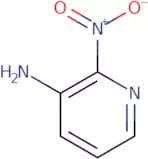
CAS:Glycidyl-4-nitrobenzoate (GLYNB) is an opioid receptor ligand, which binds to the κ opioid receptor. It has been used in biological testing and has been shown to have affinity for the κ opioid receptor. GLYNB may be a useful tool for investigating the molecular diversity of this receptor and its function in both normal and pathological conditions.Formula:C9H9NO6SPurity:Min. 95%Molecular weight:259.24 g/mol3-Amino-2-nitropyridine
CAS:3-Amino-2-nitropyridine is a heterocyclic compound that is an oxidation product of 2,4,6-trinitrotoluene. 3-Amino-2-nitropyridine is a potent inhibitor of the d4 receptor and has been shown to be active in animal models of cancer and autoimmune diseases. The mechanism of action of this drug is not well understood, but it has been found to inhibit cell proliferation in vitro by binding to nucleophilic sites on the receptor. Nitrobenzoic acid may also contribute to its activity. 3-Amino-2-nitropyridine inhibits inflammatory responses by inhibiting cell proliferation and migration.Formula:C5H5N3O2Purity:Min. 95%Molecular weight:139.11 g/mol




![6-(7-Nitro-benzo[2,1,3]oxadiazol-4-ylamino)-hexanoyl-Arg-Pro-Lys-Pro-Leu-Ala-Nva-Trp-Lys((7-dimeth…](/_next/image/?url=https%3A%2Fstatic.cymitquimica.com%2Fproducts%2F3D%2Fthumb-webp%2FFN110943.webp&w=3840&q=75)