Ketones
Found 18871 products of "Ketones"
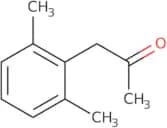
(2,6-Dimethylphenyl)acetone
CAS:2,6-Dimethylphenyl)acetone is a high quality chemical that has been used as a reagent and an intermediate for the production of complex compounds. It is also a useful scaffold for the synthesis of new compounds and is a speciality chemical with various applications in research. 2,6-Dimethylphenyl)acetone can be used as a versatile building block for organic syntheses, such as reactions with carbonyl compounds and alcohols. This chemical has been shown to be useful in the production of drugs such as acetaminophen, ibuprofen, and naproxen.
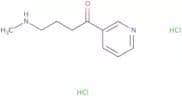
Formula:C11H14OPurity:Min. 95%Color and Shape:Clear LiquidMolecular weight:162.23 g/mol4-(Methylamino)-1-(3-pyridyl)-1-butanone dihydrochloride
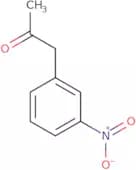
CAS:4-(Methylamino)-1-(3-pyridyl)-1-butanone dihydrochloride (4-MBA) is a natural product that has been shown to have anti-cancer properties in vitro and in vivo. It inhibits the growth of cancer cells by inhibiting DNA synthesis and inducing apoptosis, as well as by inhibiting the production of certain proteins. 4-MBA has been shown to be effective against strains of Escherichia coli and Salmonella typhimurium. This compound is found in honeybush tea, Aspalathus linearis, and other plants, but is not present in humans or animals. 4-MBA has also been shown to inhibit nicotine metabolism in humans and rats.Formula:C10H16Cl2N2OPurity:Min. 95%Color and Shape:SolidMolecular weight:251.15 g/mol(3-Nitrophenyl)acetone
CAS:3-Nitrophenylacetone is a white solid that is soluble in water and polar organic solvents. 3-Nitrophenylacetone can be used as a building block for the synthesis of other compounds, such as pharmaceuticals and dyes. This compound has been researched for its ability to inhibit protein glycosylation. 3-Nitrophenylacetone is also used as an intermediate in the synthesis of polyurethanes and polycarbonates.Formula:C9H9NO3Purity:Min. 95%Color and Shape:White PowderMolecular weight:179.17 g/molEurycomanone
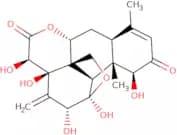
CAS:Eurycomanone is a natural product that belongs to the group of quassinoids. It is obtained from the plant Eurycoma longifolia, which grows in tropical Asia and Africa. The extract has been shown to have clinical properties such as body formation, protein target, and surface methodology. 3T3-L1 preadipocytes were used for the in vitro assays of eurycomanone. Group P2 cells were used for histological analysis and pharmacological agents were found to be chemical stable.Formula:C20H24O9Purity:Min. 95%Color and Shape:PowderMolecular weight:408.4 g/mol(4-Bromophenyl)acetone
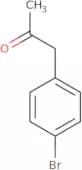
CAS:Controlled Product4-Bromophenylacetone is a useful building block that is used in the synthesis of fine chemicals, research chemicals, and specialty chemicals. This compound can be used as a reagent or as a speciality chemical and has been shown to be highly reactive. 4-Bromophenylacetone is also a versatile building block with many possible reactions. It has also been shown to be an intermediate for the synthesis of pharmaceuticals and agrochemicals. CAS No. 6186-22-7Formula:C9H9BrOPurity:Min. 95%Color and Shape:Clear LiquidMolecular weight:213.07 g/molPhenylacetone oxime
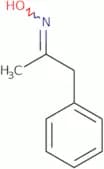
CAS:Phenylacetone oxime is a chemical intermediate that can be used in the synthesis of pharmaceuticals. It has a neutral pH and is stable in the presence of alkalis, acids, oxidizing agents, and reducing agents. Phenylacetone oxime reacts with hydrogen chloride to form 1-chloro-2-phenylethanone and 2-chloroethanol. The reaction mechanism is as follows:
Formula:C9H11NOPurity:Min. 95%Color and Shape:PowderMolecular weight:149.19 g/mol2-Bromo-2-(2-fluorophenyl)-1-cyclopropylethanone
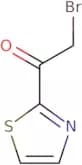
CAS:2-Bromo-2-(2-fluorophenyl)-1-cyclopropylethanone is a synthetic peroxide that is used as an additive in the production of polyvinylpyrrolidone. It has been shown to have efficient methods for the reduction of amines and chlorides to the corresponding hydroxylamine and hydrochloride, respectively. The tribromide may be generated by treatment with bromine and a base, such as potassium hydroxide or sodium hydroxide, in an inert solvent such as benzene or dichloromethane. 2-Bromo-2-(2-fluorophenyl)-1-cyclopropylethanone can also be synthesized from phenacyl chloride and acetylene.Formula:C11H10BrFOPurity:Min. 95 Area-%Color and Shape:Clear LiquidMolecular weight:257.1 g/mol1-Bromo-(1,3-thiazole-2-yl)ethane-2-one
CAS:Please enquire for more information about 1-Bromo-(1,3-thiazole-2-yl)ethane-2-one including the price, delivery time and more detailed product information at the technical inquiry form on this pageFormula:C5H4BrNOSPurity:Min. 95%Molecular weight:206.06 g/mol2(5H)-Furanone
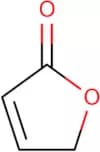
CAS:2(5H)-Furanone is a naturally occurring compound that has been found to have hypoglycemic effects. Studies have shown that 2(5H)-furanone inhibits the activity of cox-2, an enzyme involved in the synthesis of prostaglandins, which are inflammatory compounds. This chemical may be useful as an anti-inflammatory agent and for the treatment of bowel diseases. 2(5H)-Furanone also has antimicrobial properties and has been shown to inhibit the growth of animal cells that are resistant to anticancer drugs. It binds to cell nuclei and disrupts DNA synthesis by competing with basic proteins for binding sites on DNA strands. The chemical structure of 2(5H)-furanone is very similar to butenolide, a natural plant compound used in traditional Chinese medicine; both compounds have been shown to inhibit COX-2 activity.Formula:C4H4O2Purity:Min. 95%Color and Shape:Clear LiquidMolecular weight:84.07 g/mol3,8-Dihydroxy-6H-benzo[c]chromen-6-one
CAS:3,8-Dihydroxy-6H-benzo[c]chromen-6-one (3,8 DHC) is a natural compound that has been shown to have antioxidant and anti-inflammatory properties. It increases the production of ATP (cellular energy) by activating the ATP binding cassette transporter and increasing autophagy. 3,8 DHC may also inhibit apoptosis (cell death), which has been observed in studies involving balloon injury and atherosclerotic lesions. This compound may also have potential therapeutic benefits for bowel disease, cancer, and neuronal death.
Formula:C13H8O4Purity:Min. 95%Color and Shape:White To Beige To Yellow To Brown SolidMolecular weight:228.2 g/mol2-(((2-Indol-3-ylethyl)amino)ethylidene)indane-1,3-dione
CAS:Please enquire for more information about 2-(((2-Indol-3-ylethyl)amino)ethylidene)indane-1,3-dione including the price, delivery time and more detailed product information at the technical inquiry form on this page
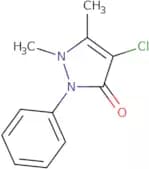
Formula:C21H18N2O2Purity:Min. 95%Color and Shape:PowderMolecular weight:330.38 g/mol4-chloro-2,3-dimethyl-1-phenyl-3-pyrazolin-5-one
CAS:Please enquire for more information about 4-chloro-2,3-dimethyl-1-phenyl-3-pyrazolin-5-one including the price, delivery time and more detailed product information at the technical inquiry form on this page
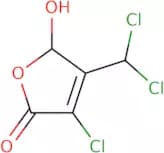
Purity:Min. 95%3-Chloro-4-(dichloromethyl)-5-hydroxy-2(5H)-furanone
CAS:3-Chloro-4-(dichloromethyl)-5-hydroxy-2(5H)-furanone belongs to the class of polymerase chain inhibitors. It inhibits DNA synthesis by binding to the enzyme DNA polymerase and blocking the progression of DNA synthesis. 3-Chloro-4-(dichloromethyl)-5-hydroxy-2(5H)-furanone has significant cytotoxicity in mammalian cells and is genotoxic, which may be due to its mutagenicity. The mechanism of its mutagenicity is not known, but it has been shown that this compound reacts with effector proteins such as thiols and sulfhydryls. 3-Chloro-4-(dichloromethyl)-5-hydroxy-2(5H)-furanone can react with chlorine in water to form a chlorinated derivative that is more stable than the parent compound. This chemical stability has been usedFormula:C5H3Cl3O3Purity:(%) Min. 95%Color and Shape:PowderMolecular weight:217.43 g/mol1-Bromobutane-2,3-dione
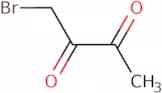
CAS:1-Bromobutane-2,3-dione is a chemical reagent that is used as a building block for the synthesis of complex compounds. It is soluble in many solvents and has a boiling point of 205°C. It is also useful as an intermediate in organic chemistry. 1-Bromobutane-2,3-dione can be converted to a variety of chemicals with different functional groups such as amides, esters, nitriles, and epoxides with the use of catalysts. This compound is also used in research to create diverse chemical scaffolds or building blocks for pharmaceuticals and other fine chemicals.
Formula:C4H5BrO2Purity:Min. 95%Color and Shape:Clear LiquidMolecular weight:164.99 g/mol1,3-Diphenylacetone
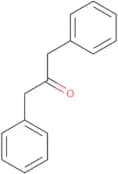
CAS:1,3-Diphenylacetone is a fine chemical that can be used as a building block for research chemicals, as a reagent in organic synthesis, or as a speciality chemical. It is also a versatile building block and has been shown to be useful in the formation of complex compounds. 1,3-Diphenylacetone can react with electrophiles to form new carbon-carbon bonds and has been used in reactions involving nucleophilic substitution, electrophilic addition, and Michael reactions. 1,3-Diphenylacetone is also water soluble and has been shown to be compatible with both ionic and covalent solvents.Formula:C15H14OPurity:Min. 99.0 Area-%Molecular weight:210.28 g/mol1-(4-Morpholin-4-ylphenyl)ethanone
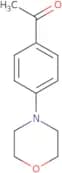
CAS:1-(4-Morpholin-4-ylphenyl)ethanone is a compound that has been shown to interact with the cox-1 enzyme. This interaction can be seen in the functional theory, which states that the rate of intramolecular hydrogen transfer is dependent on the temperature and cox-1 concentration. This inhibition of cox-1 by 1-(4-morpholin-4-ylphenyl)ethanone leads to an antibacterial effect and may be due to its ability to inhibit bacterial growth by disrupting DNA replication. The molecular modeling technique was used to determine the relationship between 1-(4-morpholin-4-ylphenyl)ethanone and cox-1. The dipole moment of this molecule was determined using various alkyl substituents, which have been found to have an inhibitory effect on cox-1. These results are consistent with those obtained from an experiment using carrageenan, which also showed
Formula:C12H15NO2Purity:Min. 95%Color and Shape:Slightly Yellow PowderMolecular weight:205.25 g/mol1,5-Bis(4-hydroxyphenyl)pentane-1,5-dione
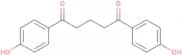
CAS:1,5-Bis(4-hydroxyphenyl)pentane-1,5-dione is a fine chemical that can be used as an intermediate in the synthesis of other compounds. It is also a useful building block for the synthesis of complex compounds. This compound can be used as a reagent for research purposes or as a reaction component in the synthesis of speciality chemicals. 1,5-Bis(4-hydroxyphenyl)pentane-1,5-dione has been shown to have high purity and quality.Formula:C17H16O4Purity:Min. 95%Molecular weight:284.31 g/mol3-(4-ethoxyphenyl)spiro[1,3-thiazolidine-2,3'-indoline]-4,7-dione
CAS:Please enquire for more information about 3-(4-ethoxyphenyl)spiro[1,3-thiazolidine-2,3'-indoline]-4,7-dione including the price, delivery time and more detailed product information at the technical inquiry form on this pagePurity:Min. 95%3-Amino-4-methylpentan-2-one hydrochloride
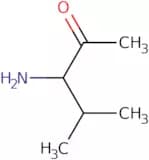
CAS:3-Amino-4-methylpentan-2-one hydrochloride is a versatile building block that is used for the synthesis of high quality research chemicals, useful scaffolds, and speciality chemicals. It is also used as a reagent in organic syntheses. This chemical has a wide range of uses and is a fine chemical that can be used as an intermediate or reaction component. 3-Amino-4-methylpentan-2-one hydrochloride can be reacted with other compounds to form complex molecules that have many different applications.Formula:C6H13NO•HClPurity:Min. 95%Color and Shape:SolidMolecular weight:151.63 g/mol6-Oxo boldione
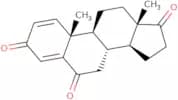
CAS:Controlled Product6-Oxo boldione is an aromatase inhibitor that inhibits the conversion of testosterone to estradiol and has been shown to be effective in inhibiting the growth of bacteria such as Typhimurium. 6-Oxo boldione has been shown to inhibit the growth of estrogen-sensitive breast cancer cells in vitro. It also has a dose-dependent effect on rat liver microsomes, with a greater inhibition at high doses. This drug may be metabolized by modification of its side chain or by biotransformation. 6-Oxo boldione is not active against other enzymes such as cytochrome P450 or glutathione S-transferases.Formula:C19H22O3Purity:Min. 95%Color and Shape:PowderMolecular weight:298.38 g/mol


![3,8-Dihydroxy-6H-benzo[c]chromen-6-one](/_next/image/?url=https%3A%2Fstatic.cymitquimica.com%2Fproducts%2F3D%2Fthumb-webp%2FFD171109.webp&w=3840&q=75)

![3-(4-ethoxyphenyl)spiro[1,3-thiazolidine-2,3'-indoline]-4,7-dione](/_next/image/?url=https%3A%2Fstatic.cymitquimica.com%2Fproducts%2F3D%2Fthumb-webp%2FFE169782.webp&w=3840&q=75)