


Carboxylic Acids
Carboxylic acids are organic molecules characterized by having a carboxyl-type functional group (-COOH). These acids are fundamental in various chemical reactions, including esterification, amidation, and decarboxylation. Carboxylic acids are widely used in the production of pharmaceuticals, polymers, and agrochemicals. In this section, you can find a large number of carboxylic acids ready to be used. At CymitQuimica, we provide a broad range of high-quality carboxylic acids to support your research and industrial applications.
Found 12454 products of "Carboxylic Acids"
Sort by
Purity (%)
0
100
|
0
|
50
|
90
|
95
|
100
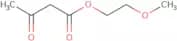
2-Methoxyethyl acetoacetate
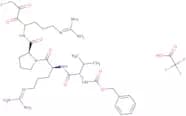
CAS:<p>2-Methoxyethyl acetoacetate is used as a raw material for coatings. It has been shown to be an effective calcium antagonist in the treatment of leukemia and other cancers. 2-Methoxyethyl acetoacetate has also been shown to inhibit the growth of HL-60 cells when it is incubated with these cells in the presence of hydrochloric acid, malonic acid, and quinoline derivatives. The reaction produces chlorine gas, which is toxic to cells.</p>Formula:C7H12O4Purity:Min. 95%Color and Shape:Clear LiquidMolecular weight:160.17 g/molZ-Val-Arg-Pro-DL-Arg-fluoromethylketone trifluoroacetate salt
CAS:<p>Please enquire for more information about Z-Val-Arg-Pro-DL-Arg-fluoromethylketone trifluoroacetate salt including the price, delivery time and more detailed product information at the technical inquiry form on this page</p>Formula:C31H49FN10O6Purity:Min. 95%Molecular weight:676.78 g/molTGF α (1-50) (rat) trifluoroacetate salt
CAS:Please enquire for more information about TGF alpha (1-50) (rat) trifluoroacetate salt including the price, delivery time and more detailed product information at the technical inquiry form on this pageFormula:C244H361N71O71S6Purity:Min. 95%Molecular weight:5,617.31 g/mol(D-Arg0, Hyp 3,D-Phe7)-Bradykinin trifluoroacetate salt
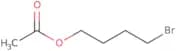
CAS:Bradykinin is a peptide hormone that has been found to act through the bradykinin receptor. It has also been found to be an antagonist of the receptor, as it inhibits the growth of cells that are stimulated by bradykinin. This drug can be used for the treatment of asthma and other inflammatory diseases. The sequence of this drug is D-Arg0, Hyp 3,D-Phe7)-Bradykinin trifluoroacetate salt H-D-Arg-Arg-Pro-Hyp-Gly-Phe-Ser-D-Phe-Phe-Arg-OH trifluoroacetate salt.Formula:C60H87N19O13Purity:Min. 95%Molecular weight:1,282.45 g/mol4-Bromobutyl acetate
CAS:4-Bromobutyl acetate is a nucleic acid that contains a hydroxyl group, two nitrogen atoms, and four carbon atoms. It is the acetic ester of 4-bromobutyric acid. 4-Bromobutyl acetate can be found in the nucleus of cells and in mitochondria. It has been shown to bind to p2y receptors on the surface of cells and is thought to have tuberculostatic activity in vitro. 4-Bromobutyl acetate has also been shown to inhibit viral replication by binding to template or molecule. This nucleic acid can be used as a sequencing template because it will form complementary base pairs with other molecules that contain complementary sequences of nucleic acids.Formula:C6H11BrO2Purity:Min. 95%Molecular weight:195.05 g/mol(Des-Gly10,Des-Ser4,D-Leu6,Pro-NHEt 9)-LHRH trifluoroacetate salt
CAS:<p>Please enquire for more information about (Des-Gly10,Des-Ser4,D-Leu6,Pro-NHEt 9)-LHRH trifluoroacetate salt including the price, delivery time and more detailed product information at the technical inquiry form on this page</p>Formula:C56H79N15O10Purity:Min. 95%Molecular weight:1,122.32 g/molTRH-AMC acetate salt
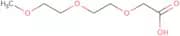
CAS:TRH-AMC acetate salt Pyr-His-Pro-AMC acetate salt is a potent and selective histidine kinase inhibitor that modulates the activity of many enzymes. TRH-AMC acetate salt Pyr-His-Pro-AMC acetate salt has a molecular weight of 476.9 g/mol and chemical formula C12H14N2O4S. The compound was synthesized by reacting tris(2,4,6-trimethoxybenzoyl)amine with pyridoxal 5'-phosphate and histidine in acetic acid. The synthesis reaction yielded a white solid that was then recrystallized from methanol to yield the final product. TRH-AMC acetate salt Pyr-His-Pro-AMC acetate salt has been shown to inhibit the enzymatic activity of numerous enzymes at nanomolar concentrations including: protein kinases, phosphatases, ligasesFormula:C26H28N6O6Purity:Min. 95%Molecular weight:520.54 g/mol(2-(2-Methoxyethoxy)ethoxy)acetic acid
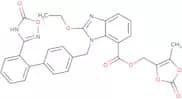
CAS:<p>2-(2-Methoxyethoxy)ethoxy)acetic acid (MEAA) is a cell stabilizer that can be used in the treatment of cancer, diabetes, and other diseases. MEAA has been shown to inhibit the growth of cells by binding to and stabilizing the cytoskeleton through inhibition of protein synthesis. It also prevents the activation of pro-inflammatory cytokines and reactive oxygen species. MEAA's magnetic resonance spectroscopy properties have been studied in detail and it has been shown to bind well with silver ions. MEAA has also been shown to have high cytotoxicity when combined with laser ablation therapy.</p>Formula:C7H14O5Purity:90%Color and Shape:Clear LiquidMolecular weight:178.18 g/molAzilsartan medoxomil
CAS:<p>Azilsartan medoxomil is an antihypertensive drug, which is a prodrug of the angiotensin II receptor blocker azilsartan. It is synthesized through a chemical process involving the modification of the medoxomil ester, converting it into its active form upon absorption in the gastrointestinal tract. The primary mode of action of azilsartan medoxomil involves selective antagonism of the angiotensin II type 1 (AT1) receptor. By blocking the effects of angiotensin II—a potent vasoconstrictor—azilsartan medoxomil effectively reduces vascular resistance, leading to decreased blood pressure.</p>Formula:C30H24N4O8Purity:Min. 95%Color and Shape:White PowderMolecular weight:568.53 g/molAlloferon - in acetate salt
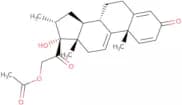
CAS:<p>Alloferon is a drug that affects the body's biological processes and has been shown to have anticancer and antimicrobial properties. Alloferon binds to histidine residues on peptidoglycan, inhibiting bacterial cell wall synthesis and the development of resistance to antibiotics. It also interacts with amide groups in proteins, which are essential for their biological activity. In addition, Alloferon binds to peptides in the form of an amide bond. This interaction makes Alloferon a bioinorganic molecule that can be used as an antimicrobial agent against microbial infections.</p>Formula:C52H75N22O16Purity:Min. 95%Molecular weight:1,264.29 g/mol17-alpha,21-Dihydroxy-16-a-methylpregna-1,4,9(11)-triene-3,20-dione 21-acetate
CAS:Controlled Product<p>Please enquire for more information about 17-alpha,21-Dihydroxy-16-a-methylpregna-1,4,9(11)-triene-3,20-dione 21-acetate including the price, delivery time and more detailed product information at the technical inquiry form on this page</p>Formula:C24H30O5Purity:Min. 95%Molecular weight:398.49 g/mol3,5-Diiodothyroformic acid
CAS:<p>3,5-Diiodothyroformic acid is a fine chemical that is used as a versatile building block in organic synthesis. It is also an intermediate for research chemicals and speciality chemicals. In addition to its use as a reagent, 3,5-Diiodothyroformic acid has been shown to be useful as a building block for the synthesis of pharmaceuticals and agricultural chemicals.</p>Formula:C13H8I2O4Purity:Min. 95%Molecular weight:482.01 g/molAbz-Amyloid β/A4 Protein Precursor770 (669-674)-EDDnp trifluoroacetate salt
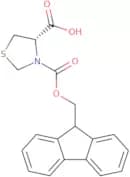
CAS:Please enquire for more information about Abz-Amyloid beta/A4 Protein Precursor770 (669-674)-EDDnp trifluoroacetate salt including the price, delivery time and more detailed product information at the technical inquiry form on this pageFormula:C43H62N12O15SPurity:Min. 95%Molecular weight:1,019.09 g/molFmoc-D-thiazolidine-4-carboxylic acid
CAS:<p>Please enquire for more information about Fmoc-D-thiazolidine-4-carboxylic acid including the price, delivery time and more detailed product information at the technical inquiry form on this page</p>Formula:C19H17NO4SPurity:Min. 95%Molecular weight:355.41 g/mol(Cys26)-Amyloid b-Protein (1-40) trifluoroacetate salt
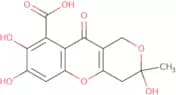
CAS:<p>Please enquire for more information about (Cys26)-Amyloid b-Protein (1-40) trifluoroacetate salt including the price, delivery time and more detailed product information at the technical inquiry form on this page</p>Formula:C194H295N53O57S2Purity:Min. 95%Molecular weight:4,345.87 g/molFulvic acid
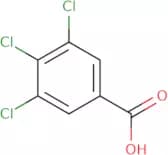
CAS:Fulvic acid is a natural organic compound that has been used in clinical and biological properties. It is a fluorescent molecule with a high quantum yield, which makes it an ideal candidate for use as a fluorescence probe. Fulvic acid has been shown to form stable complexes with malonic acid, which may be due to the strong hydrogen bonding interactions between these two molecules. The fluorescence emission spectrum of fulvic acid is sensitive to the pH of the reaction solution, and it can be used as a thermodynamic data indicator. Fulvic acid also has low toxicity, which makes it suitable for use in laboratory studies.Formula:C14H12O8Purity:Min. 90%Color and Shape:PowderMolecular weight:308.24 g/mol3,4,5-Trichlorobenzoic acid
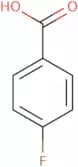
CAS:<p>Trichlorobenzoic acid is a chemical compound that is found in plants, such as Trifolium pratense L. and other legumes. It has been shown to inhibit the growth of bacteria by competitive inhibition of the enzyme ribonucleotide reductase, which catalyzes the conversion of ribonucleotides to deoxyribonucleotides. This prevents the production of RNA, which is necessary for protein synthesis and cell division. Inhibition of this enzyme can be achieved by either conjugating trichlorobenzoic acid with a sugar or using ion-exchange resins to remove it from water. The concentration required for this type of inhibition varies depending on the type of organism, but generally ranges between 5-10 ppm.END></p>Purity:Min. 95%4-Fluorobenzoic acid
CAS:4-Fluorobenzoic acid is a chemical compound with the molecular formula C6H4FO2 and is a member of the group of chemicals known as carboxylic acids. It has been shown to have high levels of antibacterial activity against Gram-positive bacteria, including methicillin-resistant Staphylococcus aureus (MRSA). 4-Fluorobenzoic acid can be used for wastewater treatment and also has the potential to be used in other applications such as an antimicrobial agent or an additive in food packaging. The mechanism of its antibacterial activity is not well understood but may be related to its ability to inhibit the enzyme diphenolase, which catalyzes the conversion of phenols into quinones.Formula:C7H5FO2Purity:Min. 95%Color and Shape:White To Yellow SolidMolecular weight:140.11 g/molAmyloid β-Protein (1-40) (scrambled) trifluoroacetate salt
CAS:Please enquire for more information about Amyloid beta-Protein (1-40) (scrambled) trifluoroacetate salt including the price, delivery time and more detailed product information at the technical inquiry form on this pageFormula:C194H295N53O58SPurity:Min. 95%Molecular weight:4,329.81 g/moltert-Butyl6-[(1e)-2-[4-(4-fluorophenyl)-6-(1-methylethyl)-2-[methyl(methylsulfonyl)amino]-5-pyrimidinyl]ethenyl]-2,2-dimethyl-1,3-di oxane-4-acetate
CAS:<p>Please enquire for more information about tert-Butyl6-[(1e)-2-[4-(4-fluorophenyl)-6-(1-methylethyl)-2-[methyl(methylsulfonyl)amino]-5-pyrimidinyl]ethenyl]-2,2-dimethyl-1,3-di oxane-4-acetate including the price, delivery time and more detailed product information at the technical inquiry form on this page</p>Formula:C29H40FN3O6SPurity:Min. 95%Molecular weight:577.71 g/mol








![tert-Butyl6-[(1e)-2-[4-(4-fluorophenyl)-6-(1-methylethyl)-2-[methyl(methylsulfonyl)amino]-5-pyrimi…](/_next/image/?url=https%3A%2Fstatic.cymitquimica.com%2Fproducts%2F3D%2Fthumb-webp%2FFB148489.webp&w=3840&q=75)