Carboxylic Acids
Carboxylic acids are organic molecules characterized by having a carboxyl-type functional group (-COOH). These acids are fundamental in various chemical reactions, including esterification, amidation, and decarboxylation. Carboxylic acids are widely used in the production of pharmaceuticals, polymers, and agrochemicals. In this section, you can find a large number of carboxylic acids ready to be used. At CymitQuimica, we provide a broad range of high-quality carboxylic acids to support your research and industrial applications.
Found 12453 products of "Carboxylic Acids"
Sort by
Purity (%)
0
100
|
0
|
50
|
90
|
95
|
100
GAP 27 acetate salt
CAS:<p>GAP 27 is a connexin that is expressed in the cardiac and skin cells. GAP 27 acetate salt H-Ser-Arg-Pro-Thr-Glu-Lys-Thr-Ile-Phe-Ile-Ile-OH acetate salt is made up of a number of amino acids, including serine, arginine, proline, glutamic acid, lysine, threonine and isoleucine. It has been shown to have biological function in vivo models and in vitro assays. GAP 27 acetate salt H-Ser-Arg-Pro-Thr-Glu-Lys-Thr--Ile--Phe--Ile--Ile--OH acetate salt has been shown to be non toxic to the heart and skin cells. This protein also shows growth factor activity when it interacts with toll like receptor 4 (TLR4) on human skin cells.</p>Formula:C60H101N15O17Purity:Min. 95%Molecular weight:1,304.53 g/moltert-Butyl 2-amino-6,7-dihydrothiazolo[5,4-c]pyridine-5(4H)-carboxylate
CAS:<p>Please enquire for more information about tert-Butyl 2-amino-6,7-dihydrothiazolo[5,4-c]pyridine-5(4H)-carboxylate including the price, delivery time and more detailed product information at the technical inquiry form on this page</p>Purity:Min. 95%Fmoc-L-aspartic acid β-methylpentyl ester
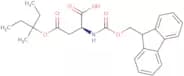
CAS:<p>Fmoc-L-aspartic acid b-methylpentyl ester is a solid phase synthesis of Asp(OtBu)-OH that has been synthesized by reacting aspartic acid with piperidine and methylbenzene. This synthesis has been shown to be effective at temperatures below 25°C, to minimize the formation of water, and to be resistant to treatments with strong acids or bases. The synthesis has also been optimized for the peptidyl bond formation and peptide synthesis, resulting in enhanced yields.</p>Formula:C25H29NO6Purity:Min. 95%Color and Shape:White PowderMolecular weight:439.5 g/mol4-Amino-5-methoxy-2-methylbenzenesulfonic acid
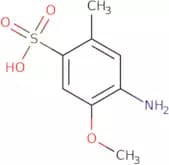
CAS:<p>4-Amino-5-methoxy-2-methylbenzenesulfonic acid is a compound that has been used as an additive to analytical reagents in order to improve their sensitivity. This compound is used as the sodium salt, which is water soluble and has a high degree of reproducibility. 4-Amino-5-methoxy-2-methylbenzenesulfonic acid has also been used for the validation of analytical methods, including calibration and cytotoxicity testing. The validation procedure includes colorants, spectra analysis, impurities, and solvents.</p>Formula:C8H11NO4SPurity:Min. 95%Color and Shape:PowderMolecular weight:217.24 g/mol(D-Arg0, Hyp 3,Igl5,D-Igl7, Oic 8)-Bradykinin trifluoroacetate salt
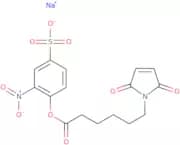
CAS:<p>Please enquire for more information about (D-Arg0, Hyp 3,Igl5,D-Igl7, Oic 8)-Bradykinin trifluoroacetate salt including the price, delivery time and more detailed product information at the technical inquiry form on this page</p>Formula:C64H95N19O13Purity:Min. 95%Molecular weight:1,338.56 g/molε-Maleimidocaproic acid-(2-nitro-4-sulfo)-phenyl ester·sodium salt
CAS:<p>Epsilon-Maleimidocaproic acid-(2-nitro-4-sulfo)-phenyl ester·sodium salt (EMAP) is a crosslinker that belongs to the group of heterobifunctional reagents. It has been used to conjugate monoclonal antibodies with other molecules, such as toxins. EMAP is activated by the dianion generated by protonation of the nitro groups on the phenyl ring and reacts with free amines or thiols in proteins. EMAP can be used for labeling immunotoxins for diagnostic use, maximizing detection sensitivity, and crosslinking DNA molecules for use in molecular cloning experiments.</p>Formula:C16H15N2NaO9SPurity:Min. 95%Molecular weight:434.35 g/molMatrix Protein M1 (58-66) (Influenza A virus) trifluoroacetate salt
CAS:<p>Please enquire for more information about Matrix Protein M1 (58-66) (Influenza A virus) trifluoroacetate salt including the price, delivery time and more detailed product information at the technical inquiry form on this page</p>Formula:C49H75N9O11·C2HF3O2Purity:Min. 95%Molecular weight:1,080.2 g/moltert-Butyl2-bromo-6,7-dihydrothiazolo[5,4-c]pyridine-5(4H)-carboxylate
CAS:<p>Please enquire for more information about tert-Butyl2-bromo-6,7-dihydrothiazolo[5,4-c]pyridine-5(4H)-carboxylate including the price, delivery time and more detailed product information at the technical inquiry form on this page</p>Formula:C11H15BrN2O2SPurity:Min. 95%Molecular weight:319.22 g/molH-Gly-Arg-Ala-Asp-Ser-Pro-OH trifluoroacetate salt
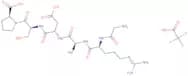
CAS:<p>H-Gly-Arg-Ala-Asp-Ser-Pro-OH trifluoroacetate salt is a peptide that binds to the α5β1 integrin receptor. It has been shown to inhibit the growth of carcinoma cell lines and induce apoptosis in tumor cells by binding to receptors on the surface of cancer cells. H-Gly-Arg-Ala-Asp-Ser-Pro-OH trifluoroacetate salt has also been shown to be effective against damaged tissue, such as adhesions, and promote wound healing by stimulating collagen production. This agent also has genotoxic effects and can cause DNA damage. H-Gly-Arg-Ala-Asp-Ser-Pro -OH trifluoroacetate salt may also have an antiapoptotic effect through its ability to bind with basic proteins, proapoptotic proteins, and epidermal growth factor receptor.</p>Formula:C23H39N9O10Purity:Min. 95%Molecular weight:601.61 g/molMethyl 4-tert-butylphenylacetate
CAS:<p>Methyl 4-tert-butylphenylacetate is a chemical compound that has been used in various research collaborations. It is also used as a solvent for the production of octanoic acid and isobutyric acid, which are important chemical compounds for use in the food industry. The utilisation of methyl 4-tert-butylphenylacetate has been studied by researchers in relation to its maltol, levulinate and hexanoic acid derivatives. This compound can be used as a replacement for other chemicals such as sulfate, butanedione and propylene glycol in industrial applications.</p>Formula:C13H18O2Purity:Min. 95%Molecular weight:206.28 g/mol(Gly21)-Amyloid b-Protein (1-40) trifluoroacetate salt
CAS:<p>Please enquire for more information about (Gly21)-Amyloid b-Protein (1-40) trifluoroacetate salt including the price, delivery time and more detailed product information at the technical inquiry form on this page</p>Formula:C193H293N53O58SPurity:Min. 95%Molecular weight:4,315.78 g/molHemokinin 1 (human) trifluoroacetate salt
CAS:<p>Hemokinin-1 is a hematopoietic cell growth factor that belongs to the group of neuropeptides. This protein has been shown to stimulate the production of white blood cells and is used as an adjuvant in vaccines. Hemokinin-1 stimulates the production of inflammatory cytokines and other proinflammatory substances. It also has been found to be involved in autoimmune diseases, cancer, and infectious diseases. The antigen binding site on Hemokinin-1 is located at residues Thr-Gly-Lys-Ala-Ser-Gln-Phe-Phe-Gly-Leu (TGLKSGPFGL) and the receptor binding site at residues Met-NH2. The receptor for Hemokinin 1 is the neurokinin 1 receptor (NK1R).</p>Formula:C54H84N14O14SPurity:Min. 95%Molecular weight:1,185.4 g/molH-Phe-Met-D-Arg-Phe-NH2 acetate salt
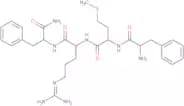
CAS:<p>Please enquire for more information about H-Phe-Met-D-Arg-Phe-NH2 acetate salt including the price, delivery time and more detailed product information at the technical inquiry form on this page</p>Formula:C29H42N8O4SPurity:Min. 95%Molecular weight:598.76 g/molH-Pro-Lys-OH acetate salt
CAS:<p>H-Pro-Lys-OH acetate salt is a synthetic compound that is specific for histidine residues. It catalyzes the hydrolysis of fibrinogen to form fibrin, which can be used in the formation of blood clots. This molecule has been shown to have a number of sequences and acid analysis. H-Pro-Lys-OH acetate salt can be used as an additive in food products. The incubation process should be done at pH 4.5 and the reaction should be stopped by adding tripeptides followed by using ion-exchange chromatography or SDS polyacrylamide gel electrophoresis to analyze the amino acids present in the product.</p>Formula:C11H21N3O3Purity:Min. 95%Molecular weight:243.3 g/mol(Arg13)-Amyloid b-Protein (1-40) trifluoroacetate salt
CAS:<p>Please enquire for more information about (Arg13)-Amyloid b-Protein (1-40) trifluoroacetate salt including the price, delivery time and more detailed product information at the technical inquiry form on this page</p>Formula:C194H300N54O58SPurity:Min. 95%Molecular weight:4,348.85 g/molOxyntomodulin (bovine, dog, porcine) trifluoroacetate salt
CAS:<p>Please enquire for more information about Oxyntomodulin (bovine, dog, porcine) trifluoroacetate salt including the price, delivery time and more detailed product information at the technical inquiry form on this page</p>Formula:C192H295N59O60SPurity:Min. 95%Molecular weight:4,421.82 g/mol2-(4-Chlorophenyl-acetyl)benzoic acid
CAS:<p>2-(4-Chlorophenyl-acetyl)benzoic acid is a fine chemical that is a versatile building block and useful intermediate. 2-(4-Chlorophenyl-acetyl)benzoic acid is used in the manufacture of other chemicals, such as pharmaceuticals, pesticides, dyes, or perfumes. It is also used for research purposes and as a reagent. It has a CAS number of 53242-76-5.</p>Formula:C15H11ClO3Purity:Min. 95%Color and Shape:PowderMolecular weight:274.7 g/mol(Trp11,D-Phe15·16)-SDF-1 (7-16) (Dimer) (human, cat, mouse) trifluoroacetate salt
<p>Please enquire for more information about (Trp11,D-Phe15·16)-SDF-1 (7-16) (Dimer) (human, cat, mouse) trifluoroacetate salt including the price, delivery time and more detailed product information at the technical inquiry form on this page</p>Formula:C134H180N34O26S2Purity:Min. 95%Molecular weight:2,747.21 g/molLinolenic acid - 98%
CAS:<p>Linolenic acid is a polyunsaturated fatty acid that is essential for human health. It is a precursor of prostaglandin E2 (PGE2), which has been implicated in the regulation of cell death and inflammation. Linolenic acid has been shown to induce apoptosis in vitro by inhibiting the mitochondrial membrane potential and activating caspases 3 and 9, thereby inducing neuronal death. In vivo, linolenic acid has been shown to have beneficial effects on cardiovascular function, including lowering cholesterol levels and improving blood flow to the heart. Linolenic acid also has antioxidant properties, which may be due to its ability to inhibit lipid peroxidation and scavenge free radicals.</p>Formula:C18H30O2Purity:Min. 95%Color and Shape:PowderMolecular weight:278.43 g/molHepcidin-24 (human) trifluoroacetate salt
<p>Please enquire for more information about Hepcidin-24 (human) trifluoroacetate salt including the price, delivery time and more detailed product information at the technical inquiry form on this page</p>Formula:C109H165N33O28S9Purity:Min. 95%Molecular weight:2,674.28 g/mol


![tert-Butyl 2-amino-6,7-dihydrothiazolo[5,4-c]pyridine-5(4H)-carboxylate](/_next/image/?url=https%3A%2Fstatic.cymitquimica.com%2Fproducts%2F3D%2Fthumb-webp%2FFB143127.webp&w=3840&q=75)


![tert-Butyl2-bromo-6,7-dihydrothiazolo[5,4-c]pyridine-5(4H)-carboxylate](/_next/image/?url=https%3A%2Fstatic.cymitquimica.com%2Fproducts%2F3D%2Fthumb-webp%2FFB148706.webp&w=3840&q=75)