Carboxylic Acids
Carboxylic acids are organic molecules characterized by having a carboxyl-type functional group (-COOH). These acids are fundamental in various chemical reactions, including esterification, amidation, and decarboxylation. Carboxylic acids are widely used in the production of pharmaceuticals, polymers, and agrochemicals. In this section, you can find a large number of carboxylic acids ready to be used. At CymitQuimica, we provide a broad range of high-quality carboxylic acids to support your research and industrial applications.
Found 12453 products of "Carboxylic Acids"
Sort by
Purity (%)
0
100
|
0
|
50
|
90
|
95
|
100
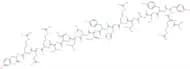
GRF (bovine) trifluoroacetate salt
CAS:<p>Growth hormone-releasing factor (GRF) or GHRH (growth hormone-releasing hormone).Binds to the growth hormone-releasing hormone receptor (GHRH-R), causing growth hormone secretion.porcine: H-YADAIFTNSYRKVLGQLSARKLLQDIMSRQQGERNQEQGARVRL-NH2bovine: H-YADAIFTNSYRKVLGQLSARKLLQDIMNRQQGERNQEQGAKVRL-NH2ovine: H-YADAIFTNSYRKILGQLSARKLLQDIMNRQQGERNQEQGAKVRL-NH2human: H-YADAIFTNSYRKVLGQLSARKLLQDIMSRQQGESNQERGARARL-NH2</p>Formula:C220H366N72O66SPurity:Min. 95%Molecular weight:5,107.77 g/mol3-Benzoyl acrylic acid
CAS:<p>3-Benzoyl acrylic acid is an organic compound that is the product of a chemical reaction between benzaldehyde and acetic anhydride. It contains a carboxylic acid group, an hydroxyl group, a nitro group, and a particle. 3-Benzoyl acrylic acid has been shown to inhibit the growth factor epidermal growth factor (EGF). This inhibition occurs by binding to the receptor for EGF on the cell membrane and blocking its activation. 3-Benzoyl acrylic acid also inhibits fatty acid synthesis and mitochondrial membrane potential, which may be due to its ability to form ester hydrochloride.</p>Formula:C10H8O3Purity:Min. 95%Color and Shape:PowderMolecular weight:176.17 g/mol(Arg17)-Amyloid b-Protein (1-42) trifluoroacetate salt
CAS:<p>Please enquire for more information about (Arg17)-Amyloid b-Protein (1-42) trifluoroacetate salt including the price, delivery time and more detailed product information at the technical inquiry form on this page</p>Formula:C203H312N58O60SPurity:Min. 95%Molecular weight:4,557.07 g/molMercuric acetate
CAS:Controlled Product<p>Mercuric acetate is a salt of mercuric and acetic acid. It is used as an antiseptic, disinfectant, and preservative in the food industry. Mercuric acetate has been shown to have anti-inflammatory properties and is used for the treatment of inflammatory bowel disease. The ester linkage between the two molecules allows it to be hydrolysed into its components by enzymes such as esterases or glucuronidases, which may be one of the reasons for its therapeutic effects. Mercuric acetate also reacts with biological molecules, including proteins, nucleic acids, and carbohydrates. This reaction mechanism may contribute to its other biological properties such as lowering blood sugar levels and inhibiting glycolysis in cells that depend on sodium-dependent glucose transport mechanisms.</p>Formula:C4H6HgO4Purity:Min. 95%Molecular weight:318.68 g/mol1-Naphthylphosphoric acid calcium
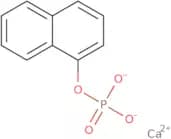
CAS:<p>1-Naphthylphosphoric acid calcium salt (1NPAC) is a fine chemical that has been used as a building block in the synthesis of complex organic compounds. 1NPAC has been shown to be useful in the production of research chemicals and speciality chemicals. It is also employed as an intermediate for the production of high quality reagents. 1NPAC has versatile uses, as it can be used to synthesize other compounds, such as pharmaceuticals and agrochemicals.</p>Formula:C20H18O8P2•CaPurity:Min. 95%Color and Shape:PowderMolecular weight:488.38 g/mol(Des-Lys38)-M65 trifluoroacetate salt
CAS:<p>Please enquire for more information about (Des-Lys38)-M65 trifluoroacetate salt including the price, delivery time and more detailed product information at the technical inquiry form on this page</p>Formula:C199H314N62O60S5Purity:Min. 95%Molecular weight:4,695.33 g/molSuc-Ala-Phe-Lys-AMC trifluoroacetate salt
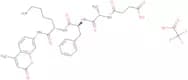
CAS:<p>Please enquire for more information about Suc-Ala-Phe-Lys-AMC trifluoroacetate salt including the price, delivery time and more detailed product information at the technical inquiry form on this page</p>Formula:C32H39N5O8·C2HF3O2Purity:Min. 95%Molecular weight:735.7 g/molHel 13-5 trifluoroacetate salt
CAS:Controlled Product<p>Hel 13-5 trifluoroacetate salt H-Lys-Leu-Leu-Lys-Leu-Leu-Leu-Lys-Leu-Trp-Leu-Lys-Leu-Leu-Lys-Leu-Leu<br>Hel 13 is a ternary anionic surfactant consisting of a helix and three head groups. The head groups are Lys, Leu, and Leu. Each of these three head groups have a hydrophilic polar group and two lipophilic chains. It is typically used as a surfactant in the pulmonary system to help maintain lung function. When Hel 13 is used in the pulmonary system, it helps to keep the alveoli open so that air can be exchanged with blood. Hel 13 also has been shown to reduce surface tension at high pressures and temperatures, which could potentially be used for industrial purposes such as oil drilling or nuclear power plants.</p>Formula:C113H204N24O19Purity:Min. 95%Molecular weight:2,202.98 g/mol3-Methylbenzofuran-2-carboxylic acid
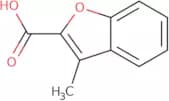
CAS:<p>3-Methylbenzofuran-2-carboxylic acid is a dianion that binds to the cell membrane and inhibits bacterial growth. This compound has been shown to be active against bacteria at low concentrations. 3-Methylbenzofuran-2-carboxylic acid has been used as an antibacterial agent for the treatment of gram-negative bacteria such as Escherichia coli and Proteus mirabilis. It also inhibits the growth of gram-positive bacteria including Staphylococcus aureus, Streptococcus pneumoniae, and Enterococcus faecalis. The reaction temperature required for the synthesis of this compound is high, but it can be prepared at lower temperatures by using anhydrous acetonitrile in place of hydrochloric acid.</p>Formula:C10H8O3Purity:Min. 95%Color and Shape:White PowderMolecular weight:176.17 g/molNeuropeptide Y (18-36) trifluoroacetate salt
CAS:<p>Neuropeptide Y (18-36) trifluoroacetate salt H-Ala-Arg-Tyr-Tyr-Ser-Ala-Leu-Arg-His-Tyr-Ile-Asn-Leu-Ile-Thr-Arg -Gln is a peptide belonging to the family of neuropeptides. It has been shown to have potent vasoconstricting activity in rat and guinea pig hearts, as well as contractile activity in rat aortic rings. Neuropeptide Y (18 - 36) trifluoroacetate salt H -Ala -Arg Tyr Tyr Ser Ala Leu Arg His Tyr Ile Asn Leu Ile Thr Arg Gln Arg Tyr NH2 trifl uoroacetate salt also inhibits the cyclase activity of adenylate cyclase, which is responsible for generating the second messenger cAMP. This compound may be used to treat congest</p>Formula:C112H174N36O27Purity:Min. 95%Molecular weight:2,456.81 g/molpTH (2-38) (human) acetate salt
CAS:<p>Please enquire for more information about pTH (2-38) (human) acetate salt including the price, delivery time and more detailed product information at the technical inquiry form on this page</p>Formula:C194H314N58O53S2Purity:Min. 95%Molecular weight:4,371.06 g/molH-Lys-Phe-Gly-Lys-OH acetate salt
CAS:<p>Please enquire for more information about H-Lys-Phe-Gly-Lys-OH acetate salt including the price, delivery time and more detailed product information at the technical inquiry form on this page</p>Formula:C23H38N6O5Purity:Min. 95%Molecular weight:478.59 g/molPAR-4 (1-6) amide (mouse) trifluoroacetate salt
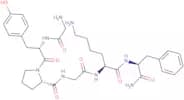
CAS:<p>PAR-4 (1-6) amide (mouse) trifluoroacetate salt H-Gly-Tyr-Pro-Gly-Lys-Phe-NH2 trifluoroacetate salt is a guanine nucleotide binding protein that belongs to the PAR family of proteins. It is expressed in wild type mice and binds to the cytosolic calcium, which regulates polymerase chain reaction. PAR-4 (1-6) amide (mouse) trifluoroacetate salt H-Gly-Tyr-Pro-Gly-Lys-Phe NH2 trifluoroacetate salt can be used as a potential drug target for epidermal growth factor. It has been shown to activate transcription polymerase chain and transcriptase polymerase chain during transcriptional regulation of messenger RNA.</p>Formula:C33H46N8O7Purity:Min. 95%Molecular weight:666.77 g/moltrans-4-[(2,5-Dihydro-2,5-dioxo-1H-pyrrol-1-yl)methyl]cyclohexanecarboxylic acid
CAS:<p>4-Maleimidomethylcyclohexanecaroboxylic acid (4MAMC) is a bifunctional molecule that is conjugated to a polymer, which has the ability to bind with cellular antigens and target tissue. It is used in clinical chemistry because it can be detected at low concentrations. 4MAMC has been shown to reduce cirrhosis caused by chronic liver injury. 4MAMC also increases the uptake of coagulation factors and decreases the expression of prothrombin, which leads to an increase in clotting time. The localization of 4MAMC is determined by the type of polymer conjugate it is bound with; for example, when it binds with human serum albumin, it localizes on the surface of cells.</p>Formula:C12H15NO4Purity:Min. 95%Color and Shape:White PowderMolecular weight:237.25 g/molBombesin (8-14) acetate salt
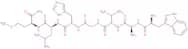
CAS:<p>Bombesin (8-14) acetate salt H-Trp-Ala-Val-Gly-His-Leu-Met-NH2 acetate salt is a bifunctional peptide that has been shown to inhibit the growth of prostate cancer cells. Bombesin (8-14) acetate salt H-Trp-Ala-Val-Gly-His-Leu-Met-NH2 acetate salt also has antiinflammatory properties and is used in treating inflammatory diseases. It inhibits collagen synthesis and fibrinogen activation, which may be important in the treatment of autoimmune diseases such as rheumatoid arthritis. Bombesin (8 14) acetate salt H Trp Ala Val Gly His Leu Met NH2 Acetate Salt has been shown to have no effect on healthy tissues when administered systemically.</p>Formula:C38H57N11O7SPurity:Min. 95%Molecular weight:812 g/molBis-ACV trifluoroacetate salt
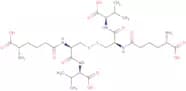
CAS:<p>Bis-ACV trifluoroacetate salt is a regulatory compound that belongs to the class of bis-acids. It is a cytosolic calcium ionophore that binds to the cytosolic calcium ion channel and regulates its activity. Bis-ACV trifluoroacetate salt also has nucleophilic attack on phosphate groups, which are essential for biosynthesis. The enzyme activity of this compound has been studied in various strains of bacteria such as E. coli and S. cerevisiae, and it was found to be involved in the synthesis of oligosaccharides and polysaccharides. This compound can be solubilized by the addition of sodium bicarbonate or urea, which facilitates its use in synthetic reactions. The synthase gene for this compound has been identified from various strains of bacteria such as E. coli and S. cerevisiae, but not from mammalian cells or plants.</p>Formula:C28H48N6O12S2Purity:Min. 95%Molecular weight:724.85 g/mol(R)-(-)-3-Amino-3-phenylpropionic acid
CAS:<p>(R)-(-)-3-Amino-3-phenylpropionic acid is a hydrogenated, stereoselective β-amino acid that is involved in the biosynthesis of animal health. The enzyme acylase catalyzes this reaction by binding with chiral pyridoxal phosphate to form an acylation product. The stereospecificity of the reaction is determined by whether the enzyme has a preference for L or D amino acids. Acylases are found in organisms such as mammals and bacteria.</p>Formula:C9H11NO2Purity:Min. 95%Color and Shape:PowderMolecular weight:165.19 g/molH-Gly-Gly-Lys-Arg-OH acetate salt
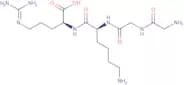
CAS:<p>The H-Gly-Gly-Lys-Arg-OH acetate salt is a diagnostic agent that belongs to the group of active analogues. It is an analogue of sialin, a compound that has been shown to be involved in the molecular pathogenesis of cancer tissues. Sialic acid is an important component of many glycoproteins and glycolipids found in the human body. This compound is metabolized by sialidase enzymes, which are present in various tissues and organs such as the brain, kidney, liver, and plasma. The H-Gly-Gly-Lys-Arg-OH acetate salt inhibits these enzymes by binding to them and preventing their action. This drug also inhibits ATP dependent transport systems for neuronal cells.</p>Formula:C16H32N8O5Purity:Min. 95%Molecular weight:416.48 g/mol(D-2-Nal 5,Cys6·11,Tyr7,D-Trp8,Val10, 2-Nal 12)-Somatostatin-14 (5-12) amide trifluoroacetate salt
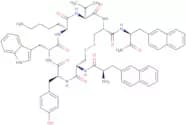
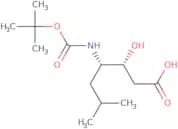
CAS:<p>Please enquire for more information about (D-2-Nal 5,Cys6·11,Tyr7,D-Trp8,Val10, 2-Nal 12)-Somatostatin-14 (5-12) amide trifluoroacetate salt including the price, delivery time and more detailed product information at the technical inquiry form on this page</p>Formula:C63H73N11O9S2Purity:Min. 95%Molecular weight:1,192.45 g/molBoc-epi-statine (3R,4S)-4-(Boc-amino)-3-hydroxy-6-methyl-heptanoic acid
CAS:<p>Please enquire for more information about Boc-epi-statine (3R,4S)-4-(Boc-amino)-3-hydroxy-6-methyl-heptanoic acid including the price, delivery time and more detailed product information at the technical inquiry form on this page</p>Formula:C13H25NO5Purity:Min. 95%Molecular weight:275.34 g/mol






![trans-4-[(2,5-Dihydro-2,5-dioxo-1H-pyrrol-1-yl)methyl]cyclohexanecarboxylic acid](/_next/image/?url=https%3A%2Fstatic.cymitquimica.com%2Fproducts%2F3D%2Fthumb-webp%2FFM54570.webp&w=3840&q=75)