Carboxylic Acids
Found 12458 products of "Carboxylic Acids"
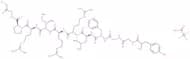
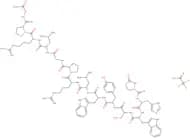
Dynorphin A (1-10)-Gly-chloromethylketone trifluoroacetate salt
CAS:Please enquire for more information about Dynorphin A (1-10)-Gly-chloromethylketone trifluoroacetate salt including the price, delivery time and more detailed product information at the technical inquiry form on this pageFormula:C60H95ClN20O12Purity:Min. 95%Molecular weight:1,323.98 g/molGRF (ovine, caprine) trifluoroacetate salt
CAS:Growth hormone-releasing factor (GRF) or GHRH (growth hormone-releasing hormone).Binds to the growth hormone-releasing hormone receptor (GHRH-R), causing growth hormone secretion.porcine: H-YADAIFTNSYRKVLGQLSARKLLQDIMSRQQGERNQEQGARVRL-NH2bovine: H-YADAIFTNSYRKVLGQLSARKLLQDIMNRQQGERNQEQGAKVRL-NH2ovine: H-YADAIFTNSYRKILGQLSARKLLQDIMNRQQGERNQEQGAKVRL-NH2human: H-YADAIFTNSYRKVLGQLSARKLLQDIMSRQQGESNQERGARARL-NH2Formula:C221H368N72O66SPurity:Min. 95%Molecular weight:5,121.8 g/molThrombin Receptor Antagonist trifluoroacetate salt
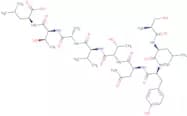
CAS:Please enquire for more information about Thrombin Receptor Antagonist trifluoroacetate salt including the price, delivery time and more detailed product information at the technical inquiry form on this pageFormula:C58H91N17O20S2Purity:Min. 95%Molecular weight:1,410.58 g/mol(Lys1015·1024)-Thrombospondin-1 (1015-1024) (human, bovine, mouse) trifluoroacetate salt
CAS:Please enquire for more information about (Lys1015·1024)-Thrombospondin-1 (1015-1024) (human, bovine, mouse) trifluoroacetate salt including the price, delivery time and more detailed product information at the technical inquiry form on this page
Formula:C68H105N17O12SPurity:Min. 95%Molecular weight:1,384.73 g/mol2-Fluoro-6-(trifluoroMethyl)pyridine-3-boronic acid
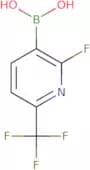
CAS:Please enquire for more information about 2-Fluoro-6-(trifluoroMethyl)pyridine-3-boronic acid including the price, delivery time and more detailed product information at the technical inquiry form on this page
Formula:C6H4BF4NO2Purity:Min. 95%Molecular weight:208.91 g/mol4-Methoxybenzylboronic acid pinacolester
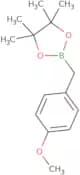
CAS:Please enquire for more information about 4-Methoxybenzylboronic acid pinacolester including the price, delivery time and more detailed product information at the technical inquiry form on this pageFormula:C14H21BO3Purity:Min. 95%Molecular weight:248.13 g/molH-Lys-Tyr-OH acetate salt
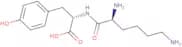
CAS:H-Lys-Tyr-OH acetate salt (HAT) is a synthetic nonsteroidal anti-inflammatory drug that has been used in the treatment of inflammatory diseases and cancer. HAT is an optical isomer of the naturally occurring amino acid L-lysine. It has been shown to have antioxidative properties and to be active against HIV infection and inflammatory diseases, including diabetes. HAT also has a molecular structure that makes it a potential therapeutic agent for cancer, as well as for women with osteoporosis and other chronic inflammatory conditions.Formula:C15H23N3O4Purity:Min. 95%Molecular weight:309.36 g/mol(D-Trp6)-LHR
Please enquire for more information about (D-Trp6)-LHR including the price, delivery time and more detailed product information at the technical inquiry form on this pageFormula:C83H115N25O17Purity:Min. 95%Molecular weight:1,734.96 g/molKyotorphin acetate salt
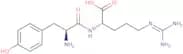
CAS:Please enquire for more information about Kyotorphin acetate salt including the price, delivery time and more detailed product information at the technical inquiry form on this pageFormula:C15H23N5O4Purity:Min. 95%Molecular weight:337.37 g/mol3,5-Dichloropyrazine-2-carboxylicacid
CAS:Please enquire for more information about 3,5-Dichloropyrazine-2-carboxylicacid including the price, delivery time and more detailed product information at the technical inquiry form on this page
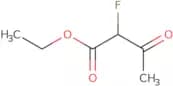
Formula:C5H2Cl2N2O2Purity:Min. 95%Molecular weight:192.99 g/molEthyl 2-fluoroacetoacetate
CAS:Ethyl 2-fluoroacetoacetate is a phosphorus oxychloride synthon that can be used to synthesize fluorinated compounds. It has been shown to react with a carbonyl group, like tyrosine, in the presence of an organocatalyst to form a tetrafluoroborate ester. The reaction mechanism of this compound is intramolecular hydrogen transfer from the phosphite oxygen atom to the electrophilic carbon atom. Ethyl 2-fluoroacetoacetate has been shown to react with alkyl halides and hydroxyl groups in the presence of base, forming enantiomeric alcohols. This compound has also been shown to have optical properties that are stable at room temperature and pressure, including infrared absorption maxima at 1740 cm-1 and 1775 cm-1 as well as ultraviolet absorption maxima at 225 nm and 254 nm.Formula:C6H9FO3Purity:Min. 95%Molecular weight:148.13 g/mol4-Oxo-1-adamantanecarboxylic acid
CAS:4-Oxo-1-adamantanecarboxylic acid is a versatile building block that can be used as a reactant and reagent in organic chemistry. It is used to synthesize various heterocyclic compounds, including the 4-oxo-1,4-dihydropyridine ring system. This compound has been shown to be useful as an intermediate or building block in the synthesis of a number of complex compounds. 4-Oxo-1-adamantanecarboxylic acid may also be used as a research chemical or speciality chemical.Formula:C11H14O3Purity:Min. 95%Color and Shape:White PowderMolecular weight:194.23 g/mol(Asn670,Leu671)-Amyloid b/A4 Protein Precursor770 (667-676) trifluoroacetate salt
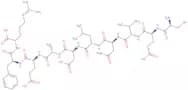
CAS:Please enquire for more information about (Asn670,Leu671)-Amyloid b/A4 Protein Precursor770 (667-676) trifluoroacetate salt including the price, delivery time and more detailed product information at the technical inquiry form on this pageFormula:C50H78N14O19Purity:Min. 95%Molecular weight:1,179.24 g/molHIV-1 gag Protein p17 (76-84) acetate salt
CAS:Acetate salt of HIV-1 gag Protein p17 (76-84) is a reactive acridone, hydrocarbon, nitrogen atom and hydrates that is injected to regulate depression. Acetate salt of HIV-1 gag Protein p17 (76-84) has been shown to bind to the telomerase enzyme and inhibit cancer cell growth. Acetate salt of HIV-1 gag Protein p17 (76-84) also has a role in regulating metabolism in cells. Acetate salt of HIV-1 gag Protein p17 (76-84) has been shown to have solvating properties and can be used as a heterocyclic ring section in gas phase reactions.Formula:C44H72N10O15Purity:Min. 95%Molecular weight:981.1 g/molSalusin-beta (human) trifluoroacetate salt
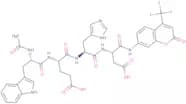
CAS:Please enquire for more information about Salusin-beta (human) trifluoroacetate salt including the price, delivery time and more detailed product information at the technical inquiry form on this pageFormula:C115H176N32O21Purity:Min. 95%Molecular weight:2,342.83 g/molAc-Trp-Glu-His-Asp-AFC trifluoroacetate salt
CAS:Please enquire for more information about Ac-Trp-Glu-His-Asp-AFC trifluoroacetate salt including the price, delivery time and more detailed product information at the technical inquiry form on this page
Formula:C38H37F3N8O11Purity:Min. 95%Molecular weight:838.74 g/molH-Gly-Arg-Gly-Asp-Ser-Pro-Cys-OH trifluoroacetate salt
CAS:H-Gly-Arg-Gly-Asp-Ser-Pro-Cys-OH trifluoroacetate salt is a peptide that has been shown to inhibit the growth of tumor cells. It has also been shown to have biological properties in a number of experimental models, including in vitro and in vivo studies. H-Gly-Arg-Gly-Asp-Ser-Pro-Cys-OH trifluoroacetate salt inhibits muscle cell proliferation by binding to the extracellular matrix protein collagen type I. This inhibition leads to reduced tissue formation and body growth. This peptide also inhibits the proliferation of cancer cells by blocking the production of growth factor beta 1 (GFβ1).
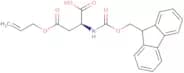
Formula:C25H42N10O11SPurity:Min. 95%Molecular weight:690.73 g/molFmoc-L-aspartic acid beta-allyl ester
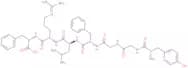
CAS:Fmoc-L-aspartic acid beta-allyl ester is a specific interaction between an amide and an enzyme target. It has been shown to have anti-inflammatory properties by inhibiting the activity of COX-2, which inhibits the production of prostaglandins. Fmoc-L-aspartic acid beta-allyl ester is a cyclic peptide with a lactam ring system that has been synthesized in a stepwise manner on a solid phase. This molecule interacts with cell line A549 and blocks the proliferation of cancer cells. Fmoc-L-aspartic acid beta-allyl ester also contains a disulfide bond that stabilizes its structure.Formula:C22H21NO6Purity:Min. 95%Molecular weight:395.41 g/mol(Phe7)-Dynorphin A (1-7) acetate salt
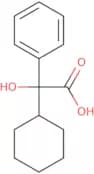
CAS:Dynorphin A (1-7) acetate salt is a potent analgesic that has been used to treat pain. It has been shown to be effective in the treatment of laryngitis and other laryngological disorders. Dynorphin A (1-7) acetate salt is a prodrug that is hydrolyzed in vivo to dynorphin A (1-7) by esterases, which can then bind to opioid receptors. This drug has been validated for use as a diagnostic agent in coatings and in algorithms for analysis of polygonal images from laryngoscopy. The dehydrogenase enzymes are added to the coating or algorithm for diagnosis of the presence of vocal cord pathology. Dynorphin A (1-7) acetate salt also shows promising results for analyzing waveforms from laryngoscopy, with the goal of classifying vocal cord pathology.Formula:C43H58N10O9Purity:Min. 95%Molecular weight:858.98 g/mol2-Cyclohexyl-2-hydroxy-phenylacetic acid
CAS:2-Cyclohexyl-2-hydroxy-phenylacetic acid is a potent inhibitor of the cholinergic muscarinic receptors. It has been used as an anticholinergic drug and in pharmaceutical preparations for the treatment of inflammatory diseases. 2-Cyclohexyl-2-hydroxy-phenylacetic acid is used to treat urinary incontinence, although it can also cause constipation. Side effects of 2-cyclohexyl-2-hydroxy phenylacetic acid include headache, drowsiness, dry mouth, and blurred vision. 2 CPHPA is an inorganic acid that reacts with phosphorus pentachloride to form an organic phosphate ester called pentachlorophosphoric acid (PCPA). This reaction can be reversed by adding hydrochloric acid. The PCPA salt of 2 CPHPA is called diethylamine salt.Formula:C14H18O3Purity:Min. 95%Molecular weight:234.29 g/mol