Carboxylic Acids
Carboxylic acids are organic molecules characterized by having a carboxyl-type functional group (-COOH). These acids are fundamental in various chemical reactions, including esterification, amidation, and decarboxylation. Carboxylic acids are widely used in the production of pharmaceuticals, polymers, and agrochemicals. In this section, you can find a large number of carboxylic acids ready to be used. At CymitQuimica, we provide a broad range of high-quality carboxylic acids to support your research and industrial applications.
Found 12458 products of "Carboxylic Acids"
Sort by
Purity (%)
0
100
|
0
|
50
|
90
|
95
|
100
Lysozyme C (46-61) (chicken) trifluoroacetate salt
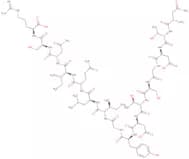
CAS:Lysozyme C (46-61) (chicken) trifluoroacetate salt is a conjugated synthetic peptide that binds to the antigen. It is a reactive molecule with solubilized properties that has been shown to bind to the peptide in binding experiments. This synthetic peptide has been found to be efficacious in transfected murine bone cells and antigen-presenting cells. The binding of Lysozyme C (46-61) (chicken) trifluoroacetate salt to phospholipid membranes may be due to its reactivity with the membrane's hydrophobic surface.Formula:C72H116N22O29Purity:Min. 95%Molecular weight:1,753.82 g/molBenzyl acetate
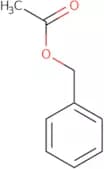
CAS:Benzyl acetate is a colorless liquid that has a pleasant odor. It is used as a flavoring agent in food, beverages and tobacco products. Benzyl acetate is also used as an intermediate in the production of other chemicals. A low-dose group of rats was given benzyl acetate at doses of 0.5, 1, 5 and 10 mg/kg/day for 30 days. The animals were observed for changes in enzyme activities and thermal expansion reactions. Chronic exposure to benzyl acetate may cause carcinogenesis by inducing dimethyl fumarate (DMF) or methyl transferase activity.Formula:C9H10O2Purity:Min. 95%Color and Shape:Colorless Clear LiquidMolecular weight:150.17 g/molPAR-2 (6-1) amide (human) trifluoroacetate salt
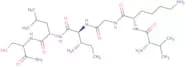
CAS:Please enquire for more information about PAR-2 (6-1) amide (human) trifluoroacetate salt including the price, delivery time and more detailed product information at the technical inquiry form on this pageFormula:C28H54N8O7Purity:Min. 95%Molecular weight:614.78 g/molOM99-2trifluoroacetate salt
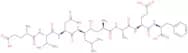
CAS:Please enquire for more information about OM99-2trifluoroacetate salt including the price, delivery time and more detailed product information at the technical inquiry form on this pageFormula:C41H64N8O14Purity:Min. 95%Molecular weight:892.99 g/mol3-(Trifluoromethyl)phenylacetic acid
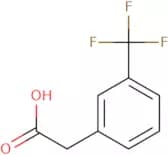
CAS:3-(Trifluoromethyl)phenylacetic acid is an isoquinoline alkaloid that has been found to have anti-inflammatory properties. It was shown to inhibit TNF-α production in mice with colitis, reducing the severity of the disease. 3-(Trifluoromethyl)phenylacetic acid can be administered orally, and it is metabolized reductively by dihydroisoquinoline reductase enzymes. The drug's pharmacokinetics are not well understood, but it is thought to be a substrate for CYP3A4 and P-glycoprotein. 3-(Trifluoromethyl)phenylacetic acid has been studied as a potential antiviral agent and systemic inflammatory response inhibitor.Formula:C9H7F3O2Purity:Min. 95%Molecular weight:204.15 g/mol(Des-Gly10,D-Pyr 1,D-Leu6,Pro-NHEt 9)-LHRH trifluoroacetate salt
Please enquire for more information about (Des-Gly10,D-Pyr 1,D-Leu6,Pro-NHEt 9)-LHRH trifluoroacetate salt including the price, delivery time and more detailed product information at the technical inquiry form on this pageFormula:C59H84N16O12Purity:Min. 95%Molecular weight:1,209.4 g/mol(D-Arg2, Sar 4)-Dermorphin (1-4) trifluoroacetate salt
CAS:Please enquire for more information about (D-Arg2, Sar 4)-Dermorphin (1-4) trifluoroacetate salt including the price, delivery time and more detailed product information at the technical inquiry form on this pagePurity:Min. 95%Molecular weight:555.63CRAMP-18 (mouse) trifluoroacetate salt
CAS:Please enquire for more information about CRAMP-18 (mouse) trifluoroacetate salt including the price, delivery time and more detailed product information at the technical inquiry form on this pageFormula:C101H171N27O24Purity:Min. 95%Molecular weight:2,147.61 g/molOrexin A (17-33) trifluoroacetate salt
CAS:Orexin A (17-33) trifluoroacetate salt H-Tyr-Glu-Leu-Leu-His-Gly-Ala-Gly-Asn-His-Ala-Ala-Gly-Ile-Leu-Thr-Leu is a peptide fragment that belongs to the orexin family. It is a potent antagonist of the G protein coupled receptors, which are responsible for mediating the effects of endogenous and exogenous ligands. Orexin A (17-33) trifluoroacetate salt H has been shown to have cytosolic interactions with calcium ions, regulating their concentration in the cytosol. It also affects choline levels and increases intracellular calcium concentrations. The peptide also potentiates responses to cocaine and other drugs that target GPCRs. This drug has been shown to be active against xestospongin, an antibiotic that inhibits protein synthesisFormula:C79H125N23O22Purity:Min. 95%Molecular weight:1,748.98 g/molH-Tyr-Tyr-Phe-OH acetate salt
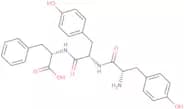
CAS:H-Tyr-Tyr-Phe-OH acetate salt is a reaction product of the matrix-assisted laser desorption ionization (MALDI) technique. It is an analog of tyrosine, with a hydroxyl group substituted for the amino group. The protonation state of this molecule has been determined by the hydration constant and the centroid to be a neutral pH. Using hydrogen bonding, H-Tyr-Tyr-Phe-OH acetate salt binds to the mitochondria in cells, which may lead to a higher rate of reaction.
Formula:C27H29N3O6Purity:Min. 95%Molecular weight:491.54 g/molAmylin (mouse, rat) trifluoroacetate
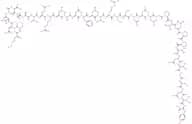
CAS:Amylin (mouse, rat) trifluoroacetate is a synthetic peptide, which is a derivative of the islet amyloid polypeptide (IAPP) found in rodent species. It is sourced from the pancreatic beta cells of mice and rats, where it is co-secreted with insulin. The mode of action involves regulation of glucose metabolism through its effects on gastric emptying, glucagon secretion, and satiety. These actions are crucial in managing postprandial blood glucose levels and provide insights into the pathophysiology of diabetes.Amylin (mouse, rat) trifluoroacetate is primarily used in research applications to study the mechanisms of amylin aggregation and its implications in type 2 diabetes. It also serves as a model for understanding the differences in amyloid fibril formation between human and rodent amylin, making it invaluable for the development of therapeutic strategies aimed at mitigating amyloid-related cellular toxicity. Researchers utilize this peptide to explore the potential compensatory roles of amylin analogs in diabetic models, advancing our understanding of diabetes progression and treatment options.Formula:C167H272N52O53S2•(C2HF3O2)xPurity:Min. 95%Molecular weight:3,920.4 g/molAmyloid beta/A4 Protein Precursor770 (394-410) trifluoroacetate salt
CAS:Please enquire for more information about Amyloid beta/A4 Protein Precursor770 (394-410) trifluoroacetate salt including the price, delivery time and more detailed product information at the technical inquiry form on this page
Formula:C86H151N31O26S2Purity:Min. 95%Molecular weight:2,099.44 g/molH-Leu-Trp-Met-Arg-Phe-Ala-OH acetate salt
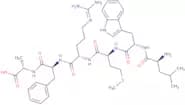
CAS:H-Leu-Trp-Met-Arg-Phe-Ala-OH acetate salt is a synthetic amino acid. It has been shown to be a substrate for peptidases and proteolytic enzymes, including serine protease. H-Leu-Trp-Met-Arg-Phe-Ala-OH acetate salt also has catalytic activity, which leads to the formation of methyl ketones. This product is used as an analytical reagent in the determination of specificities of proteolytic enzymes. It is also used to measure the activity of amyloid protein and peptidases.Formula:C40H58N10O7SPurity:Min. 95%Molecular weight:823.02 g/molGambogic acid
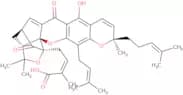
CAS:Gambogic acid is a xanthonoid compound, which is a naturally occurring product derived from the resin of Garcinia hanburyi, a tree found in Southeast Asia. It functions primarily through its apoptotic and anti-proliferative effects on cancer cells. Mechanistically, Gambogic acid binds to transferrin receptors, leading to the disruption of cell survival pathways, inhibition of the NF-kB signaling pathway, and induction of apoptosis by activating caspases and influencing mitochondrial pathways.Purity:Min. 95%Amyloid b-Protein (1-40) amide trifluoroacetate salt
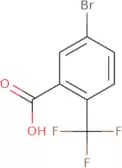
CAS:Please enquire for more information about Amyloid b-Protein (1-40) amide trifluoroacetate salt including the price, delivery time and more detailed product information at the technical inquiry form on this pageFormula:C194H296N54O57SPurity:Min. 95%Molecular weight:4,328.82 g/mol5-bromo-2-(trifluoromethyl)benzoic Acid
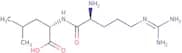
CAS:Please enquire for more information about 5-bromo-2-(trifluoromethyl)benzoic Acid including the price, delivery time and more detailed product information at the technical inquiry form on this pageFormula:C8H4BrF3O2Purity:Min. 95%Molecular weight:269.02 g/molH-Arg-Leu-OH acetate salt
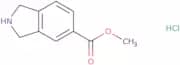
CAS:H-Arg-Leu-OH acetate salt is a synthetic version of the natural amino acid Arginine. It has been shown to have anti-inflammatory effects and to inhibit the growth of cancer cells in cell culture. H-Arg-Leu-OH acetate salt also inhibits the production of messenger RNA that leads to the synthesis of inflammatory proteins and growth factors, as well as light emission, which may be due to its effect on response elements in cells.Formula:C12H25N5O3Purity:Min. 95%Molecular weight:287.36 g/molMethyl isoindoline-5-carboxylate HCl
CAS:Please enquire for more information about Methyl isoindoline-5-carboxylate HCl including the price, delivery time and more detailed product information at the technical inquiry form on this pageFormula:C10H12ClNO2Purity:Min. 95%Molecular weight:213.66 g/molMethyl diethylphosphonoacetate
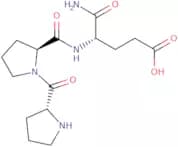
CAS:Methyl diethylphosphonoacetate is a chemical compound that contains a hydroxy group, an alkynyl group and a disulfide bond. It is used as a control agent in the production of polyurethane foams, and has also been shown to inhibit the growth of bladder cancer cells. The UV absorption peak at 220 nm can be used to identify this chemical compound. Methyl diethylphosphonoacetate reacts with proton to form diethylphosphonoacetate, which then undergoes an elimination reaction with fatty acids to form aliphatic hydrocarbons. This reaction mechanism was first proposed by Stork and co-workers in 1960. Methyl diethylphosphonoacetate also binds to thrombin receptor, which may lead to anti-inflammatory effects.Formula:C7H15O5PPurity:Min. 95%Molecular weight:210.16 g/molH-D-Pro-Pro-Glu-NH2 trifluoroacetate salt
CAS:Please enquire for more information about H-D-Pro-Pro-Glu-NH2 trifluoroacetate salt including the price, delivery time and more detailed product information at the technical inquiry form on this pageFormula:C15H24N4O5Purity:Min. 95%Molecular weight:340.38 g/mol