Carboxylic Acids
Carboxylic acids are organic molecules characterized by having a carboxyl-type functional group (-COOH). These acids are fundamental in various chemical reactions, including esterification, amidation, and decarboxylation. Carboxylic acids are widely used in the production of pharmaceuticals, polymers, and agrochemicals. In this section, you can find a large number of carboxylic acids ready to be used. At CymitQuimica, we provide a broad range of high-quality carboxylic acids to support your research and industrial applications.
Found 12454 products of "Carboxylic Acids"
Sort by
Purity (%)
0
100
|
0
|
50
|
90
|
95
|
100
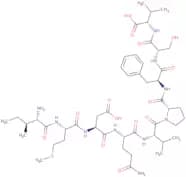
(Met186)-Melanocyte Protein PMEL 17 (185-193) (human, bovine, mouse) trifluoroacetate salt
CAS:<p>Please enquire for more information about (Met186)-Melanocyte Protein PMEL 17 (185-193) (human, bovine, mouse) trifluoroacetate salt including the price, delivery time and more detailed product information at the technical inquiry form on this page</p>Formula:C47H74N10O14SPurity:Min. 95%Molecular weight:1,035.22 g/molH-Met-AMC acetate salt
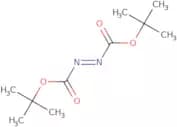
CAS:Please enquire for more information about H-Met-AMC acetate salt including the price, delivery time and more detailed product information at the technical inquiry form on this pageFormula:C15H18N2O3SPurity:Min. 95%Molecular weight:306.38 g/molDi-tert-butyl azodicarboxylate
CAS:<p>Di-tert-butyl azodicarboxylate (DTBA) is an organic compound that is used in organic synthesis as a dienophile. DTBA reacts with various electrophiles to form dihydro derivatives through a transfer mechanism, which can be monitored by the change in magnetic resonance spectroscopy signals. The reaction of DTBA with trifluoroacetic acid and hydrogen chloride forms the desired product, 3-amino-2,4,6-trichloropyridine. DTBA is also used for the synthesis of 1,4-dihydropyridines from 2-aminobenzene derivatives and bromoacetaldehyde diethyl acetal. This process is catalyzed by palladium on carbon. DTBA is asymmetric at position C5 and C6 because it has two chiral centers: one at C3 and one at C5 or C6. The use of this reagent allows for the scalable</p>Formula:C10H18N2O4Purity:Min. 98%Color and Shape:PowderMolecular weight:230.26 g/mol(D-Arg2)-Kyotorphin acetate salt
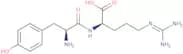
CAS:<p>(D-Arg2)-Kyotorphin acetate salt H-Tyr-D-Arg-OH acetate salt is a peptide that contains two amino acid residues, D-arginine and L-tyrosine. It has been shown to have analgesic properties in animal models of pain, and is also thought to be involved with bowel disease, congestive heart failure, and platelet aggregation. The biological activity of this peptide has been studied using whole cell recordings in the presence of an experimental model (rat dorsal root ganglion neurons). Kyotorphin acetate salt H-Tyr-D-Arg-OH acetate salt was found to inhibit enzyme activities such as cyclase and phosphodiesterase. This peptide binds to opioid receptors and acts as an electrochemical detector for cyclases, which are enzymes that produce cyclic adenosine monophosphate (cAMP). Kyotorphin acetate salt H-Tyr-D</p>Formula:C15H23N5O4Purity:Min. 95%Molecular weight:337.37 g/mol2-Hydrazinobenzoic acid hydrochloride - technical grade
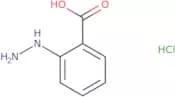
CAS:2-Hydrazinobenzoic acid hydrochloride is a synthetic compound that can be used as a ligand or substrate for the polymerase. It has been shown to interact with the NS5B polymerase, which is involved in viral replication and drug resistance. 2-Hydrazinobenzoic acid hydrochloride also produces reduction products and luminescence when combined with chloride. The luminescence is thought to be due to an interaction with the nucleophilic carbonyl group of 2-hydrazinobenzoic acid hydrochloride and a nucleophilic attack on the carbonyl oxygen atom by chloride ions. This reaction produces blue light at around 470 nm.Formula:C7H8N2O2·xHClPurity:(%) Min. 60%Color and Shape:PowderMolecular weight:188.61 g/molNeuronostatin-19 (mouse, rat) trifluoroacetate salt
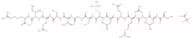
<p>Please enquire for more information about Neuronostatin-19 (mouse, rat) trifluoroacetate salt including the price, delivery time and more detailed product information at the technical inquiry form on this page</p>Formula:C91H153N29O26Purity:Min. 95%Molecular weight:2,069.37 g/molHeat Shock Protein (hsp) Fragment trifluoroacetate salt
CAS:<p>Please enquire for more information about Heat Shock Protein (hsp) Fragment trifluoroacetate salt including the price, delivery time and more detailed product information at the technical inquiry form on this page</p>Formula:C63H113N22O25PSPurity:Min. 95%Molecular weight:1,641.74 g/mol(Asn670,Leu671)-Amyloid b/A4 Protein Precursor770 (667-676) trifluoroacetate salt
CAS:<p>Please enquire for more information about (Asn670,Leu671)-Amyloid b/A4 Protein Precursor770 (667-676) trifluoroacetate salt including the price, delivery time and more detailed product information at the technical inquiry form on this page</p>Formula:C50H78N14O19Purity:Min. 95%Molecular weight:1,179.24 g/molH-Cit-AMC trifluoroacetate salt
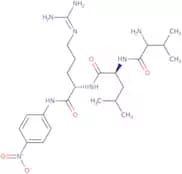
CAS:<p>Please enquire for more information about H-Cit-AMC trifluoroacetate salt including the price, delivery time and more detailed product information at the technical inquiry form on this page</p>Formula:C16H20N4O4Purity:Min. 95%Molecular weight:332.35 g/molH-DL-Val-Leu-Arg-pNA acetate salt
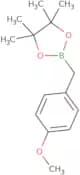
CAS:<p>H-DL-Val-Leu-Arg-pNA acetate salt is a natriuretic that is used to treat chronic kidney failure. It has an inhibitory effect on serine protease and epidermal growth factor, which are enzymes involved in the production of atrial natriuretic peptide (ANP). The drug also reduces blood pressure by inhibiting the activity of angiotensin II, which is a potent vasoconstrictor. H-DL-Val-Leu-Arg-pNA acetate salt has been shown to increase urea nitrogen levels by inhibiting the activity of alkaline phosphatase, which breaks down ammonia in the liver.</p>Formula:C23H38N8O5Purity:Min. 95%Molecular weight:506.6 g/mol4-Methoxybenzylboronic acid pinacolester
CAS:<p>Please enquire for more information about 4-Methoxybenzylboronic acid pinacolester including the price, delivery time and more detailed product information at the technical inquiry form on this page</p>Formula:C14H21BO3Purity:Min. 95%Molecular weight:248.13 g/mol(3-(4-Azidophenyl)propionyl1,D-Tyr(Me)2,Arg6,Arg8,Tyr-NH29)-Vasopressin trifluoroacetate salt
CAS:<p>Please enquire for more information about (3-(4-Azidophenyl)propionyl1,D-Tyr(Me)2,Arg6,Arg8,Tyr-NH29)-Vasopressin trifluoroacetate salt including the price, delivery time and more detailed product information at the technical inquiry form on this page</p>Formula:C63H84N20O13Purity:Min. 95%Molecular weight:1,329.47 g/molGRF (ovine, caprine) trifluoroacetate salt
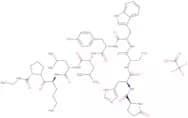
CAS:Growth hormone-releasing factor (GRF) or GHRH (growth hormone-releasing hormone).Binds to the growth hormone-releasing hormone receptor (GHRH-R), causing growth hormone secretion.porcine: H-YADAIFTNSYRKVLGQLSARKLLQDIMSRQQGERNQEQGARVRL-NH2bovine: H-YADAIFTNSYRKVLGQLSARKLLQDIMNRQQGERNQEQGAKVRL-NH2ovine: H-YADAIFTNSYRKILGQLSARKLLQDIMNRQQGERNQEQGAKVRL-NH2human: H-YADAIFTNSYRKVLGQLSARKLLQDIMSRQQGESNQERGARARL-NH2Formula:C221H368N72O66SPurity:Min. 95%Molecular weight:5,121.8 g/mol(Des-Gly10,D-Leu6, Orn 8,Pro-NHEt 9)-LHRH trifluoroacetate salt
CAS:<p>Please enquire for more information about (Des-Gly10,D-Leu6, Orn 8,Pro-NHEt 9)-LHRH trifluoroacetate salt including the price, delivery time and more detailed product information at the technical inquiry form on this page</p>Formula:C58H82N14O12Purity:Min. 95%Molecular weight:1,167.36 g/molGLP-1 (1-37) (human, bovine, guinea pig, mouse, rat) trifluoroacetate salt
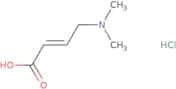
CAS:<p>GLP-1 (1-37) (human, bovine, guinea pig, mouse, rat) trifluoroacetate salt is a posttranslational modification of the endogenous human hormone GLP-1. It is a synthetic form of this hormone that has been modified to allow for improved stability and solubility. This peptide is found in the pancreatic alpha cells and intestinal L cells and stimulates the release of insulin from pancreatic beta cells. GLP-1 (1-37) (human, bovine, guinea pig, mouse, rat) trifluoroacetate salt has also been shown to increase glucose uptake by muscle tissue as well as stimulate the release of incretin hormones such as glucagon-like peptide 1 and gastric inhibitory polypeptide. GLP-1 (1-37) (human, bovine, guinea pig, mouse, rat) trifluoroacetate salt</p>Formula:C186H275N51O59Purity:Min. 95%Molecular weight:4,169.48 g/moltrans 4-Dimethylaminocrotonic acid HCl
CAS:<p>Intermediate in the synthesis of afatinib</p>Formula:C6H12ClNO2Purity:Min. 95%Color and Shape:White To Off-White SolidMolecular weight:165.62 g/mol(D-Ala2,N-Me-Phe4,methionin(O)-ol5)-Enkephalin trifluoroacetate salt
CAS:<p>D-Ala2,N-Me-Phe4,methionin(O)-ol5)-Enkephalin trifluoroacetate salt H-Tyr-D-Ala-Gly-N-Me-Phe-methionin(O)-ol trifluoroacetate salt is an analog of the endocannabinoid neurotransmitter, anandamide. It has been shown to be effective in the treatment of autoimmune diseases such as multiple sclerosis and inflammatory bowel disease. D-(3R)-3-[(1S,2R,3R,5R) -3-[2-(2,6 dichlorophenyl)ethenyl] -1H -indole]-1 -butanamine trifluoroacetate salt has been shown to inhibit the replication of a number of viruses including human immunodeficiency virus type 1 (HIV). This drug also inhibits the growth of organisms that are resistant</p>Formula:C29H41N5O7SPurity:Min. 95%Molecular weight:603.73 g/molNeuropeptide FF (5-8) acetate salt
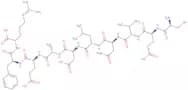
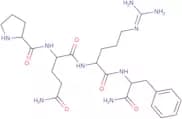
CAS:<p>Please enquire for more information about Neuropeptide FF (5-8) acetate salt including the price, delivery time and more detailed product information at the technical inquiry form on this page</p>Formula:C25H39N9O5Purity:Min. 95%Molecular weight:545.63 g/molH-Nle-Arg-Phe-NH2 acetate salt
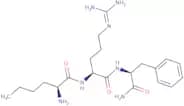
CAS:<p>Please enquire for more information about H-Nle-Arg-Phe-NH2 acetate salt including the price, delivery time and more detailed product information at the technical inquiry form on this page</p>Formula:C21H35N7O3Purity:Min. 95%Molecular weight:433.55 g/mol3-Amino-4-hydroxybenzoic acid hydrochloride
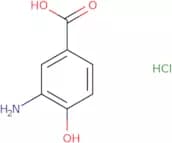
CAS:<p>3-Amino-4-hydroxybenzoic acid hydrochloride (3ABA) is a crystalline compound with a molecular formula of C6H5NO2. It is an acidic compound that is soluble in water and alcohol, but not in ether. 3ABA has been used as the starting material for the synthesis of many other organic compounds. It can be obtained by reacting phenol with chlorobenzoyl chloride to form the chlorobenzoate salt, which on hydrolysis yields 3ABA. This compound has also been used as a reagent for synthesizing carbon nanotubes. The crystal structure of 3ABA was determined using X-ray diffraction data from crystallographic studies, and it was found to have three independent molecules per unit cell. Diffraction indicated that each molecule is composed of two benzene rings joined by a single bond between carbon atoms 1 and 2 and another bond between carbon atoms 2 and 3.</p>Formula:C7H8ClNO3Purity:Min. 95%Molecular weight:189.6 g/mol