Pharmaceutical Standards
Subcategories of "Pharmaceutical Standards"
- APIs for research and impurities(275,018 products)
- Enzyme Activators and Inhibitors(2,827 products)
- Nitrosamines(2,606 products)
- Pharmaceutical and Veterinary Compounds and Metabolites(2,888 products)
- Toxicology(13,643 products)
Found 7836 products of "Pharmaceutical Standards"
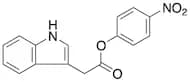
4-Nitrophenyl 1H-Indole-3-acetic Acid Ester
CAS:Controlled ProductApplications 4-Nitrophenyl 1H-Indole-3-acetic Acid Ester is an intermediate used in the synthesis of Indole-3-acetyl-L-aspartic Acid (I577370), which is an indole-3-acetyl-amino acid conjugate involved in regulatory mechanisms for the control of auxin activity during physiological and pathophysiological responses.
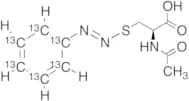
References Ostrowski, M., et al.: J Plant Physiol, 191, 63-72 (2016)Formula:C16H12N2O4Color and Shape:NeatMolecular weight:296.277(R,E)-2-Acetamido-3-((phenyldiazenyl)thio)propanoic-13C6 Acid
Controlled ProductApplications (R,E)-2-Acetamido-3-((phenyldiazenyl)thio)propanoic-13C6 Acid is labelled N-Acetyl-S-phenyl-L-cysteine (P335600), which is an important metabolite of Benzene.
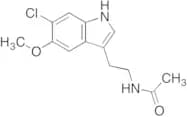
References Muller, G., et al.: Anal. Hazard. Subst. Biol. Mater., 5, 143 (1997)Formula:C6C5H13N3O3SColor and Shape:NeatMolecular weight:273.266-Chloromelatonin
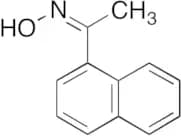
CAS:Controlled ProductFormula:C13H15ClN2O2Color and Shape:NeatMolecular weight:266.723(Z)-1-(1-Naphthalenyl)ethanone Oxime
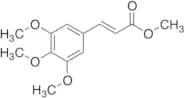
CAS:Controlled ProductFormula:C12H11NOColor and Shape:NeatMolecular weight:185.222Methyl 3,4,5-Trimethoxycinnamate
CAS:Controlled ProductApplications Methyl 3,4,5-trimethoxycinnamate (cas# 7560-49-8) is a useful research chemical.
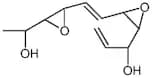
Formula:C13H16O5Color and Shape:NeatMolecular weight:252.26(8Z,11Z,14Z,17Z)-Eicosatetraenoic Acid Methyl Ester
CAS:Controlled ProductFormula:C21H34O2Color and Shape:ColourlessMolecular weight:318.4935(2R,3S)-rel-3-Hexyl-2-oxiranenonanoic acid methyl ester-d3
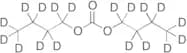
CAS:Controlled ProductFormula:C18H31D3O3Color and Shape:NeatMolecular weight:449.928Dibutyl Carbonate-d18
CAS:Controlled ProductApplications Dibutyl Carbonate-d18 is the deuterated form of Dibutyl Carbonate (D427995), which is a potential fuel substitute due to the observed decrease in CO2 emissions. Also used in CO2 catalytic activation.
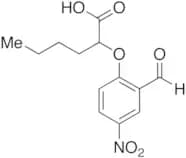
References Hellier, P. et al.: Energy Fuel, 27, 5222 (2013); Shang, J. et al.: Green Che,., 14, 2899 (2012);Formula:C9D18O3Color and Shape:NeatMolecular weight:192.3482-(2'-Formyl-4'-nitrophenoxy)caproic Acid
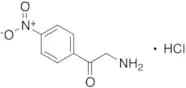
CAS:Controlled ProductFormula:C13H15NO6Color and Shape:NeatMolecular weight:281.2612-Amino-1-(4-nitrophenyl)ethanone Hydrochloride
CAS:Controlled ProductApplications 2-AMINO-1-(4-NITROPHENYL)ETHANONE HYDROCHLORIDE (cas# 5425-81-0) is a useful research chemical.
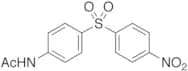
Formula:C8H8N2O3·HClColor and Shape:NeatMolecular weight:180.16 + (36.46)4-Nitro-4’-acetylaminodiphenyl Sulfone
CAS:Controlled ProductApplications An intermediate in the synthesis of the Daspone metabolite.
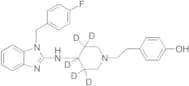
Formula:C14H12N2O5SColor and Shape:NeatMolecular weight:320.32O-Desmethyl Astemizole-d5
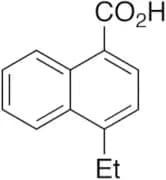
CAS:Controlled ProductFormula:C27D5H24FN4OColor and Shape:NeatMolecular weight:449.5754-Ethyl-1-naphthoic Acid
CAS:Controlled ProductApplications Used in the preparation of antimalarial compounds. It also shows some plant-growth activity.
References Bachmann, W. et al.: J. Am. Chem. Soc. 72, 4911 (1950); Fujita, T. et al.: Agr. Biol. Chem. 25, 719 (1961)Formula:C13H12O2Color and Shape:NeatMolecular weight:200.232-Hydroxy-3-(carboxymethylamino)-hydrocinnamic Acid, Dipotassium Salt
CAS:Controlled ProductApplications 2-Hydroxy-3-(carboxymethylamino)-hydrocinnamic Acid, Dipotassium Salt (cas# 100750-38-7 ) is a compound useful in organic synthesis.
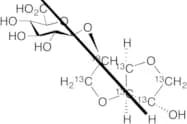
Formula:C11H11K2NO5Color and Shape:NeatMolecular weight:315.41Isosorbide 5-β-D-Glucuronide-13C6
CAS:Controlled ProductFormula:C6C6H18O10Color and Shape:NeatMolecular weight:328.2216-Bromo-3,4-dihydro-1H-[1,8]naphthyridin-2-one
CAS:Controlled ProductApplications 6-Bromo-3,4-dihydro-1H-[1,8]naphthyridin-2-one (cas# 129686-16-4) is a compound useful in organic synthesis.
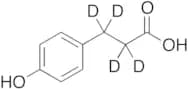
Formula:C8H7BrN2OColor and Shape:Off-White To YellowMolecular weight:227.063-(4-Hydroxyphenyl)propionic Acid-d4
CAS:Controlled ProductApplications 3-(4-Hydroxyphenyl)propionic Acid-d4 is the deuterated isotope of 3-(4-Hydroxyphenyl)propionic Acid (H9508200). Antioxidant
References Arnous, A., et al.: J. Agr. Food Chem., 49, 5736 (2001)Formula:C9D4H6O3Color and Shape:NeatMolecular weight:170.198




![6-Bromo-3,4-dihydro-1H-[1,8]naphthyridin-2-one](/_next/image/?url=https%3A%2Fstatic.cymitquimica.com%2Fproducts%2FTR%2Fthumb-webp%2FB684035.webp&w=3840&q=75)