Glycoscience
Glycoscience is the study of carbohydrates and their derivatives, as well as the interactions and biological functions they participate in. This field of research is crucial for understanding a wide variety of biological processes, including cell recognition, signaling, immune response, and disease development. Glycoscience has important applications in biotechnology, medicine, and the development of new drugs and therapies. At CymitQuimica, we offer a wide selection of high-quality, high-purity products for glycoscience research. Our catalog includes monosaccharides, oligosaccharides, polysaccharides, glycoconjugates, and specific reagents, designed to support researchers in their studies on the structure, function, and applications of carbohydrates in biological systems. These resources are intended to facilitate scientific discoveries and practical applications in various areas of bioscience and medicine.
Subcategories of "Glycoscience"
- Aminosugars(108 products)
- Glyco-Related Antibodies(282 products)
- Glycolipids(46 products)
- Glycosaminoglycans (GAGs)(55 products)
- Glycosides(419 products)
- Monosaccharides(6,624 products)
- Oligosaccharides(3,682 products)
- Polysaccharides(503 products)
Found 11046 products of "Glycoscience"
Sort by
Purity (%)
0
100
|
0
|
50
|
90
|
95
|
100
6-Deoxy-3,5-O-[(R)-benzylidene]-L-gluconic acid g-lactone
CAS:6-Deoxy-3,5-O-[(R)-benzylidene]-L-gluconic acid g-lactone is a synthetic sugar that is used in the synthesis of complex carbohydrates. It can be modified with fluorination, glycosylation, and methylation reactions to produce other derivatives. 6-Deoxy-3,5-O-[(R)-benzylidene]-L-gluconic acid g-lactone has CAS No. 322726-64-7 and a molecular weight of 247.Purity:Min. 95%5'-O-(2-Amino-2-deoxy-D-glucopyranosyl) cytidine
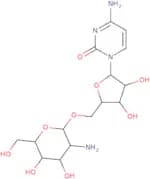
CAS:<p>5'-O-(2-Amino-2-deoxy-D-glucopyranosyl) cytidine is a synthetic carbohydrate, which can be modified in a variety of ways to create custom glycoproteins. This product can be used for glycosylation and polysaccharide synthesis. It has been fluorinated with trifluoromethanesulfonic acid to allow for click modifications, methylated, or sugar modified. The purity of this product is high and the CAS number is 631842-23-4.</p>Formula:C15H24N4O9Purity:Min. 95%Molecular weight:404.37 g/molUDP-2-deoxy-2-fluoro-D-galactose
CAS:<p>UDP-2-deoxy-2-fluoro-D-galactose is a methylated and fluorinated saccharide that is used in click chemistry. It is a synthetic compound that can be custom synthesized to create polysaccharides or oligosaccharides. This product has high purity and can be modified with glycosylation, methylation, and other modifications.</p>Formula:C15H23FN2O16P2Purity:Min. 98 Area-%Color and Shape:PowderMolecular weight:568.29 g/mol3-(N-(3R, 4R) -3, 4-Dihydroxy- L- prolinyl)-propanoic acid
<p>3-(N-(3R, 4R) -3, 4-Dihydroxy- L- prolinyl)-propanoic acid is a synthetic compound. It is a sugar that can be modified with fluorination and methylation to produce 3-(N-(3R,4S)-3,4-dihydroxy-L-prolinyl)-propanoic acid. This product can be used for glycosylation of oligosaccharides or sugars. It has high purity and is available in bulk quantities.</p>Purity:Min. 95%3-O-Acetyl-1,2:5,6-di-O-isopropylidene-α-D-glucofuranose
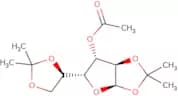
CAS:<p>3-O-Acetyl-1,2:5,6-di-O-isopropylidene-a-D-glucofuranose is a synthetic sugar that contains an acetyl group at the C3 position and an isopropylidene group at the C6 position. It can be fluorinated at either the C3 or C6 position to produce 3-fluoro-, 3,5-, or 3,6-diacetyl derivatives. This molecule has a molecular weight of 514.2 g/mol and a melting point of 158 °C. It has been used in glycosylation reactions to prepare oligosaccharides for use as nonfouling materials and as biomaterials for drug delivery.</p>Formula:C14H22O7Purity:Min. 95%Color and Shape:PowderMolecular weight:302.32 g/mola-Cyclodextrin
CAS:<p>α-Cyclodextrin is a cyclic oligosaccharide with 6 D-glucose residues which are α-1,4-linked. α-cyclodextrin is used in the food industry to encapsulate flavors and fragrances (Kfoury, 2016). α-cyclodextrin is also an effective inhibitor of the upstream inflammatory response induced by cholesterol crystals. Cholesterol crystal-induced complement activation is a critical step in the development of atherosclerosis, thus inhibition of complement with α-cyclodextrin has the potential to be used in the treatment of atherosclerosis (Pilely, 2019).</p>Formula:C36H60O30Purity:Min. 90.0 Area-%Molecular weight:972.84 g/molMethyl 2,3,4-tri-O-benzyl-6-O-tert-butyldiphenylsilyl-a-D-galactopyranoside
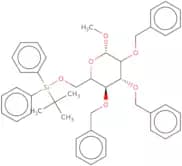
<p>Methyl 2,3,4-tri-O-benzyl-6-O-tert-butyldiphenylsilyl-a-D-galactopyranoside is a synthetic sugar that is used in the synthesis of complex carbohydrates. It has been shown to be useful in glycosylation reactions by preparing glycosides of amino acids and peptides. This compound can also be modified with methyl groups to create a variety of derivatives. Methyl 2,3,4-tri-O-benzyl-6-O-tert-butyldiphenylsilyl--a--D--galactopyranoside has a CAS number and is sold as a high purity product.</p>Formula:C44H50O6SiPurity:Min. 95%Molecular weight:702.95 g/molMethyl (methyl-4-deoxy-α-L-threo-hex-4-enopyranosid)uronate
CAS:<p>Methyl (methyl-4-deoxy-alpha-L-threo-hex-4-enopyranosid)uronate is an intermediate in the synthesis of saccharides. It is a custom synthesis product that has been fluorinated and is available with a high purity. Methyl (methyl-4-deoxy-alpha-L-threo-hex-4-enopyranosid)uronate can be used for modification of oligosaccharides, glycosylation, click chemistry, and polysaccharide synthesis.</p>Formula:C8H12O6Purity:Min. 95%Molecular weight:204.18 g/mol4-Methoxyphenyl a-D-mannopyranoside
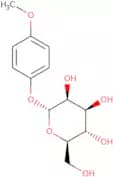
CAS:<p>4-Methoxyphenyl a-D-mannopyranoside is a fluorinated monosaccharide. It is synthesized by the reaction of 4-methoxyphenol with an aldose in the presence of sodium hydroxide and sulfuric acid. The product is purified by chromatography with silica gel and eluted with methanol. This compound is also used to produce polysaccharides, glycosyls, oligosaccharides, or complex carbohydrates through glycosylation or polysaccaride synthesis. 4-Methoxyphenyl a-D-mannopyranoside can be modified to produce methylated, acetalized, or deoxygenated derivatives for use in click chemistry reactions.</p>Formula:C13H18O7Purity:Min. 95%Color and Shape:White PowderMolecular weight:286.28 g/mol1,4-β-D-Xylobiitol
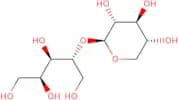
CAS:<p>1,4-β-D-Xylobiitol is a monosaccharide that is synthesized by the glycosylation of β-D-xylose. It is an important component of complex carbohydrates found in plants and animals. Xylobiitol can be modified with methylation or Click chemistry to produce 1,4-β-D-xylopyranosiduronic acid and 1,4-β-D-xylopyranuronic acid respectively. In addition, it can be fluorinated to create 1,4-β-D-fluoroxylobiitol and modified with saccharide or oligosaccharides to produce 1,4-[α]-,1,3-[α]- or 1,3-[β]-linked xylobiitols. Xylobiitol can also be modified with polysaccharides to form xylanolybioside conjugates in which GlcUA residues are linked</p>Formula:C10H20O9Purity:Min. 95%Color and Shape:PowderMolecular weight:284.26 g/mol2-Azido-2-deoxy-L-lyxono-1,4-lactone
<p>2-Azido-2-deoxy-L-lyxono-1,4-lactone is a fluorinated monosaccharide. It is synthesized using the Curtius rearrangement of 2-azidoethyl 4,6-dioxohexanoate and a Lewis acid. This compound is used as an intermediate in the synthesis of glycosylides and polysaccharides. The methylation of this molecule has been shown to be useful for the modification of carbohydrates, such as polysaccharides. The product purity can be as high as 98% when it is custom synthesized to order.</p>Purity:Min. 95%N-Acetyl-9-O-(N-acetyl-a-neuraminosyl)-neuraminic acid
CAS:N-Acetyl-9-O-(N-acetyl-a-neuraminosyl)-neuraminic acid is a synthetic, fluorinated monosaccharide that is used in the synthesis of glycosides and polysaccharides. It can be custom synthesized to any desired purity. This chemical has many modifications, including methylation, esterification, and glycosylation. The CAS number for this product is 96425-77-3.Formula:C22H36N2O17Purity:Min. 95%Molecular weight:600.52 g/molβ-D-Thiogalactose sodium
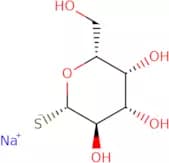
CAS:β-D-Thiogalactose sodium (DTGS) is a radiometric technique that evaluates the profiles of gases by measuring their molecular weights. DTGS is used to measure gas concentrations in the atmosphere, which are transferred to positions on a map. The DTGS technique is validated and calibrated by comparing its measurements with those of other techniques, such as infrared spectroscopy. It can be used to evaluate water vapor and other gases in the atmosphere. This technique has been shown to have accurate results at temperatures ranging from −5°C up to 100°C and at frequencies from 1 Hz up to 10 MHz.Formula:C6H11NaO5SPurity:Min. 95%Color and Shape:PowderMolecular weight:218.2 g/mol1,2,3,6-Tetra-O-acetyl-4-O-[2,4,6-tri-O-acetyl-3-O-(2-acetamido-3,4,6-tri-O-acetyl-2-deoxy-b-D-glucopyranosyl)-b-D-galactopyranosyl] -b-D-glucopyranose
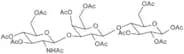
<p>Tetracose is a complex carbohydrate that is composed of 1,2,3,6-tetra-O-acetyl-4-O-[2,4,6-tri-O-acetyl-3-O-(2 acetamido)-β-D-galactopyranosyl]-β-D-glucopyranose and β--D--galactopyranosyl. Tetracose is a high purity custom synthesis sugar. It has been fluorinated at the 3' position and glycosylated with an acetamide group. Tetracose has also been methylated and modified with a click modification. Tetracose has CAS No.: 145925-75-5</p>Formula:C40H55NO26Purity:Min. 95%Molecular weight:965.86 g/molN,N'-Diacetylchitobiose
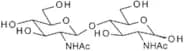
CAS:<p>Carbon source for E. coli; inhibitor of lysozymes</p>Formula:C16H28N2O11Purity:Min. 95%Color and Shape:White PowderMolecular weight:424.4 g/molMethyl 3-O-(2-acetamido-2-deoxy-b-D-galactopyranosyl)-a-D-galactopyranoside
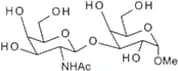
CAS:Methyl 3-O-(2-acetamido-2-deoxy-b-D-galactopyranosyl)-a-D-galactopyranoside is a sugar that is synthesized by the Click modification of 3,4,6-trihydroxybenzoic acid and 2,3,6,7,8-pentahydroxyacetophenone. This sugar is used in glycosylation reactions to modify proteins or peptides.Formula:C15H27NO11Purity:Min. 95%Color and Shape:White PowderMolecular weight:397.38 g/mol5-Fluorouridine 5'-Diphosphate Galactose
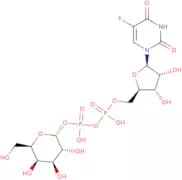
CAS:5-Fluorouridine 5'-Diphosphate Galactose is a nucleotide that is used as an inhibitor of thymidylate synthase. It is a chemotherapeutic agent that inhibits the production of DNA and RNA, which leads to the death of tumor cells. 5-Fluorouridine 5'-Diphosphate Galactose binds to a specific site on the enzyme thymidylate synthase, preventing it from catalyzing the conversion of thymine to thymine monophosphate. This prevents DNA synthesis and also causes the death of tumor cells due to lack of DNA and RNA synthesis. 5-Fluorouridine 5'-Diphosphate Galactose is synthesized from uracil and galactose. It is converted into 5-fluorouridine 5'-diphosphate by pyrophosphatase, which then reacts with ATP or GTP to form 5-fluorouridineFormula:C15H23FN2O17P2Purity:Min. 95%Molecular weight:584.29 g/molMethyl 2,3,5-tri-O-(p-chlorobenzoyl)-β-D-ribofuranoside
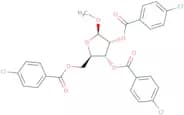
CAS:<p>Methyl 2,3,5-tri-O-(p-chlorobenzoyl)-b-D-ribofuranoside is a custom synthesis that has been modified with fluorination and methylation. It is a monosaccharide that can be synthesized by the reaction of 3,5-di-O-(p-chlorobenzoyl)ribose with formaldehyde. Methyl 2,3,5-tri-O-(p-chlorobenzoyl)-b-D-ribofuranoside can be used in saccharide or glycosylation reactions to produce oligosaccharides or polysaccharides. This chemical is also useful for click chemistry modifications.</p>Formula:C27H21Cl3O8Purity:Min. 95%Color and Shape:White to off-white solid.Molecular weight:579.81 g/mol(3S, 4S, 5S) -3, 4-Dihydroxy- 5- (hydroxymethyl) - L- proline
CAS:(3S, 4S, 5S) -3, 4-Dihydroxy-5-(hydroxymethyl) -L-proline (1) is a modification of the amino acid proline. It is an oligosaccharide with a complex carbohydrate structure. The molecular weight of the compound was determined to be 1,664.1 g/mol by mass spectrometry analysis. This product is available for custom synthesis and can be purchased in high purity and synthetic form. It also has a CAS number of 1225455-73-1 and its chemical name is 3-[(2R)-2-(3,4-dihydroxypropanoyloxy)] -4-[(2R)-2-(3,4-dihydroxypropanoyloxy)] -5-[(2R)-2-(hydroxymethyl)oxido] -L-proline.Formula:C6H11NO5Purity:Min. 95%Molecular weight:177.16 g/molHyaluronic acid sodium salt - Average MW 70,000-80,000
CAS:<p>Gycosaminoglycan in many organs; joint lubricant and shock absorber</p>Formula:(C14H20NO11Na)nPurity:Min. 90 Area-%Color and Shape:Powder
![6-Deoxy-3,5-O-[(R)-benzylidene]-L-gluconic acid g-lactone](/_next/image/?url=https%3A%2Fstatic.cymitquimica.com%2Fproducts%2F3D%2Fthumb-webp%2FMD163973.webp&w=3840&q=75)