Glycoscience
Glycoscience is the study of carbohydrates and their derivatives, as well as the interactions and biological functions they participate in. This field of research is crucial for understanding a wide variety of biological processes, including cell recognition, signaling, immune response, and disease development. Glycoscience has important applications in biotechnology, medicine, and the development of new drugs and therapies. At CymitQuimica, we offer a wide selection of high-quality, high-purity products for glycoscience research. Our catalog includes monosaccharides, oligosaccharides, polysaccharides, glycoconjugates, and specific reagents, designed to support researchers in their studies on the structure, function, and applications of carbohydrates in biological systems. These resources are intended to facilitate scientific discoveries and practical applications in various areas of bioscience and medicine.
Subcategories of "Glycoscience"
- Aminosugars(108 products)
- Glyco-Related Antibodies(282 products)
- Glycolipids(46 products)
- Glycosaminoglycans (GAGs)(55 products)
- Glycosides(419 products)
- Monosaccharides(6,622 products)
- Oligosaccharides(3,682 products)
- Polysaccharides(503 products)
Found 11041 products of "Glycoscience"
Sort by
Purity (%)
0
100
|
0
|
50
|
90
|
95
|
100
λ-Carrageenan
CAS:<p>Lambda-Carrageenan is a non-gelling sulphated galactan extracted from red seaweed (typically Gigartina stellata and Chondrus crispus). The structure of all carrageenans consists of a strictly alternating masked repeating unit of 1,3-linked α-D-galactose and 1,4-linked β-D-galactose. λ-Carrageenan has the α-linked unit 2-6-disulphated and the β-linked unit is 2-sulphated.<br>The image was kindly provided by Prof Mike Guiry from Cork who runs ‘The Seaweed Site’.</p>Color and Shape:PowderMolecular weight:1140.922-Azidomethyl-2-deoxy-3,4-O-isopropylidene-4-C-methyl-L-ribono-1.5-lactone
<p>2-Azidomethyl-2-deoxy-3,4-O-isopropylidene-4-C-methyl-L-ribono-1.5-lactone is a modification of the sugar molecule ribose. It is synthesized by the methylation of 2,6 anhydroglucose with formaldehyde and sodium azide in methanol. This modification prevents the formation of cyclic hemiacetals and epimerization reactions that may occur during glycosylation or polysaccharide formation. 2A diol has been used as a model for oligosaccharides, carbohydrates, and complex carbohydrates. It is highly purified, has a CAS number, and can be used in custom synthesis projects.</p>Purity:Min. 95%GD1a-Ganglioside sodium
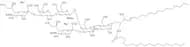
CAS:<p>GD1a (shown as sodium salt) is one of the major gangliosides in neuronal and glial membranes. It has a core tetrasaccharide structure (Galβ1,3GalNAcβ1,4Galβ1,4Glc) with sialic acids linked α2,3/α2,8 to the inner galactose residue, α2,3 to the outer galactose residue and ceramide linked β to position 1 on the reducing terminal glucose residue (Ledeen, 2009). It interacts with myelin-associated glycoprotein (MAG) and is essential for long-term axon-myelin stability. It plays a role in viral infection as it is a receptor for viral glycoproteins in rotavirus and paramyxovirus 1. The hexasaccharide GD1a moiety was also found on a glycoprotein that acts as a receptor for adenovirus type 37. GD1a ganglioside also interacts with botulinum neurotoxin and is crucial for its entry into cells (Kolter, 2012).</p>Formula:C84H148N4O39·xNaPurity:Min. 95%Color and Shape:White PowderMolecular weight:1,838.08 g/molMaltodextrin, dextrose equivalent 10-15
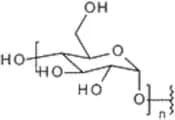
CAS:<p>Ex starch-partial hydrolysis,food ingredient, moderatly sweet, easily digested</p>Color and Shape:Powder2,3:4,5-Di-O-isopropylidene-D-arabinose
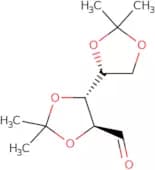
CAS:<p>Synthetic building block</p>Formula:C11H18O5Purity:Min. 95%Color and Shape:Colorless PowderMolecular weight:230.26 g/molD-Xylonic-1,4-lactone
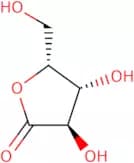
CAS:<p>D-Xylonic acid-1,4-lactone is a substrate that participates in the synthesis of glyceric acid. It has been shown to be a synthetic substrate for benzyl groups and leukemia HL-60 cells. D-Xylonic acid-1,4-lactone can react with chloride ions to form D-xylose. The product of this reaction is an epimerization reaction that occurs when the hydroxyl group on the carbon atom adjacent to the carbonyl group (C1) reacts with a proton from water to form a double bond at C2. This conversion produces xylonic acid and lactone.</p>Formula:C5H8O5Purity:Min. 97 Area-%Color and Shape:White PowderMolecular weight:148.11 g/molMethyl 6-O-acetyl-3-O-benzyl-2-benzyloxycarbonylamino-2-deoxy-a-D-glucopyranoside
CAS:<p>Methyl 6-O-acetyl-3-O-benzyl-2-benzyloxycarbonylamino-2-deoxy-a-Dglucopyranoside is a synthetic sugar with an acetyl group at the 6th position and a benzyloxycarbonyl group at the 3rd position. This sugar has been modified to produce complex carbohydrates, oligosaccharides, and polysaccharides. Methyl 6-O-acetyl 3 -O -benzyl 2 -benzyloxycarbonylamino 2 -deoxy a D glucopyranoside is used in the synthesis of glycosylates, which are sugars that have been modified by the addition of other molecules. This molecule is also used in click chemistry as it can be modified by adding fluorine atoms to its structure. Methyl 6 -O -acetyl 3 -O -benzyl 2 -benzyloxycarbonylam</p>Formula:C24H29NO8Purity:Min. 95%Molecular weight:459.49 g/molHyaluronic acid tetrasaccharide
CAS:<p>Hyaluronic acid is a polysaccharide containing repeating disaccharide units of 1,3-N-acetyl glucosamine and 1, 4-glucuronic acid. This tetrasaccharide and other enzymatically produced polymer homologs have been of value in the study of hyaluronic acid metabolism in both healthy and diseased tissues (Hascall, 2019).</p>Formula:C28H44N2O23Purity:Min. 95%Color and Shape:White PowderMolecular weight:776.65 g/molD-Glucosamine-2-N-sulfate sodium
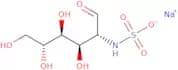
CAS:<p>D-Glucosamine-2-N-sulfate sodium is a synthetic, high purity carbohydrate with a custom synthesis. It is an oligosaccharide that is also a sugar and a saccharide. The methylation of D-glucosamine 2-N-sulfate sodium can be achieved by glycosylation or click modification. Click modification is the addition of a carbon atom to the molecule through the reaction with an electrophile, such as N-hydroxysuccinimide ester. This modification can be used to introduce fluorine atoms into the molecules, which can improve their solubility and stability. The product has shown anti-inflammatory activities in animal models, which may be due to its ability to inhibit prostaglandin synthesis.</p>Formula:C6H12NNaO8SPurity:Min. 95 Area-%Color and Shape:White Off-White PowderMolecular weight:281.22 g/molL-g-Ethylidene glutanic acid
<p>L-g-Ethylidene glutamic acid is an organic compound that is used in the production of pharmaceuticals, agrochemicals, and other chemicals. It can be synthesized by the methylation of L-glutamic acid with formaldehyde and sodium cyanoborohydride. L-g-Ethylidene glutamic acid has also been modified by a click reaction to create a fluorinated derivative. This product is a white crystalline solid that has a CAS number. The product is available at high purity and can be ordered as either monosaccharide or polysaccharide.<br>L-g-Ethylidene glutamic acid is a sugar that belongs to the carbohydrate family and can be classified as complex carbohydrates because it comprises two or more sugars linked together. This product may also be referred to as an oligosaccharide or polysaccharide, depending on its molecular size.</p>Purity:Min. 95%Colloidal Chitin
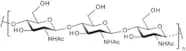
CAS:<p>Chitin is a polysaccharide which is found widely in nature, where it functions in a manner similar to collagen in chordates. It forms the tough fibrous exoskeletons of insects, crustaceans and other arthropods, and, in addition to its presence in some fungi, it occurs in at least one alga. The structure of chitin is similar to that of cellulose but with glucose replaced with N-acetyl-D-glucosaminyl units linked β-D-(1,4) in a linear chain. It is normally produced from the shells of lobster, crab or shrimp.</p>Color and Shape:Powder2, 5- Anhydro-4,6-O-isopropylidene-D- idonic acid
<p>2, 5-Anhydro-4,6-O-isopropylidene-D-idonic acid is a carbohydrate that can be used as a saccharide or oligosaccharide. This product has been fluorinated and methylated. It is also glycosylated and click modified. 2,5-Anhydro-4,6-O-isopropylidene-D-idonic acid can be synthesized to order and is available in high purity.</p>Purity:Min. 95%Tragacanth gum
CAS:<p>Gum tragacanth is an exudate gum from species of Astragalus trees mainly grown in Iran and Turkey. Tragacanth finds applications as an effective emulsifying and thickening agent in the food and pharmaceutical industries. The gum is a slightly acidic salt consisting of two fractions namely the water soluble tragacanthin and the fraction bassorin which swells in water to form a gel. Water soluble tragacanthin is reported as a branched arabiogalactan which is soluble in 70% ethanol. The acidic bassorin has a chain of (1,4)-linked a-D-galacturonic acid units some of which are substituted at O-3 with β-D-xylopyranosyl units and some of these being terminated with galactose or fucose.</p>Color and Shape:White Powder2-Acetamido-3,4,6-tri-O-acetyl-2-deoxy-b-D-glucopyranosyl isothiocyanate
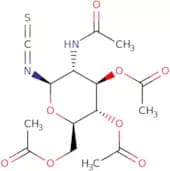
CAS:<p>2-Acetamido-3,4,6-tri-O-acetyl-2-deoxy-b-D-glucopyranosyl isothiocyanate is a synthetic glycosylating agent that has been shown to be effective in the synthesis of complex carbohydrates. It is used for the modification of saccharides and polysaccharides with click chemistry. Click chemistry is an organic reaction that synthesizes carbon–carbon bonds by the addition of a copper catalyst at room temperature without the need for high energy input. 2AATIGI can also be used to modify oligosaccharides and glycosylates proteins. For example, this compound was found to be effective in modifying a protein with a carbohydrate moiety that was derived from 2′,3′,5′ triacetylhexaose (2T3H).</p>Formula:C15H20N2O8SPurity:Min. 95%Color and Shape:Off-White PowderMolecular weight:388.39 g/mol2,3,4,6-Tetra-O-acetyl-1-deoxy-D-arabino-hex-1-enopyranose
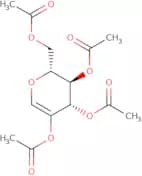
CAS:<p>Tetra-O-acetyl-1-deoxy-D-arabinohexopyranose is a boron trifluoride etherate method for the synthesis of tetraacetylated 1-deoxyhexopyranoses. The yield of this reaction is dependent on the formamide concentration and the hydrogenation time. When formamide is used, the yields are greater than when it is not. This product can be used in a variety of reactions such as the synthesis of 2,3,4,6-tetraiodo-, 2,3,4,6-tetrahalogeno-, or 2,3,4,-trihalogeno hexoses by substitution with iodine or chlorine. Tetraacetylated 1-deoxyhexopyranoses can also be used to synthesize ethanethiols and other alcohols by elimination reactions.</p>Formula:C14H18O9Color and Shape:White PowderMolecular weight:330.29 g/molMethyl 2,3:4,6-di-O-isopropylidene-D-mannopyranoside
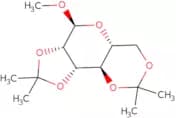
CAS:<p>Methyl 2,3:4,6-di-O-isopropylidene-D-mannopyranoside is a synthetic glycosylate sugar that has been modified with fluorination. It is a monosaccharide that is used in the synthesis of complex carbohydrates. Click modification of this molecule has been performed to yield high purity and desired modifications. CAS number 50705-56-1.</p>Formula:C13H22O6Purity:Min. 95%Color and Shape:PowderMolecular weight:274.31 g/mol6-Cyano-6-deoxy-γ-cyclodextrin
<p>This gamma-cyclodextrin (γ-CD) derivative is a modified cyclic oligosaccharide composed of eight glucose units, featuring a larger cavity size than α- and β-cyclodextrins. This structural characteristic allows γ-CDs to form inclusion complexes with a wider range of guest molecules, making it particularly versatile in various industries. In the food sector, it is used as a carrier and stabilizer for flavors, fat-soluble vitamins, and polyunsaturated fatty acids, protecting volatile compounds from evaporation. In pharmaceuticals, it enhances the solubility and bioavailability of poorly water-soluble drugs and, thanks to its larger ring size, allows for the encapsulation of larger molecules or even entire drug molecules. γ-CDs and derivatives are also used for environmental remediation and, in analytical chemistry, for the extraction and concentration of target substances.</p>Formula:C56H72N8O32Purity:Min. 95%Molecular weight:1,369.21 g/molVarenicline N-glucoside
CAS:<p>Varenicline N-glucoside is a modification of varenicline, which is an antagonist of the nicotinic acetylcholine receptor. This compound has been synthesized using custom synthesis and glycosylation to obtain high purity. It has been methylated and fluorinated in order to remove any impurities. Varenicline N-glucoside is a carbohydrate with a molecular weight of 581.5 g/mol, consisting of one monosaccharide and one disaccharide. It also contains a complex carbohydrate with an oligosaccharide chain that is composed of glycosylation and saccharide units. The CAS number for this compound is 873302-31-9.</p>Formula:C19H23N3O5Purity:Min. 95%Color and Shape:PowderMolecular weight:373.4 g/mol2-O-Benzyl-2,4-di-C-methyl-L-arabinopyranose
<p>2-O-Benzyl-2,4-di-C-methyl-L-arabinopyranose is a high purity, complex carbohydrate that is custom synthesized for use in glycosylation reactions. It is a synthetic compound that is sold by the CAS number. 2-O-Benzyl-2,4-di-C-methyl-L-arabinopyranose is a carbohydrate that has been modified with fluorination and methylation to provide an active site for glycosylation reactions. This product can be used to synthesize oligosaccharides and polysaccharides.</p>Purity:Min. 95%Methyl (2R,3R,4S)-2,3-dihydroxy-4-oxo-butanoate 2,4-hemiacetal
<p>Methyl (2R,3R,4S)-2,3-dihydroxy-4-oxo-butanoate 2,4-hemiacetal is a custom synthesis chemical that is not found in nature. It has the molecular formula CH3O(COOCH3)2C(OH)(OCH2CH2)2CHO. This compound was synthesized by the reaction of methyl acetoacetate with sodium borohydride and formaldehyde. The product was purified by recrystallization from ethyl acetate and hexane. Methyl (2R,3R,4S)-2,3-dihydroxy-4-oxo-butanoate 2,4-hemiacetal is a colorless solid that melts at 60°C and decomposes at 160°C. The purity of this compound is greater than 99%. This chemical reacts with nucleophiles to form acetals or hemiacet</p>Purity:Min. 95%