Glycoscience
Glycoscience is the study of carbohydrates and their derivatives, as well as the interactions and biological functions they participate in. This field of research is crucial for understanding a wide variety of biological processes, including cell recognition, signaling, immune response, and disease development. Glycoscience has important applications in biotechnology, medicine, and the development of new drugs and therapies. At CymitQuimica, we offer a wide selection of high-quality, high-purity products for glycoscience research. Our catalog includes monosaccharides, oligosaccharides, polysaccharides, glycoconjugates, and specific reagents, designed to support researchers in their studies on the structure, function, and applications of carbohydrates in biological systems. These resources are intended to facilitate scientific discoveries and practical applications in various areas of bioscience and medicine.
Subcategories of "Glycoscience"
- Aminosugars(108 products)
- Glyco-Related Antibodies(282 products)
- Glycolipids(46 products)
- Glycosaminoglycans (GAGs)(55 products)
- Glycosides(419 products)
- Monosaccharides(6,622 products)
- Oligosaccharides(3,682 products)
- Polysaccharides(503 products)
Found 11041 products of "Glycoscience"
Sort by
Purity (%)
0
100
|
0
|
50
|
90
|
95
|
100
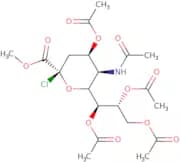
N-Acetyl-2-chloro-2-deoxyneuraminic acid methyl ester 4,7,8,9-tetraacetate
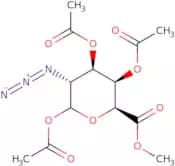
CAS:<p>N-Acetyl-2-chloro-2-deoxyneuraminic acid methyl ester 4,7,8,9-tetraacetate is a sialic acid analog that has been shown to have antiviral properties. It binds to the influenza virus and inhibits its activity by blocking the hemagglutinin receptor. The compound is soluble in water and organic solvents and can be modified with perbenzylated groups to increase its stability in plasma and tissues. N-Acetyl-2-chloro-2-deoxyneuraminic acid methyl ester 4,7,8,9-tetraacetate is resistant to hydrolysis by esterases and can also be used for the treatment of infections caused by bacteria or fungi.</p>Formula:C20H28ClNO12Purity:Min. 95%Color and Shape:PowderMolecular weight:509.89 g/mol2-Azido-1,3,4-tri-O-acetyl-2-deoxy-D-galacturonide methyl ester
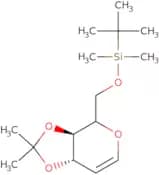
CAS:<p>2-Azido-1,3,4-tri-O-acetyl-2-deoxy-D-galacturonide methyl ester is a custom synthesis that is intended for use in research. This product is not a food or drug and is not intended to diagnose, treat, cure or prevent any disease.</p>Formula:C13H17N3O9Purity:Min. 95%Color and Shape:Colourless SolidMolecular weight:359.29 g/mol6-O-tert-Butyldimethylsilyl-3,4-O-isopropylidene-D-galactal
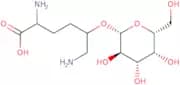
CAS:<p>6-O-tert-Butyldimethylsilyl-3,4-O-isopropylidene-D-galactal is a synthetic carbohydrate that can be used as a building block for preparing complex carbohydrates. It is an analog of D-galactal, which has been shown to have antiviral activity. 6-O-tert-Butyldimethylsilyl-3,4-O-isopropylidene-D-galactal can be used in the synthesis of oligosaccharides and glycosylations.</p>Formula:C15H28O4SiPurity:Min. 95%Molecular weight:300.47 g/mol5-(β-D-Galactopyranosyloxy)-DL-lysine
CAS:<p>5-(β-D-Galactopyranosyloxy)-DL-lysine is a custom synthesized compound that has been modified with 5-(β-D-galactopyranosyloxy) groups. It is an oligosaccharide, polysaccharide, and saccharide that belongs to the category of carbohydrates. This product is available for purchase in high purity and has been fluorinated. The CAS number for this product is 35910-05-5.</p>Formula:C12H24N2O8Purity:Min. 95%Color and Shape:PowderMolecular weight:324.33 g/molPalatinose monohydrate
CAS:<p>Palatinose monohydrate is a hydrogenated form of the natural disaccharide palatinose. It is often used as a solid catalyst in pharmaceutical preparations and has been shown to have a lower molecular weight than sucrose. Palatinose monohydrate may have beneficial effects on postprandial plasma glucose, protein data, and lipid metabolism. The hydrogenation process also produces fatty acids that are less reactive than those found in other sugars. Amine groups are also reduced in palatinose monohydrate, which may improve its taste. Palatinose monohydrate is not toxic at high doses and has been shown to be safe for use in toxicity studies. Surface methodology has been used to characterize the surface properties of palatinose monohydrate crystals, which can be used as a model for other sugar crystals.</p>Formula:C12H24O12Purity:Min. 95%Molecular weight:360.31 g/molHexyl 2-acetamido-2-deoxy-b-D-glucopyranoside
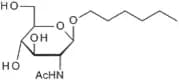
CAS:<p>Hexyl 2-acetamido-2-deoxy-b-D-glucopyranoside is a sugar that is used in the study of immune reactions. It can be used to measure albumin levels and tissue samples, as well as in animal experiments. Hexyl 2-acetamido-2-deoxy-b-D-glucopyranoside has been shown to have toxic effects on cells, which may be due to its ability to inhibit DNA concentrations. This substance also has a directional fluorescence, which means that it will emit light in one direction only when stimulated with light of a certain wavelength.</p>Formula:C14H27NO6Purity:Min. 95%Molecular weight:305.37 g/molMethyl 2-O-allyl-4,6-O-benzylidene-3-O-(2',3',4',6'-tetra-O-acetyl-a-D-mannopyranosyl)-a-D-mannopyranoside
CAS:<p>Methyl 2-O-allyl-4,6-O-benzylidene-3-O-(2',3',4',6'-tetra-O-acetyl-a-D-mannopyranosyl)-a-D-mannopyranoside is a sugar that is synthesized by the methylation of an oligosaccharide. This product is a white crystalline powder that has been shown to have high purity and a CAS number of 82185-93-1. It has also been modified with fluorination, which makes it resistant to degradation. Methyl 2-O-allyl 4,6 O benzylidene 3 O (2',3',4',6'-tetra - O acetyl - a D mannopyranosyl) - a D mannopyranoside is used in the synthesis of complex carbohydrates.</p>Formula:C31H40O15Purity:Min. 95%Molecular weight:652.64 g/mol2-Acetamido-4,6-O-benzylidene-N-Boc-1,2,5-trideoxy-1,5-imino-D-glucitol
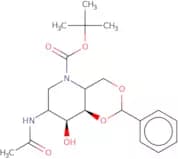
CAS:<p>2-Acetamido-4,6-O-benzylidene-N-Boc-1,2,5-trideoxy-1,5-imino-D-glucitol is a complex carbohydrate that belongs to the class of oligosaccharides. It is a methylated and glycosylated saccharide. 2ACBG has been modified with Click chemistry to introduce a fluorine atom at the C2 position on the glucose moiety. This modification prevents the formation of an intramolecular hemiacetal linkage between C2 and C3 in the ring structure, thereby preventing cyclization and stabilizing the linear configuration of 2ACBG. 2ACBG can be synthesized using high purity raw materials such as glucose and acetic acid in a two step process using ethyl bromoacetate as a reagent for acetylation followed by NBS (N-(3-bromopropyl)phthal</p>Formula:C20H28N2O6Purity:Min. 95%Molecular weight:392.45 g/molBenzyl 5-amino-5-deoxy-2,3-O-isopropylidene-6-O-trityl-a-D-mannofuranoside
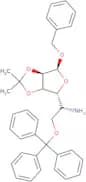
CAS:<p>Benzyl 5-amino-5-deoxy-2,3-O-isopropylidene-6-O-trityl-a-D-mannofuranoside is a complex carbohydrate that is synthesized by the glycosylation of benzyl 5-amino-5,6,7,8,9,10,11,12,13,14-, 2,3,4-, or 6-(N","N"-dimethylamino)ethyl 5-[(2","N"-dimethylamino)-ethoxycarbonyl]-5-[(2","N"-dimethylamino)ethoxycarbonyl]-4H-[1]benzopyranose with 6-(N","N"-dimethylaminomethylene)-a-"D"mannofuranose. The chemical modification includes fluorination and methylation. This product has a CAS number of 9136415 and purity of more than</p>Formula:C35H37NO5Purity:Min. 95%Molecular weight:551.67 g/mol(2R,4R)-2-[L-Xylo-tetrahydroxybut-1-yl]-1,3-thiazolidine-4-carboxylic acid
CAS:<p>(2R,4R)-2-[L-Xylo-tetrahydroxybut-1-yl]-1,3-thiazolidine-4-carboxylic acid is a methylated saccharide that can be used for the synthesis of glycosides and other carbohydrate derivatives. (2R,4R)-2-[L-Xylo-tetrahydroxybut-1-yl]-1,3-thiazolidine-4-carboxylic acid has been shown to react with various reagents such as iodine and bromine. This product has been synthesized by Click modification.</p>Formula:C8H15NO6SPurity:Min. 95%Molecular weight:253.27 g/molHyaluronate rhodamine - Molecular Weight - 2500kDa
<p>Hyaluronate rhodamine is a modified, fluorinated, methylated, and monosaccharide-containing polysaccharide. It is synthesized by the addition of a click modification to an oligosaccharide. The saccharide is used in glycosylation reactions to produce complex carbohydrates. Hyaluronate rhodamine has a molecular weight of 2500kDa.</p>Purity:Min. 95%Octyl 2-acetamido-3,4,6-tri-O-acetyl-2-deoxy-b-D-glucopyranoside
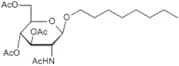
CAS:<p>Octyl 2-acetamido-3,4,6-tri-O-acetyl-2-deoxy-b-D-glucopyranoside is an antigen that is expressed in tumor tissue. It is a polynucleotide molecule that can be used for the diagnosis of cancer and autoimmune diseases. The octyl 2-acetamido-3,4,6-tri-O acetyl 2 deoxy b D glucopyranoside molecule is a programmable molecule that can be used to induce a specific phenotype in cells. Octyl 2 acetamido 3,4,6 tri O acetyl 2 deoxy b D glucopyranoside has been shown to be an effective antigen for the generation of CD8+ T cells.</p>Formula:C22H37NO9Purity:Min. 95%Molecular weight:459.53 g/mol2-(N-Octylcarboamido)phenyl-2-acetamido-2-deoxy-b-D-glucopyranoside
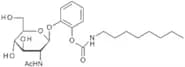
<p>2-(N-Octylcarboamido)phenyl-2-acetamido-2-deoxy-b-D-glucopyranoside is a modified carbohydrate which is used as a synthetic monosaccharide. It is also used in the preparation of Oligosaccharides, Carbohydrates, and Complex Carbohydrates. 2-(N-Octylcarboamido)phenyl-2-acetamido-2-deoxy-b-D--glucopyranoside has been fluorinated to 2-(N-[3,5-(diiodo)phenyl]carboamido)phenyl)-2-[3,5-(diiodo)phenyl]-acetamide.</p>Formula:C23H36N2O8Purity:Min. 95%Molecular weight:468.54 g/molOctyl 2-acetamido-2-deoxy-b-D-glucopyranoside
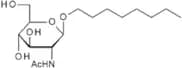
CAS:<p>Octyl 2-acetamido-2-deoxy-b-D-glucopyranoside is a lyotropic liquid that is flammable. It can be used to prepare potassium hydride, which is an organometallic. Potassium hydride reacts with organic acids and atorvastatin to produce argon gas. This reaction can be done in the presence of chlorine gas instead of air. Preparative methods for octyl 2-acetamido-2-deoxy-b-D-glucopyranoside include heating it in a vacuum or under argon gas and then reacting it with potassium tetrachlorocobaltate in water or ethanol solution.</p>Formula:C16H31NO6Purity:Min. 95%Molecular weight:333.42 g/molSulindac sulfone acyl-b-D-glucuronide
CAS:<p>Sulindac sulfone acyl-b-D-glucuronide is a modification of sulindac sulfone, which is an Oligosaccharide. The complex carbohydrate is synthesized from a custom synthesis and has a high purity. It has the CAS No. 60018-37-3 and Methylation, Glycosylation, Polysaccharide, sugar, Fluorination, saccharide.</p>Formula:C26H25FO10SPurity:Min. 95%Molecular weight:548.54 g/molN-(trans-3-Hydroxycotinine)-b-D-glucuronide
CAS:<p>N-(trans-3-Hydroxycotinine)-b-D-glucuronide is a hydroxy metabolite of trans-3-hydroxycotinine, which is a pyridine derivative and an endogenous metabolite of nicotine. It is formed by conjugation with glucuronate in the liver and excreted in the urine. It has been detected in human urine after oral administration of nicotine. N-(trans-3-Hydroxycotinine)-b-D-glucuronide can be used as an indicator for tobacco exposure or use.</p>Formula:C16H20N2O8Purity:Min. 95%Molecular weight:368.34 g/molCyclohexylbutanoyl-N-hydroxyethylglucamide
CAS:<p>Cyclohexylbutanoyl-N-hydroxyethylglucamide (CHBE) is a nitrite reductase inhibitor that has been shown to be effective in plant cell cultures and in proton uptake assays. It inhibits the biosynthesis of cyclic guanosine monophosphate (cGMP), which is an important regulator of smooth muscle relaxation. CHBE has been shown to inhibit nitrite reductase activity, as well as cavity formation and protein synthesis in the bacteria typhimurium. This drug also binds to the active site of nitrite reductase, inhibiting its function by stabilising a reduced form of the enzyme.</p>Formula:C18H35NO7Purity:Min. 95%Molecular weight:377.47 g/mol4-Hydroxyestradiol-4-O-b-D-glucuronide
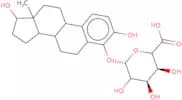
CAS:<p>4-Hydroxyestradiol-4-O-b-D-glucuronide is a custom synthesis of a sugar, Click modification, fluorination, glycosylation, synthetic, methylation, modification and oligosaccharide. It has CAS No. 90746-95-5. 4-Hydroxyestradiol-4-O-b-D-glucuronide is a saccharide with a complex carbohydrate structure.</p>Formula:C24H32O9Purity:Min. 95%Molecular weight:464.51 g/mol1-O -Acetyl-2,5-di-O-benzoyl-3-fluoro-3-deoxy-D-ribofuranoside
CAS:<p>1-O -Acetyl-2,5-di-O-benzoyl-3-fluoro-3-deoxy-D-ribofuranoside is a synthetic carbohydrate that has been modified by fluorination and methylation. The molecule has a molecular weight of 581.1 g/mol, with the chemical formula C14H12F6O8N2. It is a white crystalline solid that can be used in the synthesis of glycosides, saccharides, oligosaccharides, and monosaccharides. 1-O -Acetyl-2,5-di-O-benzoyl-3-fluoro-3-deoxyribofuranoside can be useful for glycosylation reactions such as click chemistry or glycosidase reactions. This product is high purity and custom synthesis to order.</p>Formula:C21H19FO7Purity:Min. 95%Molecular weight:402.37 g/molSennoside C
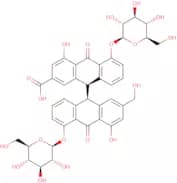
CAS:<p>Sennoside C is a bioactive phytochemical extracted from the leaves of Eclipta prostrata. It has been shown to have anti-tumor and anti-inflammatory properties. Sennoside C has also been found to be effective in treating autoimmune diseases, including psoriasis and rheumatoid arthritis. Sennoside C is a low-energy compound that binds with fatty acids to form a bound form. This bound form can be hydrolyzed by sodium hydroxide solution to release free sennosides, which are anthraquinone glycosides that can be used for the treatment of skin conditions such as eczema and dermatitis.</p>Formula:C42H40O19Purity:Min. 95%Color and Shape:SolidMolecular weight:848.76 g/mol


![(2R,4R)-2-[L-Xylo-tetrahydroxybut-1-yl]-1,3-thiazolidine-4-carboxylic acid](/_next/image/?url=https%3A%2Fstatic.cymitquimica.com%2Fproducts%2F3D%2Fthumb-webp%2FMX01046.webp&w=3840&q=75)