Glycoscience
Glycoscience is the study of carbohydrates and their derivatives, as well as the interactions and biological functions they participate in. This field of research is crucial for understanding a wide variety of biological processes, including cell recognition, signaling, immune response, and disease development. Glycoscience has important applications in biotechnology, medicine, and the development of new drugs and therapies. At CymitQuimica, we offer a wide selection of high-quality, high-purity products for glycoscience research. Our catalog includes monosaccharides, oligosaccharides, polysaccharides, glycoconjugates, and specific reagents, designed to support researchers in their studies on the structure, function, and applications of carbohydrates in biological systems. These resources are intended to facilitate scientific discoveries and practical applications in various areas of bioscience and medicine.
Subcategories of "Glycoscience"
- Aminosugars(108 products)
- Glyco-Related Antibodies(282 products)
- Glycolipids(46 products)
- Glycosaminoglycans (GAGs)(55 products)
- Glycosides(419 products)
- Monosaccharides(6,622 products)
- Oligosaccharides(3,682 products)
- Polysaccharides(503 products)
Found 11041 products of "Glycoscience"
Sort by
Purity (%)
0
100
|
0
|
50
|
90
|
95
|
100
2,3-O-Isopropylidene-1,6-di-O-p-toluenesulfonyl-a-L-sorbofuranose
CAS:<p>2,3-O-Isopropylidene-1,6-di-O-p-toluenesulfonyl-a-L-sorbofuranose is a synthetic sugar that has been modified with fluorine. It has a molecular weight of 594.65 and melting point of 190°C. The compound is used as a precursor for the synthesis of oligosaccharides and polysaccharides.</p>Formula:C23H28O10S2Purity:Min. 95%Molecular weight:528.59 g/molMethyl 3-O-(2-acetamido-2-deoxy-b-D-galactopyranosyl)-b-D-galactopyranoside
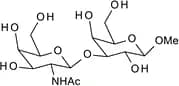
CAS:<p>Methyl 3-O-(2-acetamido-2-deoxy-b-D-galactopyranosyl)-b-D-galactopyranoside is a modified sugar that can be used for synthesis of saccharides, oligosaccharides, and polysaccharides. This product has been custom synthesized to be a high purity compound with CAS No. 130234-66-1. It has been fluorinated and is available in the glycosylation form.</p>Formula:C15H27NO11Purity:Min. 95%Molecular weight:397.36 g/mol3,6-Anhydro-D-galactose dimethylacetal
CAS:<p>3,6-Anhydro-D-galactose dimethylacetal is a glycosylation intermediate that has been modified for use in synthetic chemistry. It can be used to synthesize complex carbohydrates, polysaccharides, or oligosaccharides. The product is custom-synthesized and available in high purity.</p>Formula:C8H16O6Purity:Min. 95%Molecular weight:208.21 g/mol3,6-Di-O-tert-butyldimethylsilyl-D-glucal
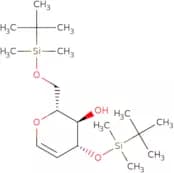
CAS:<p>3,6-Di-O-tert-butyldimethylsilyl-D-glucal is a stereoselective synthetic compound that can be used as a glycosyl donor in the synthesis of glycosides. It is an intermediate in the synthesis of uridine, which is an important component of nucleic acids. 3,6-Di-O-tert-butyldimethylsilyl-D-glucal has been shown to inhibit the action of glycogen synthase and amylo-(1→4)-α-(1→2)-glycosidases. This inhibition prevents the breakdown of glycogen, which leads to a build up of glucose in the body and produces insulin resistance.</p>Purity:Min. 95%2N-Fmoc-4N-(2,3,4,6-tetra-O-acetyl-b-D-glucopyranosyl)-L-aparagine
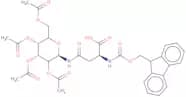
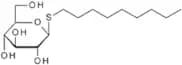
CAS:<p>2N-Fmoc-4N-(2,3,4,6-tetra-O-acetyl-b-D-glucopyranosyl)-L-aparagine is a modified carbohydrate that is used as a starting material for the synthesis of oligosaccharides and polysaccharides. It is synthesized by reacting 2N-Fmoc-L-serine with 4N-(2,3,4,6-tetraO-(acetyl)-bDglucopyranosyl)-Laparagine. The OAc group provides protection for the amino functions and can be removed in the presence of acid to yield an unprotected L(+)-serine. This product has high purity and can be purchased in various custom synthesis quantities.</p>Formula:C33H36N2O14Purity:Min. 95%Molecular weight:684.66 g/molNonyl b-D-thioglucopyranoside
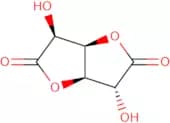
CAS:<p>Nonyl b-D-thioglucopyranoside is a methylating agent that can be used in the synthesis of oligosaccharides and polysaccharides. This compound is a fluorinated sugar that is used as an intermediate in the synthesis of saccharide derivatives. Nonyl b-D-thioglucopyranoside is also a highly pure, stable chemical that has been modified to meet customer specifications. It can be used for the preparation of glycosyl fluorides, which are used to modify monosaccharides and other carbohydrates.</p>Formula:C15H30O5SPurity:Min. 95%Molecular weight:322.46 g/mol1,4:6,3-Glucarodilactone
CAS:<p>1,4:6,3-Glucarodilactone is an undecenoate with a sustainable and degradable structure. It can be used as a monomer in the production of polyols that are used in various industries, such as the plastics industry. 1,4:6,3-Glucarodilactone is also an acidic compound that has been shown to have a crystalline product and isomeric transition. It is possible to produce this compound by ring-opening polymerization of p-xylylenediamine with butyl vinyl ether or isobutyl vinyl ether.</p>Formula:C6H6O6Purity:Min. 95%Molecular weight:174.11 g/molRhein 1-D-glucuronide
CAS:<p>Rhein 1-D-glucuronide is a synthetic sugar that can be used in the synthesis of complex carbohydrates. It is a monosaccharide that has been modified with fluorination and has been shown to have high purity. Rhein 1-D-glucuronide is a methylated form of rhein, which is an oligosaccharide or polysaccharide found in plants. The modification of rhein 1-D-glucuronide allows for an increased resistance to hydrolysis by esterases or glucuronidases, allowing for its use as a synthetic intermediate in the production of saccharides.</p>Purity:Min. 95%1,2:5,6-Dianhydrogalactitol
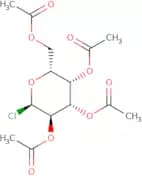
CAS:<p>1,2:5,6-Dianhydrogalactitol is a drug that has been shown to reduce the growth of tumors in mice. It is an antitumor agent that inhibits the activity of enzymes such as protein kinase A and phosphorylase kinase. This drug also inhibits the activity of the mitochondrial membrane potential, which is necessary for normal cellular function. The structure of 1,2:5,6-dianhydrogalactitol was first determined by analytical methods on mouse tumor tissue and then verified by a preparative high performance liquid chromatography (HPLC) experiment. It has been shown to be effective against pediatric tumors and is currently being evaluated for use in other cancer models.</p>Formula:C6H10O4Purity:Min. 95%Color and Shape:PowderMolecular weight:146.14 g/mol2,3,4,6-Tetra-O-acetyl-a-D-galactopyranosyl chloride
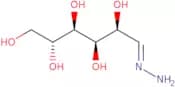
CAS:<p>2,3,4,6-Tetra-O-acetyl-a-D-galactopyranosyl chloride is a synthetic carbohydrate that can be used for glycosylation and modification. It is a sugar with a molecular weight of 434.58 and an empirical formula of C12H24O14. It has been shown to have a high purity of over 98%.</p>Formula:C14H19ClO9Purity:Min. 95%Molecular weight:366.75 g/molD-Glucose hydrazon
CAS:<p>D-Glucose hydrazon is a custom synthesis of complex carbohydrate. It is made by the reaction of Methylation, Click modification, and Fluorination with saccharide and sugar. The product is a white crystalline solid that is soluble in water.</p>Purity:Min. 95%S-Flurbiprofen-acyl-b-D-glucuronide
CAS:<p>Flurbiprofen-acyl-b-D-glucuronide is a modification of the compound flurbiprofen. It is a complex carbohydrate that has been custom synthesized and purified. Flurbiprofen-acyl-b-D-glucuronide is an oligosaccharide that contains a number of monosaccharides, methylated sugars, glycosylated sugars, and polysaccharides. It also contains a fluorinated saccharide at the terminal end of its structure. Flurbiprofen-acyl-b-D-glucuronide is used in research to study the interactions between carbohydrates and drugs.</p>Formula:C21H21FO8Purity:Min. 95%Molecular weight:420.39 g/mol4-Methoxyphenyl 4-O-[3,6-di-O-benzyl-2-deoxy-4-O-(4,6-O-benzylidene-2-O-levulinoyl-b-D-glucopyranosyl)-2-phthalimido-b-D-glucopyrano sy]-3-O-benzyl-2-deoxy-6-O-(4-methoxybenzyl)-2-phthalimido-b-D-glucopyranoside
<p>4-Methoxyphenyl 4-O-[3,6-di-O-benzyl-2-deoxy-4-O-(4,6-O-benzylidene-2-O-levulinoyl)-bDglucopyranosyl]-2-phthalimido -bDglucopyranoside is a modification of the natural compound 3,6 di O benzyl 2 deoxy 4 O (4,6 O benzylidene 2 O levulinoyl) b D glucopyranosyld. It is a synthetic oligosaccharide that contains one monosaccharide and two polysaccharides. The synthesis of this product involves methylation and glycosylation. This compound has CAS number 5374031 and can be used as an intermediate in the synthesis of other products with fluorination or saccharide modifications.</p>Formula:C82H80N2O22Purity:Min. 95%Color and Shape:White to off-white crystalline powder.Molecular weight:1,445.51 g/molBlood group A type 3/4 tetrasaccharide
<p>Gala1-3(Fuca1-2)Galb1-3GalNAc</p>Formula:C28H48N2O20Purity:Min. 95%Molecular weight:732.68 g/molCys-spacer-Gly-Gly-Tyr-D-Thr-Gly-Phe-Leu-Ser(glucoside)-amide
<p>Custom synthesis, Modification, Fluorination, Methylation, Monosaccharide, Synthetic, Click modification, Oligosaccharide, saccharide<br>CAS No.: 1101-98-2<br>Polysaccharide: Glycosylated<br>Sugar: Carbohydrate<br>Complex carbohydrate: Glycosylated<br>Glycosylation: sugar</p>Purity:Min. 95%4-O-(b-D-Galactopyranosyl)-D-glucosamine
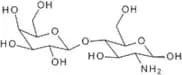
CAS:<p>4-O-(b-D-Galactopyranosyl)-D-glucosamine is a sugar that is found in the human body. It has been shown to have anti-cancer properties and is being studied as a potential therapeutic agent for squamous cell carcinoma. Basic structural analysis of 4-O-(b-D-Galactopyranosyl)-D-glucosamine has been performed on methyl glycosides, oligosaccharides, and bovine serum albumin. The sugar can be used to inhibit transcriptional regulation through its interactions with DNA. 4-O-(b-D-Galactopyranosyl)-D-glucosamine has also been found to inhibit the activities of enzymes involved in methyl glycoside synthesis, which may be related to its effects on cancer cells.</p>Formula:C12H23NO10Purity:Min. 95%Color and Shape:White PowderMolecular weight:341.31 g/molCellulose acetate hydrogen phthalate
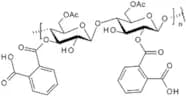
CAS:<p>Cellulose acetate phthalate (CAP) finds use in the formulation of pharmaceuticals, such as the enteric coating of tablets or capsules and for controlled release formulations, where it is often used with other coating agents such as ethyl cellulose. It contains about 50% acetate and 25% as the phthalate ester with the rest as free hydroxyl groups. Enteric coatings based on CAP are resistant to acidic gastric fluids, but easily soluble in mildly basic medium of the intestine. The pH-sensitive solubility of CAP is mainly determined (as are other properties of this mixed ester) by the degree of substitution and by the molar ratio (acetyl and phthaloyl groups).</p>Purity:Min. 95%Methyl 6-deoxy-2-O-methyl-a-D-galactopyranoside
CAS:<p>Methyl 6-deoxy-2-O-methyl-a-D-galactopyranoside is a custom synthesis that has been modified with fluorination, methylation and click chemistry. The product is a monosaccharide or oligosaccharide that is synthetic and can be used as a sugar or carbohydrate. It has CAS No. 59981-27-0 and can be found in Polysaccharides, Glycosylations, Carbohydrates, Complex Carbohydrates.</p>Formula:C8H16O5Purity:Min. 95%Molecular weight:192.21 g/mol1,3,4,5,6-Penta-O-acetyl-2-keto-D-fructose
CAS:<p>1,3,4,5,6-Penta-O-acetyl-2-keto-D-fructose is a custom synthesis of monosaccharide. It has been modified by fluorination and methylation. The CAS number for 1,3,4,5,6-Penta-O-acetyl-2-keto-D-fructose is 494828–55–6. This product is a saccharide that is a sugar with a complex carbohydrate structure.</p>Formula:C16H22O11Purity:Min. 95%Molecular weight:390.34 g/molPyrocatechol monoglucoside
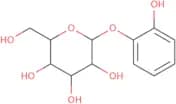
CAS:<p>Pyrocatechol monoglucoside is a phenolic compound that is found in many plants. It has an anti-thrombotic effect, inhibits bacterial growth, and has anticarcinogenic effects. Pyrocatechol monoglucoside is also hepatoprotective and can be used as a natural food preservative. It has a bitter taste and can be found in leuconostoc mesenteroides and mesenteroides strains of bacteria.</p>Purity:Min. 95%