Glycoscience
Glycoscience is the study of carbohydrates and their derivatives, as well as the interactions and biological functions they participate in. This field of research is crucial for understanding a wide variety of biological processes, including cell recognition, signaling, immune response, and disease development. Glycoscience has important applications in biotechnology, medicine, and the development of new drugs and therapies. At CymitQuimica, we offer a wide selection of high-quality, high-purity products for glycoscience research. Our catalog includes monosaccharides, oligosaccharides, polysaccharides, glycoconjugates, and specific reagents, designed to support researchers in their studies on the structure, function, and applications of carbohydrates in biological systems. These resources are intended to facilitate scientific discoveries and practical applications in various areas of bioscience and medicine.
Subcategories of "Glycoscience"
- Aminosugars(108 products)
- Glyco-Related Antibodies(282 products)
- Glycolipids(46 products)
- Glycosaminoglycans (GAGs)(55 products)
- Glycosides(419 products)
- Monosaccharides(6,622 products)
- Oligosaccharides(3,682 products)
- Polysaccharides(503 products)
Found 11041 products of "Glycoscience"
Sort by
Purity (%)
0
100
|
0
|
50
|
90
|
95
|
100
Man-7D2 N-Glycan
<p>Man-7D2 N-glycan is a custom synthesis of mannose. It is a modification of the glycan, which is an oligosaccharide that consists of many monosaccharides linked together. The process of glycosylation involves the addition of one or more sugars to an existing carbohydrate molecule. In this case, the sugar is mannose and it has been modified by fluorination, methylation, and click chemistry. This product can be used as a substitute for natural glycans in research applications. The CAS number for this product is 59569-81-1.</p>Purity:Min. 95%6-Deoxy-3-C-methyl-D-gulose
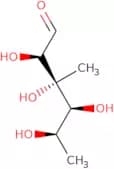
CAS:<p>6-Deoxy-3-C-methyl-D-gulose is an enantiomer of 3,6-dideoxy-D-gluconic acid. This compound has been shown to be a virulent factor in mastitis caused by the mutant strain of Escherichia coli (MT1) and to be expressed at a higher level in mastitic milk than in normal milk. 6DMG has also been shown to induce monoclonal antibody production and stimulate specific immune responses. It is thought that 6DMG damages cells, which leads to the release of intracellular components that trigger an antibody response. The biological function of 6DMG is not known, but it may play a role in the infection process by stimulating an antibody response against infectious agents.</p>Purity:Min. 95%Methyl 6-azido-6-deoxy-2,3-di-O-benzyl-a-D-glucopyranoside
CAS:<p>Methyl 6-azido-6-deoxy-2,3-di-O-benzyl-a-D-glucopyranoside is a custom synthesized compound that belongs to the group of glycosylation. It is an Oligosaccharide, sugar, Synthetic, Fluorination, Custom synthesis, Methylation, Monosaccharide, Polysaccharide and saccharide. This compound has CAS No. 54522-58-6 and a molecular weight of 598.29 g/mol. The purity level is >99% and the modification level is Click modification.</p>Formula:C21H25N3O5Purity:Min. 95%Molecular weight:399.18 g/molGM1a-Oligosaccharide
<p>GM1a pentasaccharide (ammonium salt) has a core tetrasaccharide structure (Galβ1,3GalNAcβ1,4Galβ1,4Glc) with a single sialic acid residue linked α2,3 to the inner galactose residue (Ledeen, 2009). GM1a pentasaccharide is the carbohydrate moiety in GM1a ganglioside which interacts and modulates tyrosine kinases, such as, neural tropomyosin receptor kinase A (TrkA), by inducing the release of neurotrophins from fibroblast cells and the epidermal growth factor receptor (EGFR) (Higuero, 2009). Oligosaccharide domain of monosialylated glycosphingolipid GM1 of a-series that specifically interacts with cholera toxin B subunit (CBT) fromâ¯V. cholerae, heat-labile toxin B subunit (LTB) fromâ¯E. coliâ¯and alpha toxin fromâ¯C. perfrigens. This ganglioside is abundant in nervous system as well as in other peripheral tissues (Chiricozzi, 2020).</p>Formula:C37H61N2O29NaPurity:Min. 95%Color and Shape:PowderMolecular weight:1,020.87 g/mol3,5-O-Isopropylidene-L-arabinofuranose
<p>3,5-O-Isopropylidene-L-arabinofuranose is a sugar that is used in the synthesis of saccharides. It is a monosaccharide that can be modified by fluorination, methylation, and custom synthesis. This product has been shown to be an excellent substrate for click chemistry and can be used as an intermediate in the production of oligosaccharides and polysaccharides. 3,5-O-Isopropylidene-L-arabinofuranose has a high purity level and can be used as a replacement for other sugars in complex carbohydrate synthesis.</p>Purity:Min. 95%2-Acetamido-2,4-dideoxy-4-fluoro-6-O-(3-mercaptopropanoyl)-D-glucopyranose
<p>2-Acetamido-2,4-dideoxy-4-fluoro-6-O-(3-mercaptopropanoyl)-D-glucopyranose is a sugar with a molecular formula of C10H14O7F3NO6 and a molecular weight of 441.33. It has high purity and is custom synthesized to order. It is an important building block in the synthesis of oligosaccharides, monosaccharides, saccharides, and complex carbohydrates. 2-Acetamido-2,4-dideoxy-4-fluoro-6-O-(3-mercaptopropanoyl)-D-glucopyranose has many modifications including fluorination, glycosylation, methylation, and modification. This product has CAS number 1778791 and can be found under the name Oligosaccharide (CAS No. 17</p>Purity:Min. 95%L-Ribose
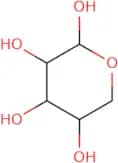
CAS:<p>L-Ribose is a monosaccharide that is a constituent of ribonucleic acid, deoxyribonucleic acid and other compounds. It can be found in small quantities in most living organisms. L-Ribose has been modified to include fluorine atoms at the C2 position. The addition of fluorine atoms increases the stability of the molecule and its resistance to hydrolysis by esterases. L-Ribose has also been modified with methyl groups at the C3 position and glycosylation at the C4 position. This modification preserves the biological activity of L-Ribose and increases its water solubility. L-Ribose is used as a building block for custom synthesis, such as peptides or oligosaccharides.>>END>></p>Formula:C5H10O5Molecular weight:150.13 g/molEthyl b-D-fructofuranoside
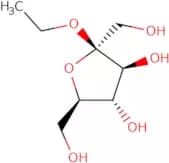
CAS:<p>Ethyl b-D-fructofuranoside is a synthetic compound that is used in the synthesis of oligosaccharides and polysaccharides. It can be custom synthesized to suit the needs of the customer. This product is available for sale as a white powder with a purity of at least 99%.</p>Formula:C8H16O6Purity:Min. 95%Molecular weight:208.21 g/mol1,2,3-Tri-O-acetyl-5-O-benzoyl-4-C-methyl-D-ribofuranose
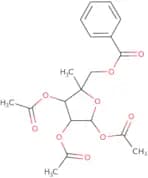
CAS:<p>1,2,3-Tri-O-acetyl-5-O-benzoyl-4-C-methyl-D-ribofuranose is a fluorinated carbohydrate that is synthesized by the click chemistry reaction. It is an oligosaccharide with three acetyl groups and four methyl groups on the sugar. This compound has a molecular weight of 514.92 g/mol and a CAS number of 503543-44-0.</p>Purity:Min. 95%3-O-Benzyl-1,2:5,6-di-O-cyclohexylidene-a-D-glucofuranose
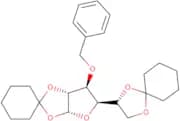
CAS:<p>3-O-Benzyl-1,2:5,6-di-O-cyclohexylidene-a-D-glucofuranose is a synthetic sugar that is used in the synthesis of glycosides and other carbohydrates. 3-O-Benzyl-1,2:5,6-di-O-cyclohexylideneglucopyranose is an oligosaccharide that has been modified with fluorine at the C3 position. This modification is often seen in saccharides that are synthesized from monosaccharides. It is also possible to methylate the C3 position of this molecule to produce 3′-[methyl(4′)benzyl] glucopyranose. This molecule can be glycosylated or click modified to create a custom synthesis.</p>Formula:C25H34O6Purity:Min. 95%Molecular weight:430.53 g/molCyanidin-3-O-sophoroside chloride
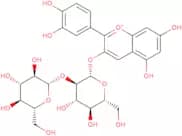
CAS:<p>Cyanidin-3-O-sophoroside chloride (CAS: 6279-21-6) is a naturally occurring phenolic compound that has been isolated from the roots of Sophora flavescens. This compound is a glycosylated form of protocatechuic acid, which is an organic compound with antioxidant properties. The surface methodology on tissue structure showed that this compound can react with nucleophilic radicals and scavenge free radicals in the presence of chloride ions, which is important for its dietary and medicinal value. COS has also been shown to have anti-inflammatory activities in a model system by inhibiting the production of prostaglandins. COS can be extracted from plants by acidic hydrolysis or preparative high performance liquid chromatography.</p>Formula:C27H31O16ClPurity:Min. 95%Color and Shape:PowderMolecular weight:646.98 g/molD-Ribose-2,3,4,5-13C4
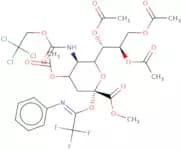
CAS:<p>D-Ribose-2,3,4,5-13C4 is a complex carbohydrate with saccharide units. It is synthesized by the chemical modification of D-ribose. This product can be used to modify or methylate glucose and other carbohydrates. It has been shown to inhibit the formation of amyloid plaques in Alzheimer's disease, which may be due to its ability to reduce nitric oxide and reactive oxygen species levels. The purity of this product is at least 98%.</p>Formula:C5H10O5Purity:Min. 95%Molecular weight:154.1 g/mol4,7,8,9-Tetra-O-acetyl-5-(2,2,2-trichloroethoxycarbonylamino)-2-(N-phenyltrifluoroacetimidate)-D-neuraminic acid methyl ester
CAS:<p>4,7,8,9-Tetra-O-acetyl-5-(2,2,2-trichloroethoxycarbonylamino)-2-(N-phenyltrifluoroacetimidate)-D-neuraminic acid methyl ester is a custom synthesis of an oligosaccharide modification. It has been modified by glycosylation, methylation, and fluorination. This complex carbohydrate is a polysaccharide that has a CAS number of 874904-91-3. The Carbohydrate Click Modification is used to create this product with high purity and high quality.</p>Formula:C29H32N2O14Cl3F3Purity:Min. 95%Molecular weight:795.92 g/molLacto-N-neotetraose-GEL
<p>Lacto-N-neotetraose-GEL is a glycosylation product that is used in the synthesis of complex carbohydrates. It is a methylated, fluorinated, and saccharide-modified oligosaccharide. This product can be custom synthesized in high purity with a CAS number and has a very low endotoxin level. Lacto-N-neotetraose-GEL has been shown to have many uses including as an adjuvant for vaccines and monoclonal antibody production. It has also been shown to suppress inflammation and increase the efficacy of cancer treatments.</p>Purity:Min. 95%3,4-Dideoxyglucosone-3-ene
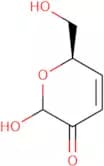
CAS:<p>3,4-di-deoxyglucosone-3-ene is a bioreactive glucose degradation product which can be formed during heat sterilisation of glucose containing peritoneal dialysis solutions. Chemically, 3,4-Dideoxyglucosone-3-ene is an α,β-unsaturated carbonyl compound which increases its reactivity with cellular sulfhydryl, amino groups, proteins, and DNA. 3,4-Dideoxyglucosone-3-ene induces apoptosis in neutrophils, renal cells and peripheral blood mononuclear cells. Such induction leads to impaired peritoneal antibacterial defence.</p>Formula:C6H8O4Purity:Min. 95 Area-%Color and Shape:Colorless PowderMolecular weight:144.13 g/mol2,3-O-Isopropylidene-L-apiose
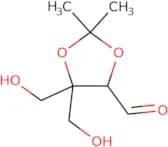
CAS:<p>2,3-O-Isopropylidene-L-apiose is a synthetic monosaccharide with a fluorinated substituent at the C2 position. It is an oligosaccharide that has been custom synthesized for glycosylation and polysaccharide modifications. The chemical name of 2,3-O-Isopropylidene-L-apiose is 2,3-O-(2,3,4,5,6) -Heptafluoroisopropylidene apiose. The CAS number for this compound is 70147-51-2. This product is available in high purity.</p>Formula:C8H14O5Purity:Min. 95%Molecular weight:190.19 g/molHyaluronate rhodamine - Molecular Weight - 1500kDa
<p>Hyaluronate rhodamine is a synthetic, high-purity, fluorinated, hydrophilic oligosaccharide. It is a complex carbohydrate with a molecular weight of 1500kDa and a very low viscosity. Hyaluronate rhodamine has been modified to include Click chemistry that provides the potential for site-specific modification on the sugar backbone. The fluorination process can be customized to produce the desired degree of substitution (DS) and functionalization for specific applications. This product has been glycosylated and polysaccharide modified to create an oligosaccharide that is suitable for use in therapeutic and diagnostic applications.</p>Purity:Min. 95%Methyl 3,6-dideoxychloroacetamido-a-D-mannopyranoside
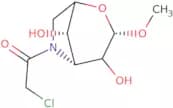
CAS:<p>Methyl 3,6-dideoxychloroacetamido-a-D-mannopyranoside is a complex carbohydrate that has been modified by fluorination and methylation. It is an important building block in the synthesis of oligosaccharides and polysaccharides. This product is also used in click chemistry, where it can be reacted with a variety of thiols to form new linkages. Methyl 3,6-dideoxychloroacetamido-a-D-mannopyranoside can also be used to modify saccharides or sugars by click chemistry. This compound is highly pure and custom synthesized to customer specifications.</p>Formula:C9H14ClNO5Purity:Min. 95%Molecular weight:251.66 g/mol1-D-a-Galactopyranosyl-4-O-[1-(2-octadecylthioethyl)-(b-D-galactopyranoside)]
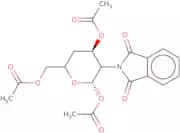
<p>1-D-a-Galactopyranosyl-4-O-[1-(2-octadecylthioethyl)-(b-D-galactopyranoside)] is a complex carbohydrate that contains a fluorinated sugar. It is synthesized from a monosaccharide and an oligosaccharide and glycosylated with a polysaccharide. The compound has been modified to include methylation and click modification. 1-D-a-Galactopyranosyl-4-O-[1-(2-octadecylthioethyl)-(b-D-galactopyranoside)] can be purchased in high purity from the CAS registry number of 538570–75–6.</p>Purity:Min. 95%1,3,6-Tri-O-acetyl-2,4-dideoxy-2-phthalimido-b-D-glucopyranose
CAS:<p>1,3,6-Tri-O-acetyl-2,4-dideoxy-2-phthalimido-b-D-glucopyranose is a modification of the sugar molecule. This product is a custom synthesis and can be used in research to synthesize complex carbohydrates. It is also a synthetic carbohydrate that has been fluorinated and saccharides have been methylated and glycosylated. It has CAS No. 1260591-45-4 and can be used as a monosaccharide or polysaccharide.</p>Formula:C20H21NO9Purity:Min. 95%Molecular weight:419.38 g/mol






![1-D-a-Galactopyranosyl-4-O-[1-(2-octadecylthioethyl)-(b-D-galactopyranoside)]](/_next/image/?url=https%3A%2Fstatic.cymitquimica.com%2Fproducts%2F3D%2Fthumb-webp%2FOG12060.webp&w=3840&q=75)