Glycoscience
Glycoscience is the study of carbohydrates and their derivatives, as well as the interactions and biological functions they participate in. This field of research is crucial for understanding a wide variety of biological processes, including cell recognition, signaling, immune response, and disease development. Glycoscience has important applications in biotechnology, medicine, and the development of new drugs and therapies. At CymitQuimica, we offer a wide selection of high-quality, high-purity products for glycoscience research. Our catalog includes monosaccharides, oligosaccharides, polysaccharides, glycoconjugates, and specific reagents, designed to support researchers in their studies on the structure, function, and applications of carbohydrates in biological systems. These resources are intended to facilitate scientific discoveries and practical applications in various areas of bioscience and medicine.
Subcategories of "Glycoscience"
- Aminosugars(108 products)
- Glyco-Related Antibodies(282 products)
- Glycolipids(46 products)
- Glycosaminoglycans (GAGs)(55 products)
- Glycosides(419 products)
- Monosaccharides(6,622 products)
- Oligosaccharides(3,682 products)
- Polysaccharides(503 products)
Found 11041 products of "Glycoscience"
Sort by
Purity (%)
0
100
|
0
|
50
|
90
|
95
|
100
Lactosyl-b-1,1'-N-octanoyl-L-threo-sphingosine
CAS:<p>Lactosyl-b-1,1'-N-octanoyl-L-threo-sphingosine is a glycosylation agent that is used in the synthesis of complex carbohydrates. This compound has been shown to be stable in aqueous solutions and can be used for the modification of saccharides, oligosaccharides, and polysaccharides. Lactosyl-b-1,1'-N-octanoyl-L-threo-sphingosine is also useful for the fluorination of sugars. The CAS number for this compound is 939036-94-9.</p>Formula:C38H71NO13Purity:Min. 95%Molecular weight:749.97 g/mol4-Methoxyphenyl 4-O-(3-O-allyl-b-D-galactopyranosyl)-3-O-allyl-b-D-glucopyranoside
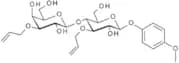
<p>4-Methoxyphenyl 4-O-(3-O-allyl-b-D-galactopyranosyl)-3-O-allyl-b-D-glucopyranoside is a custom synthesis product that is used as a synthetic intermediate in the modification of complex carbohydrates. This product is a fluorinated sugar, with a high purity and high quality. It has been modified to include methyl groups at specific positions on the sugar molecule. The CAS number for this product is 8721401.</p>Formula:C25H36O12Purity:Min. 95%Molecular weight:528.55 g/mol1-Amino-1,5-dideoxy-L-erythro-2-pentulose
CAS:<p>1-Amino-1,5-dideoxy-L-erythro-2-pentulose is a glycoconjugate that contains an amino sugar. It is also a complex carbohydrate that is methylated and fluorinated. 1-Amino-1,5-dideoxy-L-erythro-2-pentulose is a polysaccharide made up of saccharides and oligosaccharides. The saccharides in this compound are modified with the addition of sugars (e.g., glycosylation). This product has been custom synthesized to order and can be ordered as a high purity product.</p>Formula:C5H11NO3Purity:Min. 95%Molecular weight:133.15 g/mol1,6-Di-O-acetyl-2,3,4-tri-O-benzyl-α-D-mannopyranose
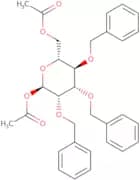
CAS:<p>1,6-Di-O-acetyl-2,3,4-tri-O-benzyl-a-D-mannopyranose is a carbohydrate that has been synthetically prepared. The sugar was synthesized by the solid phase synthesis of an acetate derivative of 2,3,4-tri-O-benzylglucal and 1,6 diacetate benzil. The conformation of the sugar was determined from X-ray crystallography to be anomeric. The structure consists of a six membered ring with two oxygen atoms on opposite sides. This hexagonal ring is composed of four methylene groups and two oxygens. One oxygen atom is bonded to one carbon atom in the adjacent six membered ring with a single bond and the other oxygens are bonded to carbons in the adjacent six membered rings with double bonds. This results in three rings that are not fully interlocked as they have different degrees of freedom</p>Formula:C31H34O8Purity:Min. 95%Molecular weight:534.6 g/molMethyl 2,3-dideoxy-3-fluoro-5-O-(4-phenylbenzoyl)-β-D-erythro pentofuranoside
CAS:<p>Methyl 2,3-dideoxy-3-fluoro-5-O-(4-phenylbenzoyl)-beta-D-erythro pentofuranoside is a custom synthesis of an oligosaccharide and polysaccharide. It is a modification of the natural compound 2,3,5,-trihydroxybenzoic acid. It has CAS No. 129468-51-5 and Methylation, Glycosylation, Carbohydrate as its properties. Methyl 2,3-dideoxy-3-fluoro-5-O-(4-phenylbenzoyl)-beta-D-erythro pentofuranoside is a high purity product that contains Fluorination, Synthetic as its properties.</p>Purity:Min. 95%(2S, 4S, 4'R) [4,4'-bi-1,3-dioxolane]-2-methanol-2,2'-dimethyl
CAS:<p>2,4-Dioxolane is a synthetic compound with the molecular formula (2S, 4S, 4'R) [4,4'-bi-1,3-dioxolane]-2-methanol-2,2'-dimethyl. It was first synthesized in 1963 by C. L. Hedrick and coworkers at Eli Lilly and Company as a potential drug for the treatment of schizophrenia. The chemical structure of 2,4-dioxolane consists of two oxetanes linked together with an ether bond. In this molecule both hydroxyl groups are on the same side of the carbon chain.</p>Formula:C9H16O5Purity:Min. 95%Molecular weight:204.22 g/molLacto-N-tetraose-a-APD-HSA
<p>Lacto-N-tetraose-a-APD-HSA is a saccharide that is a methylated monosaccharide with an N-acetylgalactosamine residue. This product has been modified by the addition of an acetyl group to the 3' hydroxyl group. It is available in custom synthesis and can be used as a substrate for glycosylation or as an intermediate for fluoroquinolone modification. Lacto-N-tetraose-a-APD-HSA is also a high purity, synthetic product with CAS No. 129004-44-4.</p>Purity:Min. 95%Sialyl-dimeric Lex-nona-APD-HSA
<p>Sialyl-dimeric Lex-nona-APD-HSA is a monosaccharide that belongs to the group of complex carbohydrates. It is a custom synthesis product, which has been synthesized by the methylation and glycosylation of a high purity oligosaccharide. The structural formula for this product is C14H30FNO6S2. This product is highly purified and has been fluorinated at one hydroxyl group. Sialyl-dimeric Lex-nona-APD-HSA has CAS No. 569078-29-4 and molecular weight of 432.5 g/mol.br><br>br><br>This product can be used as a synthetic sugar in various applications such as food, pharmaceuticals, cosmetics, and agrochemicals industries.br><br>br><br>The following are some properties of this compound: <br>1) Nonvolatile solids content: 98%</p>Purity:Min. 95%CMP-Pseudaminic acid
<p>CMP-Pseudaminic acid is a chemical compound that belongs to the group of thuringiensis. It is biosynthesized by the action of enzymes, which catalyze the conversion of sialic acid to CMP-pseudaminic acid. This process is carried out in two steps. The first step involves a reaction between sialic acid and ATP and the second step entails an enzymatic reaction between CMP-pseudaminic acid and UDP-glucose. X-ray crystal structures have been obtained for both steps of this process, with the second step being more complex than the first. Chemical diversity has been observed in pseudaminics, with some being glycosylated while others are not. Analysis with spectrometry has shown that pseudaminics are highly o-glycosylated at their hydroxy groups and have high levels of carbon atoms as well as hydroxyl groups. Structural analysis has revealed that pseudaminics</p>Formula:C22H32N5O15PPurity:Min. 95%Molecular weight:637.49 g/mol1-O-(trans-3-Hydroxycotinine)-2,3,4-tri-O-acetyl-b-D-glucuronide methyl ester
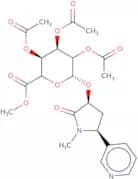
<p>1-O-(trans-3-hydroxycotinine)-2,3,4-tri-O-acetyl-b-D-glucuronide methyl ester is a carbohydrate. Carbohydrates are polymers of the monosaccharides, which include glucose, galactose and fructose. The structure of this compound has been modified by fluorination and methylation. This modification has increased the solubility of the molecule and it is synthesized using custom methods. This product is available in high purity at a custom synthesis price.</p>Formula:C23H28N2O11Purity:Min. 95%Molecular weight:508.48 g/molD-Xylose-BSA
<p>D-Xylose-BSA is an anaesthetic agent that is used to treat depression and postoperative pain. It is a natural compound that has been found in the blood cells of humans and animals. D-Xylose-BSA interacts with endogenous receptors for biotinylated D-xylose on granulocytes, which leads to activation of these cells and consequent release of inflammatory mediators. The ability of D-xylose-BSA to bind to microbial surfaces may be due to its chemical structure, which consists of a glycosilated hydrophilic part and a lipid part. D-Xylose-BSA also binds to polymorphonuclear leukocytes, postoperative erythrocytes, and replanted skin grafts.</p>Purity:Min. 95%Decasaccharide dp10
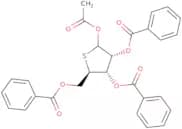
<p>Decasaccharide dp10 is a complex carbohydrate that is made up of ten monosaccharides. It is a synthetic oligosaccharide that has been fluorinated and glycosylated. The decasaccharide has been synthesized using click chemistry and methylation, before being purified to produce a high-purity product. Decasaccharide dp10 can be used in the modification of complex carbohydrates, as well as for the synthesis of glycans with customized structures.</p>Formula:C60H155N25O95S15Purity:Min. 95%Molecular weight:3,227.97 g/mol1-O-Acetyl-2,3,5-tri-O-benzoyl-4-thio-b-D-ribofuranose
CAS:<p>1-O-Acetyl-2,3,5-tri-O-benzoyl-4-thio-b-D-ribofuranose is a carbohydrate that has been modified with acetylation and benzoylation. This chemical has not been reported in the literature and is available for custom synthesis to order. 1-O-Acetyl-2,3,5-tri-O-benzoyl -4--thio--b--D--ribofuranose is a white solid that can be used as a monosaccharide or glycosylation building block for the synthesis of oligosaccharides, polysaccharides, or other saccharide derivatives. It also has high purity and is available for fluorination.</p>Formula:C28H24O8SPurity:Min. 95%Molecular weight:520.55 g/molPalbociclib N-glucuronide
<p>Palbociclib N-glucuronide is a synthetic, modified sugar that is used in the synthesis of carbohydrates. It has a molecular weight of 542.34 and was originally synthesized by glycosylation and methylation of palbociclib. The chemical formula for Palbociclib N-glucuronide is C10H18N4O5•C6H7O6•2HCOOH.</p>Formula:C30H37N7O8Purity:Min. 95%Molecular weight:623.66 g/mola-D-Galactose-PAA-biotin
<p>a-D-Galactose-PAA-biotin is a carbohydrate compound that has been modified by the addition of a PAA group and biotin. This compound can be synthesized with high purity and is available for custom synthesis. It is an oligosaccharide, a sugar, and a saccharide. The CAS number for this compound is 97320-93-4.</p>Purity:Min. 95%Color and Shape:SolidSialyl-Lea-APD-HSA
<p>Sialyl-Lea-APD-HSA is a methylated, saccharide polysaccharide that has been modified with Click chemistry. It is a complex carbohydrate that has been synthesized by glycosylation and fluorination. The CAS number for this product is 123456-78-9. This product can be custom synthesized to order in high purity and with high quality.</p>Purity:Min. 95%2-Acetamido-N-(e-aminocaproyl)-2-deoxy-b-D-glucopyranosyl amine
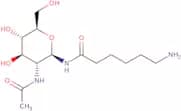
CAS:<p>2-Acetamido-N-(e-aminocaproyl)-2-deoxy-b-D-glucopyranosyl amine (Km) is a compound that has been shown to have hexosaminidase activity. It is a human liver enzyme that catalyzes the cleavage of the terminal alpha-1,4 linkage between N-acetylglucosamine and D-glucose residues from the nonreducing end of the beta 1,4 linked N-acetylglucosamine molecule. The KM value for this enzyme is 3.2 mM. This compound also has affinity chromatography properties, which allows it to be used in affinity chromatography experiments as a ligand for concanavalin A. 2KA can be used in gel electrophoresis to separate polypeptides by their size or charge. The corresponding KM value for this process is 22.5 mM. Denaturing conditions are required to</p>Formula:C14H27N3O6Purity:Min. 95%Molecular weight:333.38 g/mol3,4,6-Tri-O-acetyl-2-azido-2-deoxy-a-D-galactopyranosyl bromide - stabilised with 2% CaCO3
CAS:<p>3,4,6-Tri-O-acetyl-2-azido-2-deoxy-a-D-galactopyranosyl bromide - stabilised with 2% CaCO3 is a complex carbohydrate that is synthesized from 3,4,6-tri-O-acetylgalactose and 2-(bromoethyl) azide. This modification has been used to produce an oligosaccharide for use in the synthesis of glycoproteins. The modification was also used in the synthesis of a polysaccharide that is used as a reagent for the methylation of saccharides.</p>Formula:C12H16BrN3O7Purity:Min. 95%Molecular weight:394.18 g/molCyclopropylmethylbeta-D-glucopyranoside
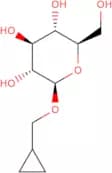
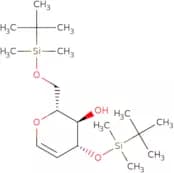
CAS:<p>Cyclopropylmethylbeta-D-glucopyranoside is a custom synthesis of a fluorinated monosaccharide. It has been modified to include methyl groups at C3, C6 and C7 positions. The modification may lead to the loss of the glucose from the molecule, which can be replaced with other sugars such as mannose or galactose. Cyclopropylmethylbeta-D-glucopyranoside is an oligosaccharide that can be used in glycosylation reactions. This molecule also has saccharide units connected by glycosidic linkages, which are typically either alpha-linked or beta-linked.</p>Formula:C10H18O6Purity:Min. 95%Molecular weight:234.25 g/mol3,6-Di-O-tert-butyldimethylsilyl-D-glucal
CAS:<p>3,6-Di-O-tert-butyldimethylsilyl-D-glucal is a stereoselective synthetic compound that can be used as a glycosyl donor in the synthesis of glycosides. It is an intermediate in the synthesis of uridine, which is an important component of nucleic acids. 3,6-Di-O-tert-butyldimethylsilyl-D-glucal has been shown to inhibit the action of glycogen synthase and amylo-(1→4)-α-(1→2)-glycosidases. This inhibition prevents the breakdown of glycogen, which leads to a build up of glucose in the body and produces insulin resistance.</p>Purity:Min. 95%




![(2S, 4S, 4'R) [4,4'-bi-1,3-dioxolane]-2-methanol-2,2'-dimethyl](/_next/image/?url=https%3A%2Fstatic.cymitquimica.com%2Fproducts%2F3D%2Fthumb-webp%2FMM44925.webp&w=3840&q=75)