Glycoscience
Glycoscience is the study of carbohydrates and their derivatives, as well as the interactions and biological functions they participate in. This field of research is crucial for understanding a wide variety of biological processes, including cell recognition, signaling, immune response, and disease development. Glycoscience has important applications in biotechnology, medicine, and the development of new drugs and therapies. At CymitQuimica, we offer a wide selection of high-quality, high-purity products for glycoscience research. Our catalog includes monosaccharides, oligosaccharides, polysaccharides, glycoconjugates, and specific reagents, designed to support researchers in their studies on the structure, function, and applications of carbohydrates in biological systems. These resources are intended to facilitate scientific discoveries and practical applications in various areas of bioscience and medicine.
Subcategories of "Glycoscience"
- Aminosugars(108 products)
- Glyco-Related Antibodies(282 products)
- Glycolipids(46 products)
- Glycosaminoglycans (GAGs)(55 products)
- Glycosides(419 products)
- Monosaccharides(6,622 products)
- Oligosaccharides(3,682 products)
- Polysaccharides(503 products)
Found 11041 products of "Glycoscience"
Sort by
Purity (%)
0
100
|
0
|
50
|
90
|
95
|
100
2,3,5-Tri-O-p-chlorobenzyl-L-fucopyranoside
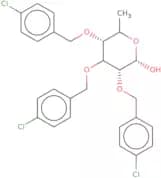
CAS:<p>2,3,5-Tri-O-p-chlorobenzyl-L-fucopyranoside is a modified sugar and an effective inhibitor of the glycosidase enzymes. It has been shown to inhibit the synthesis of glycogen in vitro. 2,3,5-Tri-O-p-chlorobenzyl-L-fucopyranoside is a major component of commercially available agarose gel electrophoresis buffers and is also used for modification of proteins by click chemistry. The compound can be custom synthesised with a high degree of purity and can be fluorinated for use in mass spectrometry.</p>Formula:C27H27Cl3O5Purity:Min. 95%Molecular weight:537.86 g/mol4-Fluorophenyl 2-acetamido-2-deoxy-b-D-glucopyranoside
CAS:<p>4-Fluorophenyl 2-acetamido-2-deoxy-b-D-glucopyranoside is a synthetic carbohydrate that has been modified with fluorine. It is a complex carbohydrate, which is a sugar composed of several monosaccharides linked together by glycosidic bonds. 4-Fluorophenyl 2-acetamido-2-deoxy-b-D-glucopyranoside can be methylated and glycosylated to produce desired structures. This product can be custom synthesized to meet your specifications. It is available in high purity and can be used for research purposes.</p>Formula:C14H18FNO6Purity:Min. 95%Molecular weight:315.29 g/mol6-Azido-6-deoxy-2,3-O-isopropylidene-a-L-sorbofuranose
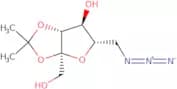
CAS:<p>6-Azido-6-deoxy-2,3-O-isopropylidene-a-L-sorbofuranose is a custom synthesis that is methylated with the click modification. This chemical can be used in the synthesis of oligosaccharides and polysaccharides. It has a purity of over 99%. This product is available for purchase as a monosaccharide or sugar.</p>Formula:C9H15N3O5Purity:Min. 95%Molecular weight:245.24 g/mol(4-Methoxyphenyl)methylbeta-D-glucopyranoside
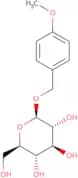
CAS:<p>(4-Methoxyphenyl)methylbeta-D-glucopyranoside is a synthetic sugar that is used for research purposes. It has been modified with fluorine and methyl groups to create a new compound that can be used as a fluorescence probe for DNA. This sugar has been synthesized by glycosylation of 4-methoxyphenol, followed by an oxidation reaction. The molecular weight of this compound is 792.7 g/mol, and it has been assigned the CAS number 81381-72-8.</p>Formula:C14H20O7Purity:Min. 95%Molecular weight:300.3 g/mol1,2:5,6-Di-O-isopropylidene-L-chiro-inositol
CAS:<p>1,2:5,6-Di-O-isopropylidene-L-chiro-inositol is a custom synthesis that can be modified by fluorination, methylation and click modification. The product is a monosaccharide and an oligosaccharide. It is also a synthetic saccharide and a polysaccharide. The product can be glycosylated or sugar modified with carbohydrates such as complex carbohydrate to form 1,2:5,6-Di-O-isopropylidene-L-chiro-inositol.</p>Formula:C12H20O6Purity:Min. 95%Molecular weight:260.28 g/mol3,4-O-Carbonyl-D-galactal
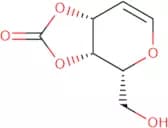
CAS:<p>3,4-O-Carbonyl-D-galactal is a custom synthesis that can be used to modify oligosaccharides, carbohydrates or complex carbohydrates. It has a high purity and is non-toxic in humans. 3,4-O-Carbonyl-D-galactal has been fluorinated and saccharide modified. This product has CAS No. 149847-26-7 and can be synthesized with methylation and glycosylation.</p>Purity:Min. 95%1,3,4,6-Tetra-O-acetyl-2-deoxy-2-iodo-a-D-glucopyranose
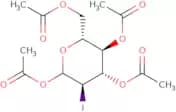
CAS:<p>1,3,4,6-Tetra-O-acetyl-2-deoxy-2-iodo-a-D-glucopyranose is a sugar molecule that is used to measure the efficiency of glycosidases. It has been shown to be an efficient site-specific inhibitor for glycosidases and analogues. This compound has been shown to inhibit the activity of glycoconjugates and glycan synthesis by interfering with the binding sites on enzymes such as endoglycosidase H. 1,3,4,6-Tetra-O-acetyl-2-deoxy-2-iodo-(1→4)-a-[alpha]-D-[beta]-D-[alpha]-glucopyranoside is an analog of this compound that can be used in place of it for specific purposes.</p>Formula:C14H19IO9Purity:Min. 95%Molecular weight:458.2 g/molDulcitol
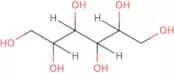
CAS:<p>Dulcitol is a sugar alcohol that is used in the food industry and as an alternative to sucrose. Dulcitol can be found in wastewater treatment and has been shown to be an inhibitor of wild-type strains of Escherichia coli and Bacteroides fragilis. It also inhibits the growth of Gram-positive bacteria, such as Staphylococcus aureus, by inhibiting their ability to synthesize DNA. Dulcitol is metabolized through a number of metabolic transformations, including hydrolysis by esterases or glucuronidases, oxidation by cytochrome P450 enzymes, reduction by glutathione reductase, or conjugation with glucuronic acid. Dulcitol can also inhibit the activity of certain enzymes such as protein kinase C (PKC).</p>Formula:C6H14O6Purity:Min. 99.0 Area-%Molecular weight:182.17 g/molRef: 3D-D-9500
1kgTo inquire5kgTo inquire10kgTo inquire25kgTo inquire2500gTo inquire-Unit-kgkgTo inquireChitosan - non-animal origin
CAS:<p>Chitosan is the deacetylated form of chitin. The polysaccharide is deacetylated in order to render it soluble, which is then possible at pH values of less than 7 (normally in dilute acid). This then allows the material to be used in a number of industrial applications as a binder and film former.</p>Formula:(C6H11NO4)nMethyl a-D-mannofuranoside
CAS:<p>Methyl a-D-mannofuranoside is a synthetic sugar that has been modified by the addition of fluorine at C-1 and methylation at C-2. This modification provides the compound with desired physical properties, such as increased stability and solubility. Methyl a-D-mannofuranoside can be used in the synthesis of oligosaccharides, which are complex carbohydrates consisting of three to ten monosaccharides linked together by glycosidic bonds. It is also used for click chemistry modifications.</p>Formula:C7H14O6Purity:Min. 95%Molecular weight:194.18 g/mol6-O-(a-D-Maltotriosyl)-D-glucopyranose tetradecaacetate
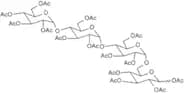
<p>6-O-(a-D-Maltotriosyl)-D-glucopyranose tetradecaacetate is a carbohydrate that belongs to the class of saccharides. It is synthesized from D-glucose by glycosylation and methylation. 6-O-(a-D-Maltotriosyl)-D-glucopyranose tetradecaacetate is a complex carbohydrate with a high purity and custom synthesis. It can be used in click chemistry, due to its reactive group on the C6 position.</p>Formula:C52H70O35Purity:Min. 95%Molecular weight:1,255.09 g/molD-Glucose-1,2,3-13C3
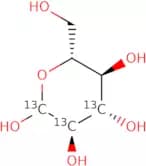
CAS:<p>D-Glucose-1,2,3-13C3 is a synthetic monosaccharide that has been fluorinated at the 1, 2 and 3 positions. The 13C isotope has been used to study the glycosylation of this compound. This product is available in custom synthesis quantities.</p>Formula:C3C3H12O6Purity:Min. 95%Molecular weight:183.16 g/molBenzyl b-D-glucopyranosiduronic acid methyl ester triacetate
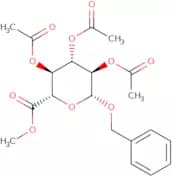
CAS:<p>Benzyl b-D-glucopyranosiduronic acid methyl ester triacetate is a synthetic sugar that can be modified to produce a wide range of oligosaccharides. It is suitable for glycosylation reactions, such as the synthesis of complex carbohydrates. This compound has high purity and is custom synthesized according to customer specifications. Benzyl b-D-glucopyranosiduronic acid methyl ester triacetate has been fluorinated, methylated, and monosaccharide modifications. These modifications provide this compound with many potential uses in the food industry, medicine, and other industries.</p>Formula:C20H24O10Purity:Min. 95%Molecular weight:424.4 g/mol1,2:4,5-Di-O-isopropylidene-D-mannitol
CAS:<p>1,2:4,5-Di-O-isopropylidene-D-mannitol is a synthetic compound that is used as a non-ionic surfactant. It has been shown to have an enzymatic reaction with lipases and acetonitrile. The isomers of this compound are also synthesised from acetonitrile. 1,2:4,5-Di-O-isopropylidene-D-mannitol is found in human liver cells and can be used to synthesise polyols. This molecule forms orthoacids when it reacts with methoxyethylidene and the surfactant nonylphenoxypolyethoxyethanol (NPEE).</p>Formula:C12H22O6Purity:Min. 95%Color and Shape:PowderMolecular weight:262.3 g/mol1-Methyl-2-propenylbeta-D-glucopyranoside
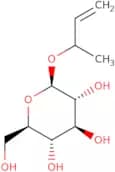
CAS:<p>1-Methyl-2-propenylbeta-D-glucopyranoside is a fluorinated carbohydrate that may be used for the modification of carbohydrates. It is a synthetic oligosaccharide that has been custom synthesized and modified with methylation, glycosylation, and click chemistry. This product is offered at high purity levels.</p>Formula:C10H18O6Purity:Min. 95%Molecular weight:234.25 g/molCellobiuronic acid
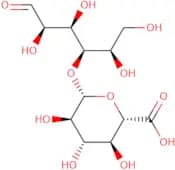
CAS:<p>Cellobiuronic acid is a polysaccharide that contains glucose and uronic acids. It is found in the cell walls of gram-positive bacteria, where it may play an important role in maintaining the structural integrity of the cell wall. Cellobiuronic acid has been shown to be a potent antigen for pneumococcus. Cellobiuronic acid has also been shown to be conjugated with proteins and used as a vaccine adjuvant for inducing antibody responses against pneumococcal antigens. Cellobiuronic acid is synthesized from glucose by bacterial cells, which use it as a carbon source. The biosynthesis of cellobiuronic acid is poorly understood because it does not occur in mammalian cells.</p>Formula:C12H20O12Purity:Min. 95%Molecular weight:356.28 g/mol2-Deoxy-3,4:5,6-di-O-isopropylidene-D-arabino-hexose propane-1,3-diyl dithioacetal
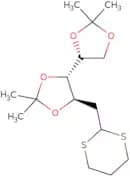
CAS:<p>The antibiotic 2-deoxy-3,4:5,6-di-O-isopropylidene-D-arabino-hexose propane-1,3-diyl dithioacetal is a shikimate analog that inhibits the shikimate pathway. It prevents the synthesis of aromatic compounds and other nitrogenous substances by inhibiting the enzyme chorismate synthase. Chorismate synthase catalyzes the conversion of 3,4:5,6-di-O-isopropylidene D-arabino hexose to chorismic acid which is then converted to shikimic acid. The antibiotic binds covalently to an active site cysteine residue on the enzyme and inhibits its activity. This inhibition blocks the production of aromatic amino acids and other nitrogenous substances required for protein synthesis in bacteria.</p>Formula:C15H26O4S2Purity:Min. 95%Molecular weight:334.5 g/molMaltose solution
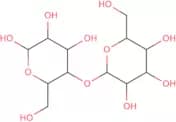
CAS:<p>The maltose solution we offer is a 20% solution in water and of high purity and can be customized to meet your needs.</p>Formula:C12H22O11Purity:Min. 95%Molecular weight:342.3 g/mol1-Deoxy-L-idonojirimycin hydrochloride
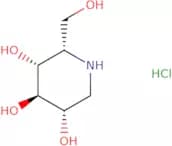
CAS:<p>1-Deoxy-L-idonojirimycin hydrochloride is a chaperone that is structurally related to the natural substrate, L-idonojirimycin. It has been found to interact with recombinant human Hsp70 and Hsp90. 1-Deoxy-L-idonojirimycin hydrochloride enhances the kinetic and thermodynamic parameters of these chaperones in vitro. The structural analysis of this compound revealed that it binds to both Hsp70 and Hsp90, which may be due to its ability to mimic the natural substrate's binding site on these chaperones.</p>Formula:C6H14ClNO4Purity:Min. 95%Molecular weight:199.63 g/mol1,4-β-D-Glucosyl-D-mannobiose
CAS:<p>1,4-β-D-Glucosyl-D-mannobiose is a specialized carbohydrate substrate, which is derived from complex polysaccharides typically found in plant cell walls. It acts as a substrate for endo-1,4-β-mannanase, an enzyme that cleaves specific glycosidic bonds within mannans. This substrate facilitates the investigation of enzymatic activity by allowing the measurement of endo-1,4-β-mannanase efficiency and specificity under controlled conditions.In biochemical enzyme assays, 1,4-β-D-Glucosyl-D-mannobiose serves as a critical component for quantifying mannanase activity. It enables researchers to study the enzyme's role in various biological processes, including polysaccharide degradation. Additionally, this product is invaluable in in vitro diagnostic analyses where precise enzyme activity assessment is crucial for understanding pathological states or the functionality of industrial enzyme preparations. Its applications extend to biotechnology research, where it aids in the formulation of enzyme-based solutions and optimization of enzymatic reactions in diverse biological and industrial contexts.</p>Formula:C18H32O16Purity:Min. 95%Molecular weight:504.4 g/mol