Glycoscience
Glycoscience is the study of carbohydrates and their derivatives, as well as the interactions and biological functions they participate in. This field of research is crucial for understanding a wide variety of biological processes, including cell recognition, signaling, immune response, and disease development. Glycoscience has important applications in biotechnology, medicine, and the development of new drugs and therapies. At CymitQuimica, we offer a wide selection of high-quality, high-purity products for glycoscience research. Our catalog includes monosaccharides, oligosaccharides, polysaccharides, glycoconjugates, and specific reagents, designed to support researchers in their studies on the structure, function, and applications of carbohydrates in biological systems. These resources are intended to facilitate scientific discoveries and practical applications in various areas of bioscience and medicine.
Subcategories of "Glycoscience"
- Aminosugars(108 products)
- Glyco-Related Antibodies(283 products)
- Glycolipids(46 products)
- Glycosaminoglycans (GAGs)(55 products)
- Glycosides(419 products)
- Monosaccharides(6,619 products)
- Oligosaccharides(3,711 products)
- Polysaccharides(505 products)
Found 11027 products of "Glycoscience"
Sort by
Purity (%)
0
100
|
0
|
50
|
90
|
95
|
100
Phosphoric acid mono-((2R,3R,4S,5R)-2,3,4,5,6,7-hexahydroxy-heptyl) ester barium salt
Phosphoric acid mono-((2R,3R,4S,5R)-2,3,4,5,6,7-hexahydroxy-heptyl) ester barium salt is a Glycosylation product. It is a complex carbohydrate with the molecular formula C6H14O6P. The glycosylation of this compound can be accomplished by methylation or by Click modification. This product also has an Oligosaccharide content and Polysaccharide properties. The CAS Number for this compound is 595-25-1.Formula:C7H15O10PBaPurity:Min. 95%Molecular weight:427.49 g/mol5-O-Carbomethoxy-1,2-O-isopropylidene-3-O-p-toluenesulfonyl-α-D-xylofuranose
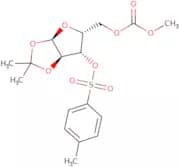
CAS:5-O-Carbomethoxy-1,2-O-isopropylidene-3-O-p-toluenesulfonyl-a-D-xylofuranose is a synthetic chemical that is used in antiperspirant and deodorant products. It works by inhibiting the activity of the eccrine glands and causing a temporary blockage of sweat release. This chemical also decreases the production of bacteria on the skin surface, which can cause bad odors. 5OCMPTOSF is a combination product that includes both an antiperspirant and a deodorant.br> br> Antiperspirants are substances applied to the skin to prevent sweating. They work by blocking sweat from reaching the skin's surface or by masking body odor with their own fragrance. Antiperspirants are most effective when applied to dry skin and can be combined with other cosmetics such as moisturizers or sunscreensFormula:C17H22O9SPurity:Min. 95%Molecular weight:402.42 g/molN-(4-Chlorobenzyliden)imino-2,3,4,6-tetra-O-pivaloyl-D-glucopyranoside
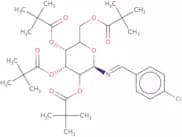
This product is a complex carbohydrate that is custom synthesized by our experts. It is made of Oligosaccharide, Carbohydrate, Custom synthesis, Synthetic, High purity, CAS No., Monosaccharide, Methylation, Glycosylation and Polysaccharide. This product has the following properties: Fluorination, saccharide.Formula:C33H48ClNO9Purity:Min. 95%Molecular weight:638.19 g/molTri-b-GalNAcAc3-NHCbz
CAS:This peracetylated tri-b-GalNAcAc3-NHCbz, a triantennary N-acetylgalactosamine (GalNAc) ligand with protected functionalities, serves as a valuable building block for ASGPR-targeted therapies. Its three branches or arms, each ending in a GalNAc sugar, ensure strong binding to hepatocyte ASGPR. However, the key feature lies in its protective groups: acetylated sugars allow for controlled removal to expose reactive sites for conjugation, while the Cbz-protected amine provides stability and can be selectively cleaved to introduce a reactive amine group for further biomolecule attachment, ultimately enabling researchers to tailor Tri-b-GalNAcAc3-NHCbz into customized conjugates for specific therapeutic applications.Formula:C87H134N10O38Purity:Min. 97 Area-%Molecular weight:1,928.04 g/molNonyl β-D-thiomaltopyranoside
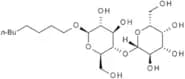
CAS:Nonyl b-D-thiomaltopyranoside is a custom synthesis of an oligosaccharide and polysaccharide. It is prepared by the modification of saccharides with methylation, glycosylation and carbamylation. The compound has CAS No. 148565-55-3 and can be used as a fluorescent probe for carbohydrate binding proteins. Nonyl b-D-thiomaltopyranoside is a high purity synthetic sugar that has been fluorinated. Click modification has been performed on this sugar to create a fluorescent probe for carbohydrate binding proteins. This sugar has also been synthesized using the technique of glycosylation, which involves the addition of monosaccharides to form disaccharides or polysaccharides.Formula:C21H40O10SPurity:Min. 95%Color and Shape:White PowderMolecular weight:484.6 g/molN-Acetyl-D-glucosamine - plant source
CAS:Please enquire for more information about N-Acetyl-D-glucosamine - plant source including the price, delivery time and more detailed product information at the technical inquiry form on this page
Formula:C8H15NO6Purity:Min. 98 Area-%Molecular weight:221.21 g/molMonosialyl, monofucosyllacto-N-neohexaose
Please enquire for more information about Monosialyl, monofucosyllacto-N-neohexaose including the price, delivery time and more detailed product information at the technical inquiry form on this pageFormula:C57H95N3O43Purity:Min. 95%Molecular weight:1,510.36 g/molCyanidin-3-O-lathyroside chloride
CAS:Cyanidin-3-O-lathyroside chloride is a synthetic compound with antioxidant and anti-inflammatory effects. It is activated by the chloride ion, leading to increased bioavailability of the molecule. Cyanidin-3-O-lathyroside chloride has been shown to have anticancer properties, as well as an ability to activate calcium metabolism in cells. This compound also has a low bioavailability, which may be due to its hydrophobic nature and the fact that it is not orally active. This compound has been shown to be beneficial for cancer therapy because of its ability to inhibit cancer growth, induce apoptosis in cancer cells, and reduce tumor size. Cyanidin-3-O-lathyroside chloride has also been shown to have positive effects on fertility when taken at high doses orally.Formula:C26H29O15•ClPurity:Min. 95%Color and Shape:PowderMolecular weight:616.95 g/molLauryl maltose neopentyl glycol
CAS:Amphiphilic detergentFormula:C47H88O22Purity:Min. 97 Area-%Color and Shape:White Off-White PowderMolecular weight:1,005.19 g/molRhamnolipids C14
CAS:Rhamnose based 'green' surfactantFormula:C32H58O13Purity:Min. 95%Color and Shape:PowderMolecular weight:650.8 g/molUndecyl a-D-maltopyranoside
CAS:Undecyl a-D-maltopyranoside is a fluorescent dye that is used in immunohistochemical and immunocytochemical techniques. It has been shown to have excellent photostability, and is also useful for the detection of sulfides. This dye emits light at 520 nm when excited with laser light. The emission spectrum can be changed by adding other dyes, such as fluorescein or rhodamine, to the molecule. The addition of these dyes can also increase its photostability, which makes it an excellent candidate for use in confocal microscopy techniques. Undecyl a-D-maltopyranoside has been shown to react with proteins through an immunoreaction technique.Formula:C23H44O11Purity:Min. 95%Color and Shape:PowderMolecular weight:496.59 g/molDodecyl α-D-maltopyranoside
CAS:Dodecyl a-D-maltopyranoside is a solubilized fat that has an optimum pH of 11. It is soluble in chloroform, ethanol, and water. The molecular weight of dodecyl a-D-maltopyranoside is 587.87 g/mol. Dodecyl a-D-maltopyranoside can be used as an absorption marker for lipids in the human liver, wheat germ, and chloroplasts. Dodecyl a-D-maltopyranoside contains two monomers and four subunits. Dodecyl a-D-maltopyranoside can be used to measure the density of lipids in the cell membrane by nmr spectra.Formula:C24H46O11Purity:Min. 95%Color and Shape:PowderMolecular weight:510.62 g/mol6-O-Desmethyl donepezil glucuronide sodium (Mixture of Diastereomers)
CAS:Please enquire for more information about 6-O-Desmethyl donepezil glucuronide sodium (Mixture of Diastereomers) including the price, delivery time and more detailed product information at the technical inquiry form on this pageFormula:C29H35NO9•NaPurity:Min. 95%Molecular weight:540.59 g/molHexadecyl b-D-maltopyranoside
CAS:Hexadecyl b-D-maltopyranoside is a lamellar liquid crystal composed of octadecanol and hexadecyl b-D-maltopyranoside. It is an inorganic, crystalline polymorph that forms monomers and micelles with surfactant properties. Hexadecyl b-D-maltopyranoside has been shown to transduce x-ray data, which can be used in techniques such as microscopy. The lamellar phase of this compound may be metastable and depend on additives.Formula:C28H54O11Purity:Min. 95%Color and Shape:PowderMolecular weight:566.72 g/mol3-O-Benzyl-2-deoxy-1,6-di-O-methoxyphenyl-2-phthalimido-β-D-glucopyranoside
3-O-Benzyl-2-deoxy-1,6-di-O-methoxyphenyl-2-phthalimido-b-D-glucopyranoside is a synthetic glycosylation agent. It is a sugar with an Oligosaccharide structure. 3-O-Benzyl--2'-deoxy--1,6'-di--O--methoxyphenyl--2'-phthalimido--b--D--glucopyranoside has been synthesized by fluorination of the sugar and methylation of the benzyl group. Click modification can be used to modify the carbohydrate to create complex carbohydrates. This compound is made from natural ingredients and has a high purity level. Molecular weight: 592.24 g/mol CAS Number: 251300 EINECS Number: 208–831–3 Melting Point: 130°C (decFormula:C35H33NO9Purity:Min. 95%Molecular weight:611.64 g/molDecyl b-D-thioglucopyranoside
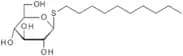
CAS:Decyl b-D-thioglucopyranoside is a saccharide that is a methylated derivative of the sugar glucose. It is used in the synthesis of oligosaccharides, glycosylations, and fluorinated carbohydrates. The compound can be custom synthesized to suit specific needs and has high purity.Formula:C16H32O5SPurity:Min. 95%Color and Shape:PowderMolecular weight:336.49 g/molPolysorbate 80
CAS:Polysorbate 80, is a non-ionic surfactant, also known as Tween 80. It also acts as an emulsifier and a solubilizer, making it a useful tool in scientific industries such as pharmaceuticals, food and cosmetics.
Formula:C32H60O10Purity:Min. 95%Color and Shape:Clear LiquidMolecular weight:604.81 g/molOctyl 3,6-di-O-(a-D-mannopyranosyl)-b-D-mannopyranoside
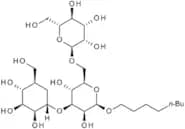
CAS:Octyl 3,6-di-O-(a-D-mannopyranosyl)-b-D-mannopyranoside is an anti-infective agent that belongs to the functional group of mannosides. It is used as a model system for investigating the inhibitory effects of chemical structures on enzymatic activity. Octyl 3,6-di-O-(a-D-mannopyranosyl)-b-D-mannopyranoside has been shown to have inhibitory effects on alzheimer's disease and other neurodegenerative diseases. The octyl 3,6 di O-(a D mannopyranosyl) b D mannopyranoside molecule can be broken down into two parts: octyl 3,6 di O-(a D mannopyranosyl) b D mannose and octyl 6 b D manno pyranose. The octyl 6 b D manno pyrFormula:C26H48O16Purity:Min. 95%Color and Shape:White To Off-White SolidMolecular weight:616.65 g/molOctadecylthioethyl 4-O-(4-O[6-O-a-D-glucopyranosyl-a-D-glucopyranosyl]-a-D-glucopyranosyl)-b-D-glucopyranoside
CAS:Octadecylthioethyl 4-O-(4-O[6-O-a-D-glucopyranosyl-a-D-glucopyranosyl]-a-D-glucopyranosyl)-b-D-glucopyranoside is a methylated, fluorinated complex carbohydrate that has been custom synthesized. It is an oligosaccharide with a saccharide and monosaccharides. The chemical name for this compound is 2-[2-(2,3,4,6,7,8,9,10,11,12,13) -octadecylthioethyl] -1-[(6Z)-6-[(4Z)-4-[(4E)-4-(3S)-3-[(R)-1-(2S) -2-(2S) -3-(2S) -5(R) -5(R) -5(R) -Formula:C44H82O21SPurity:Min. 95%Color and Shape:SolidMolecular weight:979.18 g/molOctyl 4-O-(b-D-galactopyranosyl)-b-D-glucopyranoside
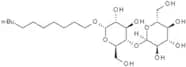
CAS:Octyl 4-O-(b-D-galactopyranosyl)-b-D-glucopyranoside is a galactose derivative of octyl 4-O-(b-D-glucopyranosyl)-b-D-glucopyranoside. It has been used to immobilize the enzyme phospholipase A2 in an exothermic reaction. This product is a white solid that is soluble in water. Octyl 4-O-(b-D-galactopyranosyl)-b-D-glucopyranoside has been shown to be effective against mycobacteria such as Mycobacterium avium complex and Mycobacterium tuberculosis, but not against other bacteria. This product may be useful for the treatment of mycobacterial infections because it exhibits excisional activity and can cleave phospholipid membranes.Formula:C20H38O11Purity:Min. 95%Color and Shape:PowderMolecular weight:454.51 g/mol










![Octadecylthioethyl 4-O-(4-O[6-O-a-D-glucopyranosyl-a-D-glucopyranosyl]-a-D-glucopyranosyl)-b-D-glu…](/_next/image/?url=https%3A%2Fstatic.cymitquimica.com%2Fproducts%2F3D%2Fthumb-webp%2FDO05214.webp&w=3840&q=75)